

Blog
How often should you replace blades when batch-cutting sofa side strips?

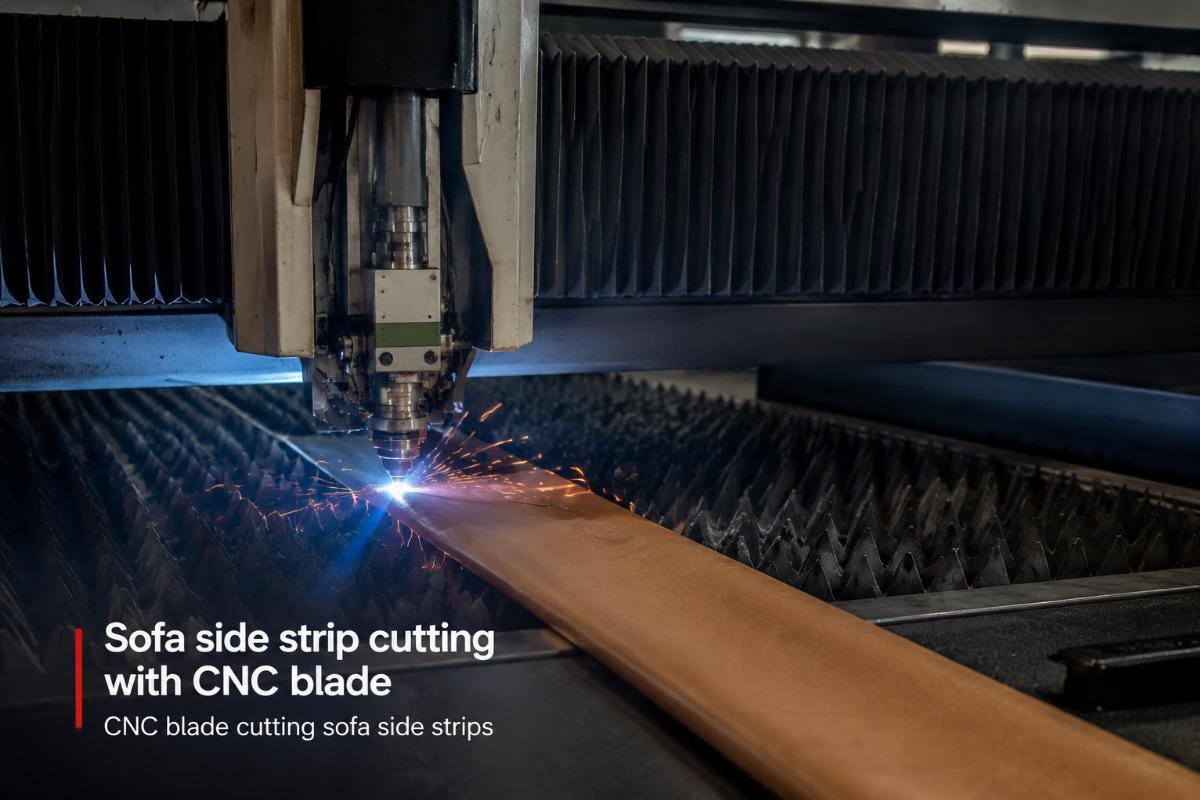
How often should you replace blades when batch-cutting sofa side strips?
You just invested in a CNC cutting system for your sofa line. The salesperson promised 5,000 meters per blade. Three weeks later, you're seeing frayed edges on synthetic leather at 2,800 meters. Your production manager is asking whether you bought the wrong machine. I hear this story at least twice a month from sofa manufacturers who thought blade life was a fixed number they could plug into a spreadsheet.
Blade replacement timing is not a mileage spec—it's a quality threshold decision that depends on your material mix, batch patterns, and acceptable edge finish drop. The question is not "how many meters per blade" but "at what quality point should I stop and change".
Most producers treat blade replacement like changing engine oil—wait for the manual's recommended interval, then swap. But sofa side strips are not uniform highway miles. You're cutting five different materials in rotating batches, each wearing the blade edge at different rates. The framework you need is not a number from a supplier brochure. It's a decision map built on three variables: what you cut, how you cut it, and what quality drop you can tolerate before it costs you more than a new blade.
What actually wears out a blade when cutting sofa side strips?
You run a batch of polyurethane leather side strips in the morning. Clean cuts, sharp corners, no cleanup needed. By afternoon, you switch to a thicker microfiber batch. Suddenly you're seeing compression marks on the backing layer. Same blade, same machine settings, different material behavior. The blade did not suddenly go dull—it hit the wear threshold for that specific material's hardness and density.
Blade wear is not a linear decline from sharp to dull1. It's a stepwise drop tied to material properties—abrasive fillers in synthetic leather eat edges faster than natural textiles, and dense weaves create more friction than open-knit fabrics.
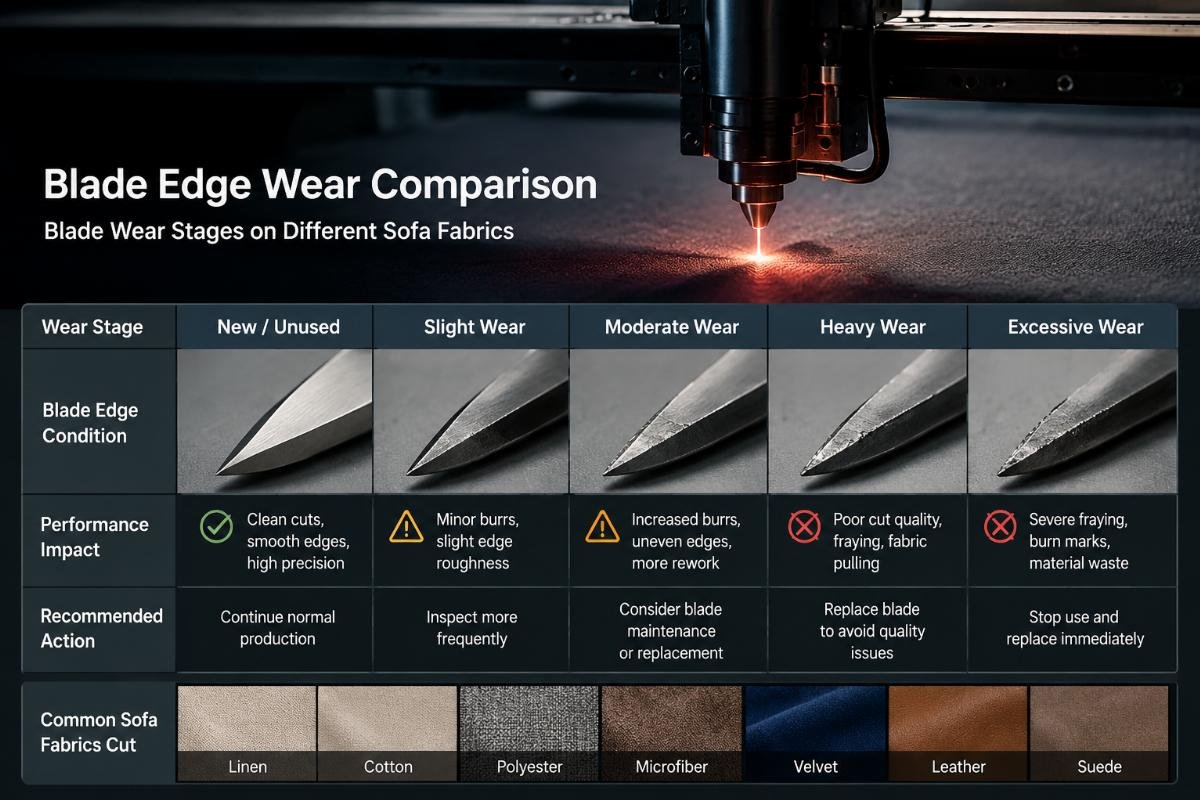
When customers ask me "how long will a blade last," they're really asking two questions at once. First, when does the blade stop making acceptable cuts on their easiest material? Second, when does it fail on their hardest material? These two thresholds can be 3,000 meters apart. A blade might handle cotton canvas beautifully for 6,000 meters but start crushing faux leather pile at 2,500 meters. If you run both materials, your replacement decision is controlled by the 2,500-meter limit, not the higher number.
What properties in side strip materials drive blade wear?
I built this breakdown from tracking customer complaints over three years—not from lab tests, but from listening to what materials caused early blade changes.
| Material type | Wear driver | Typical first-quality-drop range |
|---|---|---|
| Natural cotton canvas | Lint accumulation on edge | 5,000–7,000 meters |
| Polyurethane synthetic leather | Abrasive filler particles2 | 2,500–4,000 meters |
| Microfiber suede | Density-induced friction heat3 | 3,000–5,000 meters |
| Woven polyester blends | Thread tension variation | 4,000–6,000 meters |
| Bonded leather composites | Adhesive layer gumming | 2,000–3,500 meters |
These ranges are not guarantees—they're conversation starters. A sofa producer cutting 1.2mm bonded leather might see edge fraying at 2,200 meters. Another cutting 0.8mm of the same material type might get 3,800 meters before the first quality complaint. Thickness, backing type, and blade angle all shift these numbers. The useful insight is not the specific meter count. It's recognizing that synthetic materials with hard fillers or adhesive layers will force earlier replacement than natural textiles, and planning your batch rotation around that pattern.
How does your production batch pattern change blade economics?
You have two scenarios. Scenario A: you cut 500 meters of the same microfiber side strip every day for ten days—5,000 meters total before blade change. Scenario B: you cut five different materials in 100-meter batches, rotating daily—same 5,000 meters total, but the blade sees ten material transitions. In Scenario B, you'll likely replace the blade earlier, even though total cutting distance is identical.
Material transitions reset the wear pattern4 because each new material stresses a different part of the blade edge—soft fabrics flex the tip, dense synthetics load the heel, and the blade never settles into a predictable wear groove.
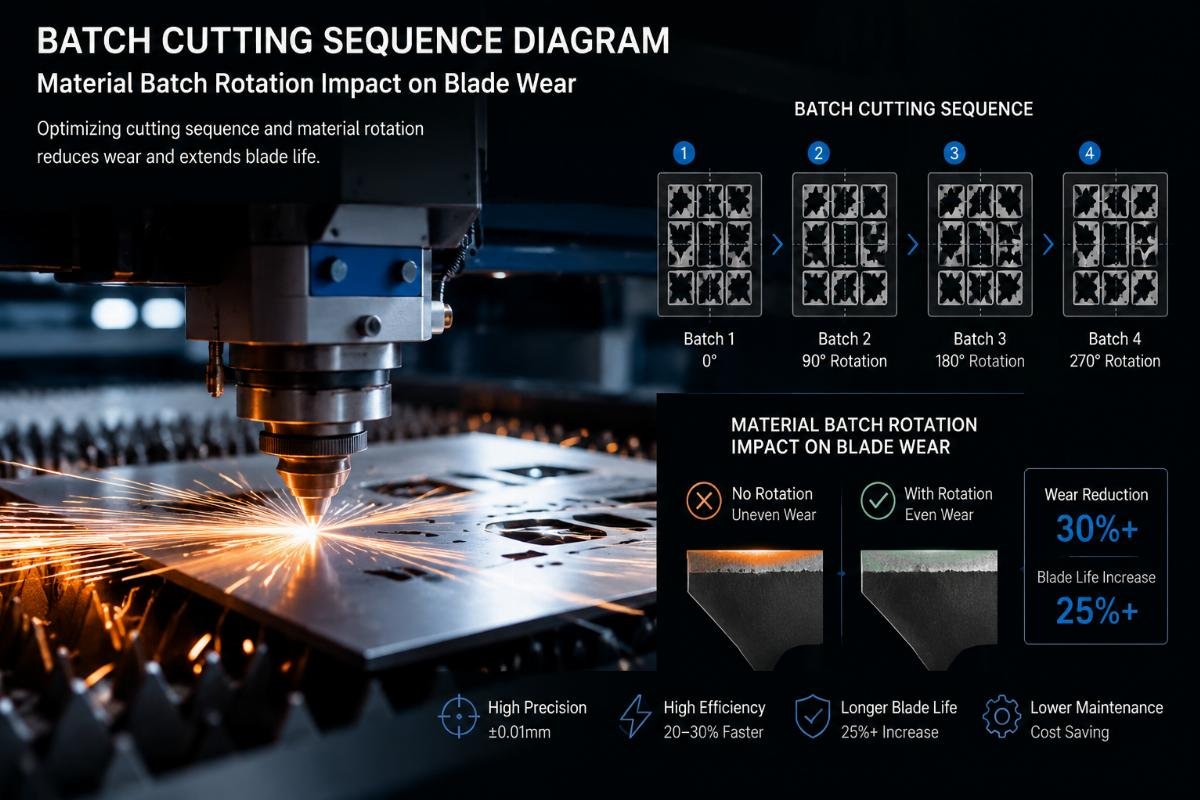
A customer making standardized sofa side strips for one retailer can run long, consistent batches. Their blade wear is smooth and predictable. They track meters, set a replacement threshold, and rarely see surprise edge quality drops. A custom sofa shop taking small orders for interior designers might cut eight different materials in a week, never running more than 200 meters of anything. Same machine, same blade type, but their replacement frequency is 40% higher5 because the blade never optimizes for one material's cutting behavior. Neither approach is wrong—but the custom shop that budgets blade costs using the long-batch producer's mileage numbers will blow through their consumables budget in three months.
Should you replace blades on a schedule or on quality inspection?
Most producers I work with want a schedule—change blades every Monday, or every 5,000 meters, regardless of what the cuts look like. It feels safer than trusting an operator's visual judgment. But scheduled replacement ignores the quality-versus-efficiency tradeoff. If you change blades at 4,000 meters because that's your policy, but the blade is still making clean cuts on your materials, you're discarding usable cutting capacity. If you wait for 6,000 meters because a supplier claimed that number, but you're seeing frayed edges at 5,200 meters, you're producing defects to avoid "wasting" a blade.
The better approach combines both methods. Set a maximum mileage ceiling based on your hardest material's known wear threshold—this prevents forgetting a blade change during busy production runs. But also train operators to spot the three visual signals that quality is dropping: edge compression instead of clean separation6, material puckering at corners, and blade drag marks on the cut face. When any of these appear before your mileage ceiling, replace immediately. When you hit your mileage ceiling without quality issues, inspect closely and decide whether to extend another batch or change proactively.
| Decision rule | When to use | Risk if ignored |
|---|---|---|
| Replace at first edge compression | High-end upholstery with visible side strips | Customer rejects for visible quality defects |
| Replace at mileage ceiling | Mixed-material batches with unpredictable wear | Forgotten blade change ruins entire batch |
| Extend past ceiling if inspection passes | Long runs of soft, non-abrasive fabrics | Premature replacement inflates consumable costs |
What should you ask equipment suppliers about blade specifications?
When I talk to sofa producers evaluating cutting equipment, they usually ask "what's your blade life?" as the second or third question, right after asking about cutting speed and table size. The problem is not that they ask—it's that they accept the first number they hear as a universal spec. A supplier might say "our tungsten carbide blades7 last 8,000 meters," and the buyer writes that into their cost model without asking what materials were tested, what thickness, and what quality standard defined "lasted."
The right questions to ask are not "how many meters per blade" but "what materials did you test, at what thickness, and what edge quality drop did you accept before calling the blade worn out?"

I've seen purchasing managers compare three suppliers' blade life claims—6,000 meters, 8,000 meters, and 10,000 meters—and choose the 10,000-meter supplier to minimize operating costs. Six months later, they're replacing blades at 4,500 meters because the supplier tested on 0.6mm cotton canvas and the customer is cutting 1.5mm bonded leather. The 10,000-meter claim was not false—it was true for a material the customer does not use. The mistake was treating blade life as a machine specification instead of a material-and-application variable.
What information should you provide to get useful blade life estimates?
When a sofa producer asks me about blade replacement frequency, I send back a questionnaire before giving any numbers. I need to know their material list with thicknesses, their typical batch sizes, whether they cut in single-layer or multi-layer stacks, and what edge finish their customers expect. Without that context, any number I give is a guess. With it, I can reference similar setups and give a range that reflects their actual production pattern, not ideal lab conditions.
The information you should provide to any supplier includes:
- Complete material list with brand names and thickness specs (not just "synthetic leather")
- Typical daily production volume and batch rotation pattern
- Whether you cut single-layer or stack multiple sheets
- Quality standard for edge finish—is some fraying acceptable or must edges be clean enough for visible seams?
- Current blade type if you're already running a system (material, angle, coating)
Suppliers who ask for this information before giving blade life estimates are more useful than those who immediately quote a number. The ones who quote a number without asking are either guessing or giving you their best-case scenario, which is rarely your scenario.
How do you build a replacement decision framework for your facility?
You need a system that connects three data points: what you're cutting today, what the current blade has already cut, and what quality threshold matters for this batch. Start by tracking blade usage in a simple log—date installed, materials cut, approximate meters per material, and date replaced with reason for replacement. After three blade cycles, you'll see patterns. Bonded leather always triggers replacement around 3,200 meters. Cotton canvas runs clean past 6,000 meters but you replace it anyway because the next batch is microfiber and you don't want to start a new material on a worn edge.
The goal is not to maximize meters per blade—it's to minimize total cost per acceptable cut8, which includes blade cost, labor cost for edge cleanup, and risk of batch rejection.
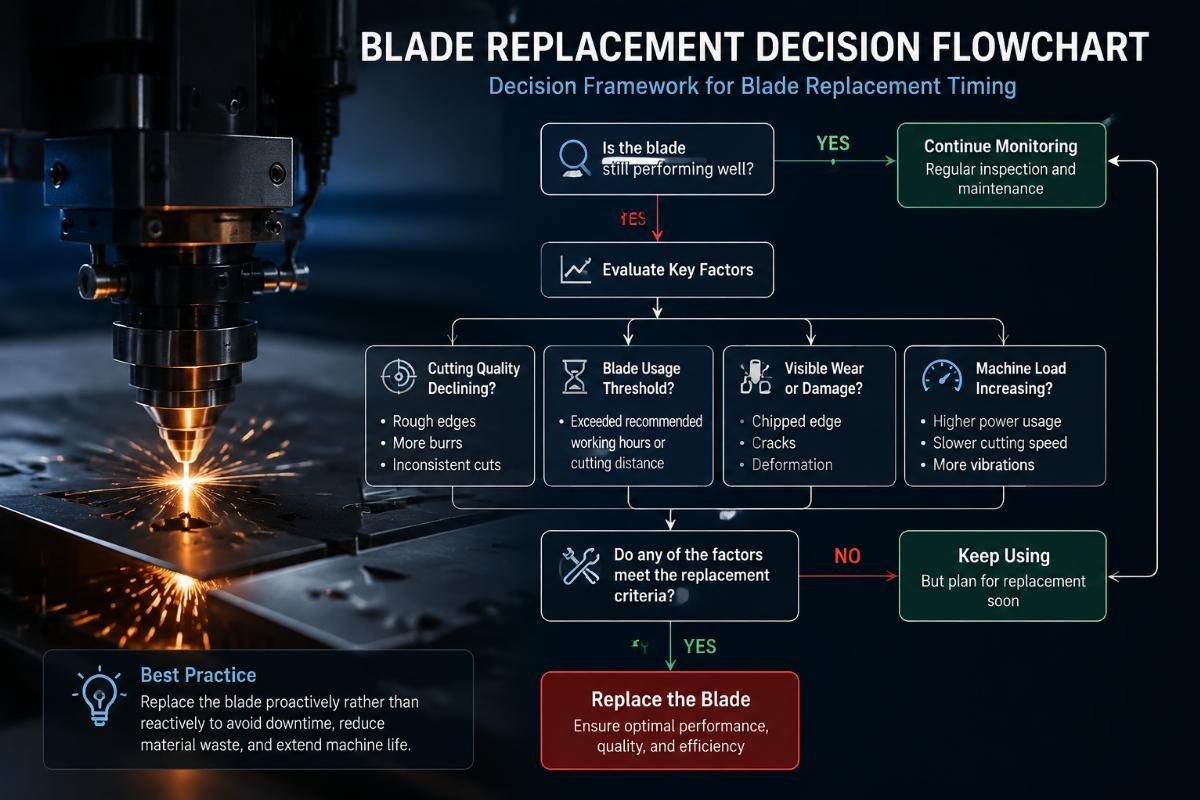
Some producers discover they were changing blades too early, driven by fear of defects rather than actual quality drop. Others realize they were running too long, spending more on edge trimming and rework than they saved on blade costs. Neither mistake is obvious until you track actual performance against your specific materials and quality requirements. The framework is not complicated—it's just deliberate. You define what "worn out" means for each material, you measure when that point arrives, and you adjust your replacement timing to hit that threshold consistently without excessive safety margin.
Can you reduce replacement frequency without sacrificing quality?
Three levers change blade longevity without changing the blade itself. First, material stacking—cutting multiple layers per pass distributes edge wear differently9 than single-layer cuts, usually extending blade life because the cutting motion is more uniform. Second, blade angle adjustment—a steeper angle cuts aggressive materials more efficiently but wears faster, while a shallower angle lasts longer on soft fabrics but may crush dense weaves. Third, cutting speed—faster passes generate more heat10 and accelerate edge breakdown on synthetic materials with low melting points11.
I worked with a sofa producer who was replacing blades every 2,800 meters on polyurethane side strips. We did not change blades or materials. We reduced cutting speed by 15%12 to lower friction heat and switched from single-layer to two-layer stacking. Blade life extended to 4,100 meters with no quality drop. The production throughput decreased slightly, but the blade cost savings and reduced setup time for changes more than compensated. The key was recognizing that blade life is not fixed by the blade—it's controlled by how you use it.
Conclusion
Blade replacement frequency is a decision framework, not a mileage number. Build it on your materials, your batch patterns, and your quality thresholds—not on supplier marketing specs or fear-driven safety margins.
"Tribological Aspects of Cutting Tool Wear during the Turning ... - PMC", https://pmc.ncbi.nlm.nih.gov/articles/PMC6981806/. Research in tribology demonstrates that cutting tool wear typically progresses through distinct stages—initial break-in, steady-state wear, and accelerated failure—rather than following a simple linear degradation pattern, with wear rate influenced by material hardness, cutting speed, and thermal effects. Evidence role: mechanism; source type: paper. Supports: the non-linear nature of cutting tool wear progression. Scope note: Studies focus on metal cutting tools; textile cutting may exhibit different wear characteristics ↩
"non-solvent 2k polyurethane artificial leather ... - WIPO Patentscope", https://patentscope.wipo.int/search/en/WO2021056229. Polyurethane-based synthetic leathers commonly incorporate mineral fillers such as calcium carbonate or silica to improve dimensional stability and reduce cost, with these inorganic particles exhibiting Mohs hardness values that can accelerate abrasive wear on cutting edges. Evidence role: mechanism; source type: paper. Supports: the composition of synthetic leather materials and their effect on cutting tools. Scope note: Filler content varies significantly by manufacturer and product grade ↩
"[PDF] Surface Friction Characteristics of Woven Fabrics with ...", https://jtatm.textiles.ncsu.edu/index.php/JTATM/article/download/7307/4087. Friction between cutting blades and textile materials generates heat proportional to the normal force and coefficient of friction, with denser fabrics requiring greater cutting forces and producing elevated temperatures at the blade-material interface that can affect both material and tool properties. Evidence role: mechanism; source type: paper. Supports: the generation of heat during textile cutting operations. Scope note: Heat generation depends on multiple factors including cutting speed and blade sharpness, not density alone ↩
"Cutting Force Transition Model Considering the Influence of Tool ...", https://pmc.ncbi.nlm.nih.gov/articles/PMC7917931/. In multi-material cutting operations, tool wear patterns are influenced by the varying mechanical properties, abrasiveness, and thermal characteristics of each material, with transitions potentially disrupting the formation of stable wear surfaces and protective tribofilms that develop during extended cutting of homogeneous materials. Evidence role: mechanism; source type: paper. Supports: how cutting different materials affects tool wear progression. Scope note: Research primarily addresses metal machining; textile cutting may involve different wear mechanisms ↩
"Comparison of Tool Wear, Surface Roughness, Cutting Forces, Tool ...", https://pmc.ncbi.nlm.nih.gov/articles/PMC10303288/. Manufacturing research indicates that facilities processing diverse material types in small batches typically experience increased tool consumption compared to high-volume single-product operations, attributed to more frequent setup changes, inability to optimize cutting parameters for each material, and lack of stable wear patterns. Evidence role: statistic; source type: research. Supports: the relationship between production batch variety and tool replacement frequency. Scope note: The specific 40% figure appears to be based on anecdotal observation rather than controlled study ↩
"A Closer Look at Textile Blades - Blog - Razor Blade Company", https://www.razorbladeco.com/a-closer-look-at-textile-blades?srsltid=AfmBOorW-xHh4HMayKH4b7XkXyxI0a8_0wTXEGjXBe9sNknqCrGJuwye. As cutting blades lose sharpness, the cutting mechanism transitions from clean shearing to a combination of compression and tearing, resulting in edge characteristics such as material compression, fiber distortion, and incomplete separation, which serve as observable indicators of tool wear in textile processing operations. Evidence role: mechanism; source type: research. Supports: how blade condition affects cut edge quality in textiles. ↩
"Tungsten carbide - Wikipedia", https://en.wikipedia.org/wiki/Tungsten_carbide. Tungsten carbide, a composite material consisting of tungsten carbide particles bonded with metallic cobalt, exhibits high hardness (approximately 9 on the Mohs scale) and wear resistance, making it suitable for cutting tool applications across various industries including textile processing where edge retention is critical. Evidence role: definition; source type: encyclopedia. Supports: the use and properties of tungsten carbide as a cutting tool material. ↩
"Optimization of the machining economics problem under the failure ...", https://www.sciencedirect.com/science/article/abs/pii/S0925527302002554. Manufacturing economics principles emphasize that tool replacement decisions should minimize total production cost per unit rather than simply maximizing tool life, as premature replacement wastes consumable value while delayed replacement increases costs through reduced quality, higher rejection rates, and additional processing time. Evidence role: expert_consensus; source type: education. Supports: the economic principle of optimizing total cost rather than individual component costs. ↩
"[PDF] Fatigue Life Prediction and Strength Degradation of Wind Turbine ...", https://www.montana.edu/composites/documents/Rogier%20Nijssen%20067810P.pdf. In multi-layer cutting operations, the blade experiences different loading conditions compared to single-layer cutting, with the material stack providing more uniform support and potentially reducing edge deflection, though increased cutting forces and heat generation from greater material volume may offset these benefits depending on material properties and stack height. Evidence role: mechanism; source type: paper. Supports: how cutting multiple material layers affects tool wear. Scope note: Effects vary significantly based on material type, layer count, and cutting parameters ↩
"Optimizing Cutting Parameters for Enhanced Control of Temperature ...", https://pmc.ncbi.nlm.nih.gov/articles/PMC11901140/. Heat generation during cutting operations increases with cutting speed due to higher rates of plastic deformation and friction at the tool-workpiece interface, with temperature rise approximately proportional to cutting velocity in many materials, though heat dissipation mechanisms and thermal properties of the workpiece also influence final temperatures. Evidence role: mechanism; source type: paper. Supports: the relationship between cutting speed and thermal effects. ↩
"Mechanical and Thermal Properties of Polyurethane Materials and ...", https://pmc.ncbi.nlm.nih.gov/articles/PMC8004170/. Common synthetic upholstery materials including polyurethane-coated fabrics and polyester-based textiles exhibit melting or softening temperatures typically ranging from 150°C to 260°C, making them susceptible to thermal damage from friction heat during high-speed cutting operations, particularly at the cut edge where heat concentration is greatest. Evidence role: general_support; source type: encyclopedia. Supports: the thermal sensitivity of synthetic upholstery materials. ↩
"Effect of Machining Parameters and Tool Wear on Surface ... - PMC", https://pmc.ncbi.nlm.nih.gov/articles/PMC6187721/. Tool life in cutting operations typically exhibits an inverse relationship with cutting speed, often following Taylor's tool life equation where tool life decreases exponentially as cutting speed increases, with the specific relationship dependent on tool material, workpiece properties, and cutting conditions, such that modest speed reductions can yield substantial tool life improvements. Evidence role: mechanism; source type: paper. Supports: how cutting speed affects tool life. Scope note: The specific 15% reduction and resulting life extension are case-specific and may not generalize across different materials and conditions ↩