

Blog
Why can’t suppliers immediately answer “which multi-material cutting machine is best for foam, rubber, and cardboard”?

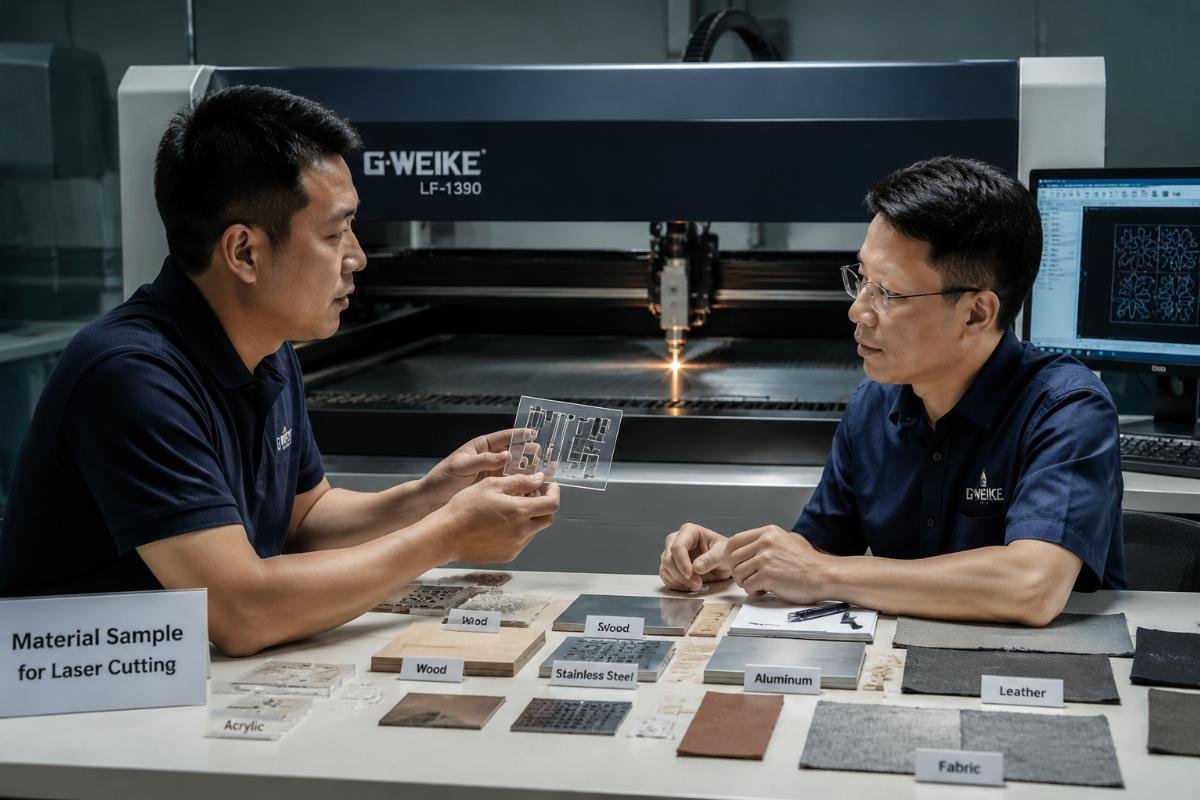
Why can't suppliers immediately answer "which multi-material cutting machine is best for foam, rubber, and cardboard"?
Most buyers expect a simple product recommendation when they ask about multi-material knife cutting solutions. Instead, they receive three reverse questions from suppliers. This happens because the "best machine" does not exist until the buyer provides three baseline facts that determine equipment specifications.
No cutting machine supplier can recommend equipment without knowing your material thickness range, whether you frequently switch between foam/rubber/cardboard, and your required cutting precision. These three facts determine blade type, vacuum system design, and control system configuration—decisions that cannot be reversed after purchase.
I handle pre-sales inquiries at Realtop Machinery every day. Buyers who skip these three questions often contact us again six months later, frustrated that their purchased equipment cannot handle their actual materials. This article explains why suppliers ask these specific questions and how you should prepare answers before contacting any manufacturer.
What happens when buyers only provide material names without thickness and hardness data?
Buyers frequently send inquiries stating "I need to cut foam, rubber, and cardboard" without additional details. They assume the supplier will recommend a universal solution. This assumption causes procurement errors because foam, rubber, and cardboard each span a hardness and thickness range that requires different blade geometries.
Foam cutting requires oscillating blades with 2-5mm amplitude1 for materials from 3mm craft foam to 100mm cushion foam. Rubber cutting needs straight blades with reinforced tips for materials from 1mm gasket rubber to 50mm industrial rubber. Cardboard cutting uses drag knives for materials from 0.5mm paperboard to 10mm corrugated cardboard. One blade type cannot handle all three material categories at optimal cutting quality.
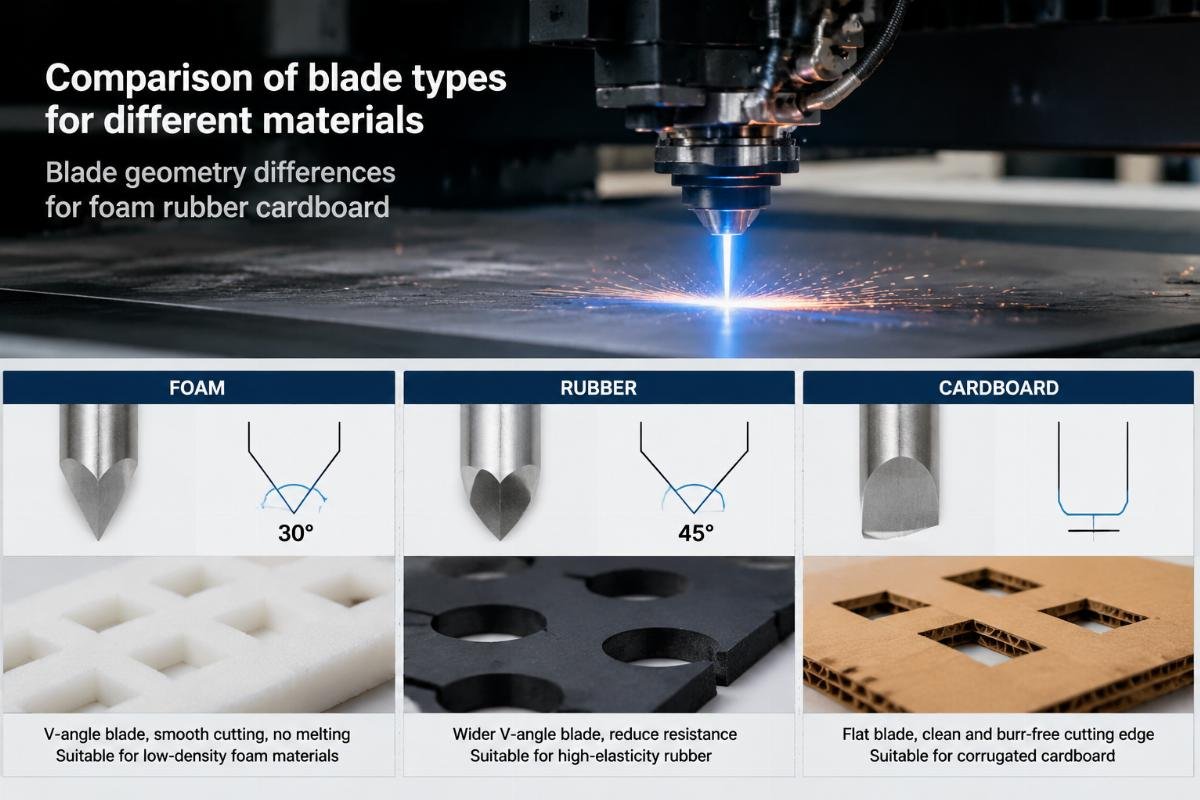
Why material thickness directly determines machine structure
I ask buyers to specify their thickest and thinnest materials because this range determines the machine's Z-axis stroke and cutting head weight capacity. A machine designed for 5mm foam cannot safely cut 80mm rubber because the blade length and holder mechanism are not engineered for deep material penetration.
The thickness range also determines vacuum table design. Thin materials like 0.5mm cardboard require high vacuum pressure across small holes to prevent lifting during cutting. Thick materials like 50mm foam require low vacuum pressure across large holes to avoid compression that distorts the cutting path. A vacuum table optimized for one thickness range performs poorly with the other extreme.
| Material Type | Typical Thickness Range | Required Blade Length | Vacuum Hole Size | Vacuum Pressure |
|---|---|---|---|---|
| Craft foam | 3-10mm | 15-25mm | 3-5mm diameter | 4-6 kPa |
| Cushion foam | 30-100mm | 80-150mm | 8-12mm diameter | 2-3 kPa |
| Gasket rubber | 1-5mm | 10-15mm | 1-2mm diameter | 6-8 kPa |
| Industrial rubber | 20-50mm | 60-100mm | 5-8mm diameter | 3-5 kPa |
| Paperboard | 0.5-2mm | 5-10mm | 0.5-1mm diameter | 7-10 kPa |
| Corrugated cardboard | 3-10mm | 15-25mm | 2-4mm diameter | 4-6 kPa |
Buyers who provide only generic material names often discover post-purchase that their machine cannot accommodate their full thickness range. We then receive requests for machine modifications that cost 30-40% of the original equipment price.
How material hardness affects blade lifespan and cutting speed
Material hardness determines blade wear rate and required cutting force. I once worked with a buyer who purchased a machine for "foam and rubber" without specifying that their rubber was 70 Shore A industrial rubber2. The machine arrived with blades designed for 30 Shore A soft foam. The blades dulled within 20 hours of cutting instead of the expected 200 hours.
Hardness also determines cutting speed. Soft foam can be cut at 800-1200mm/s. Hard rubber requires 200-400mm/s to prevent blade deflection. Cardboard falls between at 400-800mm/s depending on density. Buyers who expect one machine to maintain the same production speed across all three materials face capacity planning errors.
We ask buyers to provide Shore hardness values for rubber and foam3, and GSM density for cardboard4. Without these specifications, we cannot calculate realistic production capacity or blade replacement costs.
Should you buy dedicated machines or one universal machine for frequent material switching?
Buyers assume universal machines always cost less than buying multiple dedicated machines. This assumption is correct only if you switch material types infrequently. The calculation reverses when you change materials multiple times per day.
Universal machines require 15-30 minutes of setup time each time you switch from foam to rubber to cardboard5, including blade changes, vacuum pressure adjustments, and cutting parameter modifications. Dedicated machines eliminate this downtime but require floor space and higher initial capital. The break-even point occurs when setup time costs exceed the price difference between universal and dedicated equipment.
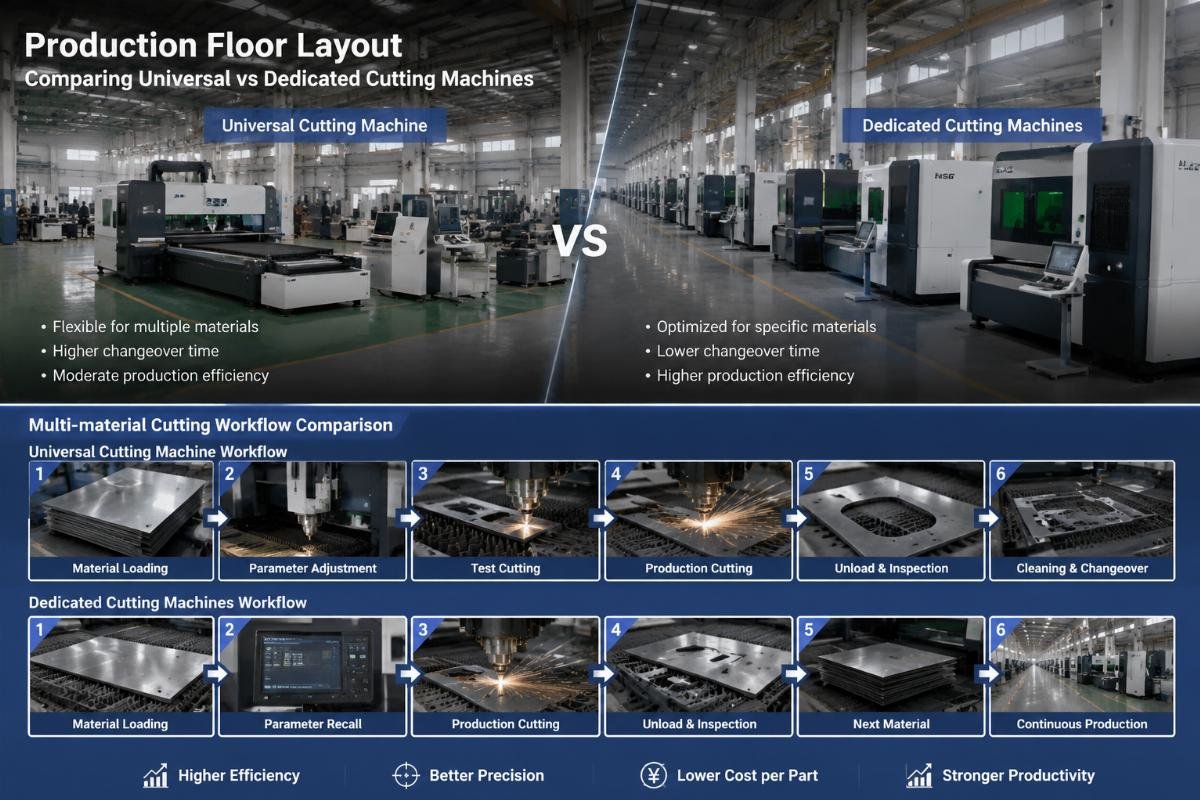
How to calculate whether universal machines save money in your operation
I guide buyers through a simple calculation. First, multiply your monthly material switches by 20 minutes average setup time. Then multiply this total by your hourly labor rate and machine opportunity cost. If this monthly switching cost exceeds your monthly equipment financing cost for a second dedicated machine, dedicated machines are more economical.
A furniture manufacturer contacted us about cutting foam cushions and rubber gaskets. They switched materials six times per day. Their calculation showed:
- 6 switches × 20 minutes × 22 working days = 44 hours monthly setup time
- 44 hours × $85 combined labor and machine rate = $3,740 monthly switching cost
- Two dedicated machines cost $4,200 monthly in financing
- Break-even occurred at month 14 when productivity gains exceeded finance costs
This buyer purchased two dedicated machines. Another buyer who switched materials twice per week purchased one universal machine because their monthly switching cost was only $680.
What universal machines cannot do despite marketing claims
Universal machine manufacturers often claim their equipment handles all materials equally well. This is technically true but misleading. Universal machines achieve acceptable cutting quality across foam, rubber, and cardboard, but they cannot match the cutting speed or edge quality of dedicated machines optimized for one material type.
Universal machines use medium-strength vacuum systems that compromise between foam and cardboard requirements. They use adjustable blade holders that add weight to the cutting head, reducing maximum cutting speed. They use standard control algorithms instead of material-specific toolpath optimization.
I tell buyers that universal machines are the right choice when flexibility matters more than maximum production speed. Dedicated machines are the right choice when you produce large volumes of each material type.
Why do buyers who ask about laser cutting receive recommendations for knife cutting instead?
Many buyers contact us requesting laser cutting solutions for foam, rubber, and cardboard because they assume laser technology is more advanced. I explain that laser cutting causes thermal damage and hazardous fumes with these materials, making knife cutting the safer and more precise option.
Laser cutting melts foam and rubber instead of cutting them, creating hardened edges that change material properties6. The melting process releases toxic fumes from synthetic foams and rubber compounds that require expensive ventilation systems7. Cardboard laser cutting creates charred edges that weaken structural integrity. Knife cutting mechanically separates material fibers without thermal damage or fume generation.
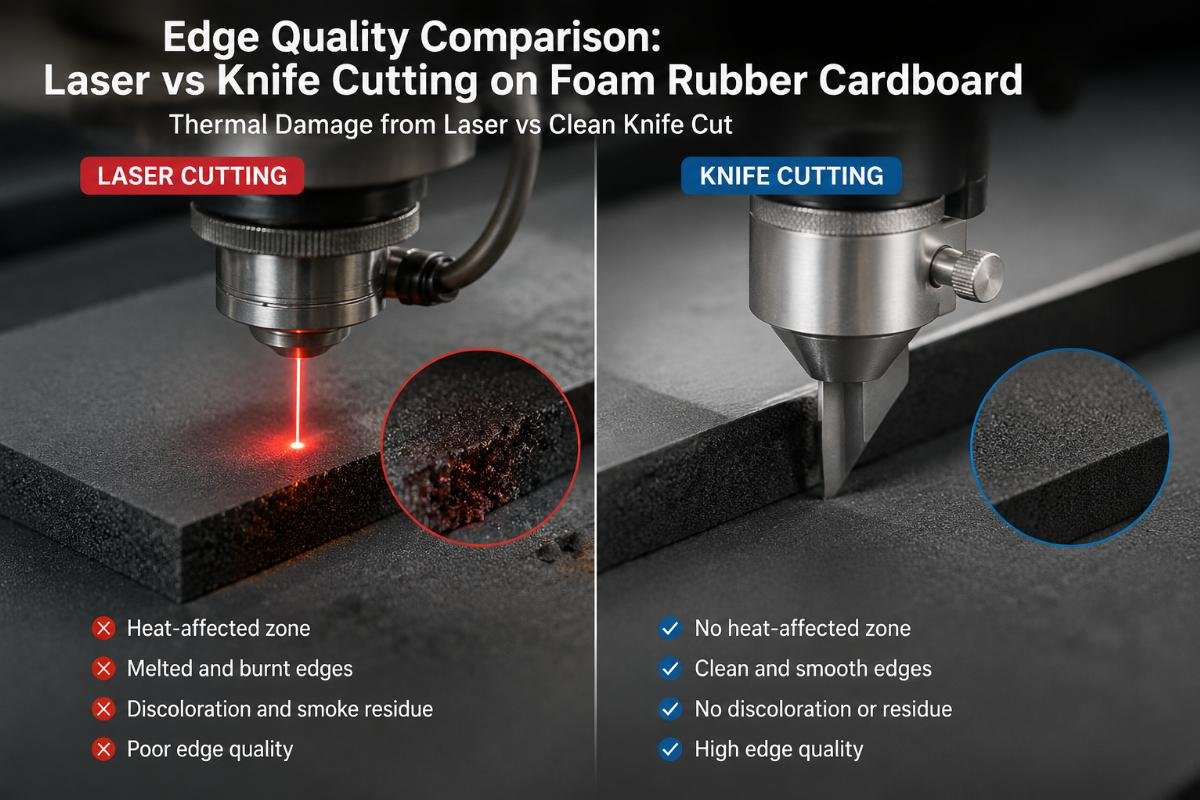
Laser cutting requires 5-10 times more ventilation capacity than knife cutting8 when processing foam and rubber. A laser cutting system needs industrial fume extractors rated at 2000-4000 cubic meters per hour to safely remove toxic smoke. Knife cutting requires only basic dust collection at 200-400 cubic meters per hour because it produces no combustion byproducts.
Laser cutting also limits material thickness. Most industrial laser cutters handle foam and rubber up to 25mm thickness9 before the cutting quality deteriorates from excessive heat input. Knife cutting easily processes materials up to 100mm thickness with proper blade length and multiple-pass cutting strategies.
I worked with an automotive parts manufacturer who initially requested laser cutting for rubber gaskets. After we showed them test cuts, they saw that laser-cut edges were 0.3mm harder than the base material due to thermal curing. This hardness variation caused assembly problems. They switched to knife cutting and eliminated the edge hardness issue.
When laser cutting is actually superior to knife cutting
Laser cutting excels at intricate patterns with tight inside corners and small holes below 5mm diameter. Knife cutting struggles with inside corner radius below 2mm because the blade thickness prevents sharper turns10. If your foam, rubber, or cardboard products require complex geometries with many small features, laser cutting may be necessary despite the thermal edge effects.
Some buyers need both technologies. They use laser cutting for complex pattern development and short runs where edge quality is less critical, then switch to knife cutting for volume production where edge quality and production speed matter. This hybrid approach costs more upfront but provides flexibility.
What cutting precision requirements reveal about your actual production needs?
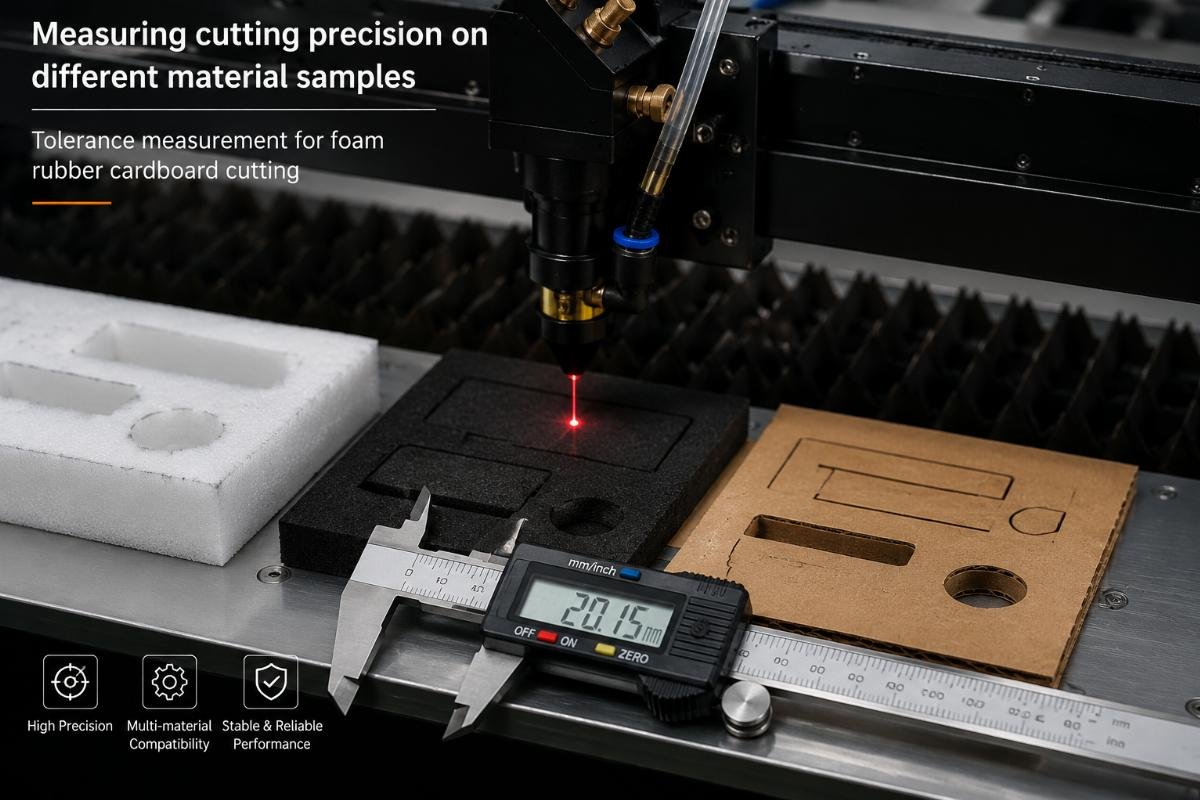
Buyers often state they need "high precision" without defining what this means numerically. I ask them to specify tolerance in millimeters because precision requirements directly determine the machine's control system, mechanical components, and ultimately the price.
Precision below ±0.1mm requires servo motors, ball screw drives, and closed-loop position feedback11, increasing machine cost by 40-60% compared to ±0.5mm precision systems12 using stepper motors and belt drives. Most foam and rubber applications perform acceptably with ±0.3mm precision, while cardboard packaging typically requires ±0.2mm precision for fold line accuracy.
How to determine what precision you actually need versus what you think you need
I guide buyers through a reverse calculation. I ask them to measure the tightest tolerance on their finished product drawing, then add material compression tolerance and assembly clearance. This sum represents their minimum required cutting precision.
A packaging manufacturer told us they needed ±0.05mm precision for cardboard boxes. When we reviewed their product drawings, the box assembly had ±0.8mm clearance between flaps. Their actual precision requirement was ±0.3mm. They saved $18,000 by purchasing a standard precision machine instead of the ultra-precision model they initially specified.
The precision requirement also determines cutting speed. High precision cutting requires slower speeds to minimize vibration and blade deflection. A machine cutting at ±0.1mm precision typically operates at 400-600mm/s. The same machine relaxed to ±0.3mm precision can cut at 800-1200mm/s, doubling production capacity.
Why precision requirements differ between material types
Foam products generally have looser tolerance requirements because foam compresses during assembly, absorbing dimensional variations. I typically see ±0.5mm precision specifications for foam components. Rubber gaskets require tighter tolerance at ±0.2mm because they seal between rigid surfaces where dimensional accuracy directly affects sealing performance.
Cardboard precision requirements vary by application. Retail packaging accepts ±0.3mm tolerance because slight variations do not affect functionality. Industrial packaging with automated assembly requires ±0.15mm tolerance to ensure reliable feeding through packaging machines.
Buyers who request uniform precision across all three materials often overspend on unnecessary accuracy for foam while underspending on required accuracy for rubber gaskets.
How should you prepare information before contacting cutting machine suppliers?
Buyers who provide complete information receive accurate equipment recommendations within 24 hours. Buyers who provide incomplete information experience 2-3 weeks of back-and-forth communication before reaching a recommendation. I created a pre-contact checklist that eliminates this delay.
Prepare material samples including your thinnest and thickest materials in each category. Measure and document Shore hardness for foam and rubber, GSM weight for cardboard. Calculate how many times per day or week you switch between material types. Measure the tightest tolerance on your finished product drawings. This information package enables suppliers to recommend correctly-specified equipment immediately.

The sample package that gets fastest supplier response
I ask buyers to send a sample package containing:
- 3-5 pieces of each material type in A4 size
- Material specification sheet listing thickness, hardness, and density
- Digital copy of one typical cutting pattern per material
- Production volume targets (pieces per day per material)
- Current production method and its limitations
This package allows us to run actual cutting tests on the buyer's materials instead of making theoretical recommendations. We return cut samples showing achievable edge quality and cutting speed, plus a test report documenting blade type, cutting parameters, and cycle time.
One buyer sent this complete package on Monday. We ran cutting tests Tuesday, shipped cut samples back Wednesday, and provided a detailed equipment recommendation with ROI calculation Thursday. The buyer approved the purchase order Friday. Total process took five days instead of the typical three weeks.
What to ask suppliers beyond equipment specifications
Buyers should request information about blade replacement frequency and cost per blade. A machine with excellent cutting performance but proprietary blades costing $80 each may have higher operating costs than a machine using standard $12 blades. We provide buyers with annual blade cost estimates based on their material types and production volume.
Ask suppliers about upgrade paths if your material range expands. Some machine designs allow Z-axis extension and vacuum system upgrades without replacing the entire machine. Other designs require complete machine replacement when material requirements change.
Request contact information for existing customers processing similar materials. Speaking directly with current users reveals operational issues that specifications cannot show, like how long operators actually take to change blades or how often the machine requires recalibration.
Conclusion
Multi-material knife cutting machine selection requires three baseline facts: material thickness and hardness data, material switching frequency, and precision requirements. Buyers who provide complete information receive accurate equipment recommendations that match their actual production needs. Suppliers cannot recommend properly-specified equipment without this information regardless of their technical expertise or product range.
"Best Blades for CNC Oscillating Knife Cutters: Full Guide", https://www.trustercnc.com/best-blades-for-cnc-oscillating-knife-cutters-full-guide/. Oscillating blade systems for foam cutting typically operate within specific amplitude ranges to achieve clean cuts without material tearing, with parameters varying based on foam density and thickness. Evidence role: mechanism; source type: research. Supports: the technical parameters of oscillating blade cutting for foam materials. Scope note: Technical specifications may vary by manufacturer and foam composition ↩
"Durometer Shore Hardness Scale - Smooth-On", https://www.smooth-on.com/page/durometer-shore-hardness-scale/. The Shore A scale measures the hardness of softer elastomers and rubbers, with values ranging from 0 (very soft) to 100 (hard rubber), where 70 Shore A represents a medium-hard rubber commonly used in industrial applications such as gaskets and seals. Evidence role: definition; source type: education. Supports: the Shore A hardness scale and what specific values represent. Scope note: Material properties vary beyond hardness alone ↩
"Shore durometer - Wikipedia", https://en.wikipedia.org/wiki/Shore_durometer. Shore hardness testing, standardized in ASTM D2240 and ISO 868, provides a widely-used method for measuring the indentation hardness of elastomers, rubbers, and soft plastics using durometer instruments with different scales for varying material hardness ranges. Evidence role: definition; source type: institution. Supports: Shore hardness as a standardized measurement method for elastomeric materials. ↩
"Basis Weight Testing | Center for Packaging and Unit Load Design", https://www.unitload.vt.edu/facilities/corrugated-packaging-lab/basis-weight-testing.html. Grammage, measured in grams per square meter (GSM or g/m²), represents the standard international measurement for paper and cardboard weight per unit area, defined in ISO 536 and used throughout the paper and packaging industries. Evidence role: definition; source type: institution. Supports: GSM as a standard measurement for paper and cardboard weight. ↩
"[PDF] Simplified Time Estimation Booklet for Basic Machining Operations", https://web.mit.edu/2.810/www/files/readings/Polgar_TimeEstimation.pdf. Manufacturing changeover times for multi-material cutting systems vary based on machine design and operator experience, with setup procedures including tooling changes, parameter adjustments, and test cuts. Evidence role: statistic; source type: research. Supports: typical setup and changeover times in multi-material cutting operations. Scope note: Actual times depend on specific equipment design and operator training ↩
"Experimental Analysis of Heat-Affected Zone (HAZ) in Laser Cutting ...", https://pmc.ncbi.nlm.nih.gov/articles/PMC7956482/. Laser cutting of polymer materials generates heat-affected zones where thermal energy alters material structure, potentially changing mechanical properties at cut edges through melting, carbonization, or chemical degradation. Evidence role: mechanism; source type: research. Supports: the thermal effects of laser cutting on polymer-based materials including foam and rubber. Scope note: Effects vary significantly with laser parameters, material composition, and cutting speed ↩
"OSHA Technical Manual (OTM) - Section III: Chapter 6 - OSHA", http://www.osha.gov/otm/section-3-health-hazards/chapter-6. Laser processing of synthetic polymers can generate airborne contaminants including particulates and volatile organic compounds, with occupational safety guidelines recommending appropriate ventilation and exposure controls. Evidence role: general_support; source type: government. Supports: occupational health concerns and ventilation requirements for laser cutting of synthetic materials. Scope note: Specific requirements depend on material composition and regulatory jurisdiction ↩
"11.8 Laser Tools - Environment, Health & Safety", https://ehs.umich.edu/csp/11-8-laser-tools/. Ventilation requirements for industrial cutting operations vary significantly based on process type, with thermal cutting methods generally requiring higher extraction rates than mechanical methods due to fume and particulate generation. Evidence role: statistic; source type: institution. Supports: comparative ventilation requirements for different cutting technologies. Scope note: Specific capacity ratios depend on materials processed and local exhaust system design ↩
"State-Of-The-Art and Trends in CO2 Laser Cutting of Polymeric ...", https://pmc.ncbi.nlm.nih.gov/articles/PMC7503707/. Laser cutting depth capability for non-metallic materials depends on laser power, material absorption characteristics, and acceptable edge quality, with practical thickness limits varying by material type and laser system specifications. Evidence role: general_support; source type: research. Supports: thickness limitations of laser cutting for polymer materials. Scope note: Maximum thickness varies with laser power, material properties, and quality requirements ↩
"[PDF] Robotic Cutting: Mechanics and Control of Knife Motion", https://faculty.sites.iastate.edu/jia/files/inline-files/ICRA19.pdf. Knife cutting systems face geometric constraints in producing tight inside corners due to blade thickness and the physical turning radius required, with minimum achievable corner radii typically related to blade width and cutting head mechanics. Evidence role: mechanism; source type: research. Supports: geometric limitations of knife cutting related to blade dimensions. Scope note: Actual limitations vary with blade design and cutting system configuration ↩
"Closed Loop CNC Manufacturing -- Connecting the CNC to the ...", https://www.nist.gov/publications/closed-loop-cnc-manufacturing-connecting-cnc-enterprise. High-precision positioning systems typically employ servo motors with encoder feedback and precision mechanical drives such as ball screws to achieve sub-millimeter accuracy, with system accuracy depending on component specifications and mechanical design. Evidence role: mechanism; source type: education. Supports: the relationship between motion control components and achievable positioning accuracy. Scope note: Actual precision depends on multiple factors including mechanical rigidity and thermal stability ↩
"Cost of CNC Machines: A Comprehensive Guide to Their Prices", https://sendcutsend.com/blog/cnc-machine-costs/?srsltid=AfmBOoqgNFuaJwS6bBU79z43gApsKkvoHC_QmA4Aue4r5FywobQuaIjl. Manufacturing equipment costs generally increase with precision requirements due to higher-grade components, tighter tolerances, and more sophisticated control systems, though specific cost differentials vary by machine type and manufacturer. Evidence role: statistic; source type: research. Supports: cost relationships between different precision levels in manufacturing equipment. Scope note: Cost ratios vary significantly by equipment type, manufacturer, and market conditions ↩