

Blog
How Contract Manufacturers Modify Equipment to Cut Foam-Bonded Fabric?

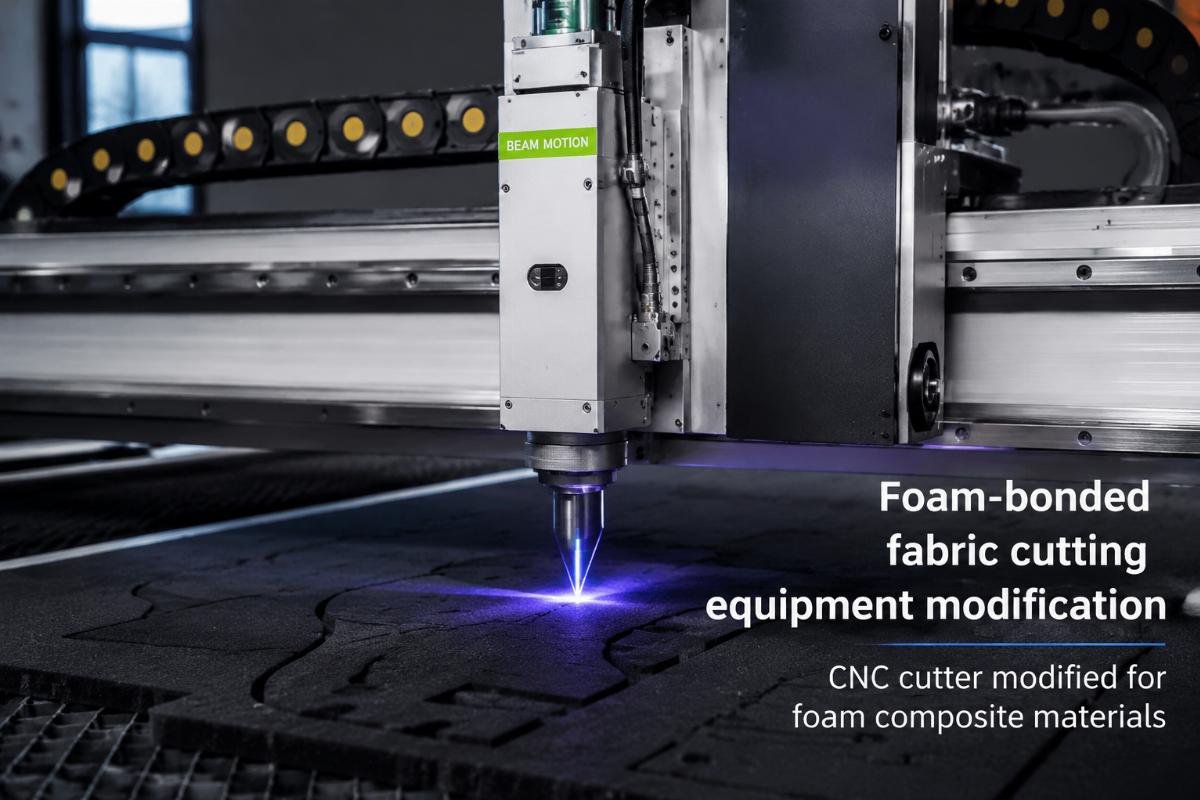
How Contract Manufacturers Modify Equipment to Cut Foam-Bonded Fabric?
I recently helped a furniture contract manufacturer solve a puzzling problem. They swapped out their standard blade for a thicker one, expecting clean cuts on foam-bonded upholstery fabric. Instead, they got worse delamination than before. Their production manager was frustrated—he thought changing the blade would fix everything. This situation repeats itself more often than you'd think.
Modifying CNC cutting equipment for foam-bonded fabric requires coordinated adjustment of three systems: knife parameters, vacuum pressure, and presser roller configuration. Simply changing the blade ignores how foam compression behavior affects material stability during cutting1, which leads to layer separation and edge quality failures that often exceed the cost of proper modification.
I've worked with dozens of contract manufacturers who face this exact challenge. They receive orders for automotive headliners2, furniture upholstery, or packaging materials that combine foam backing with fabric faces. Their existing equipment handles single-layer materials fine, but foam composites behave completely differently under the blade. Let me walk you through what actually needs to change.
Why Does Foam-Bonded Fabric Behave Differently Than Single Materials?
Contract manufacturers often underestimate how much foam's elastic properties affect cutting dynamics. When I visit facilities to diagnose cutting problems, I see the same pattern—operators treat foam composites like thicker versions of regular fabric.
Foam-bonded fabric creates three distinct challenges during cutting: the foam layer compresses and rebounds under blade pressure3, the adhesive layer can soften from friction heat4, and the fabric face layer experiences tension that pulls away from the unstable foam base. These behaviors interact to cause delamination that single-material cutting systems aren't designed to prevent.
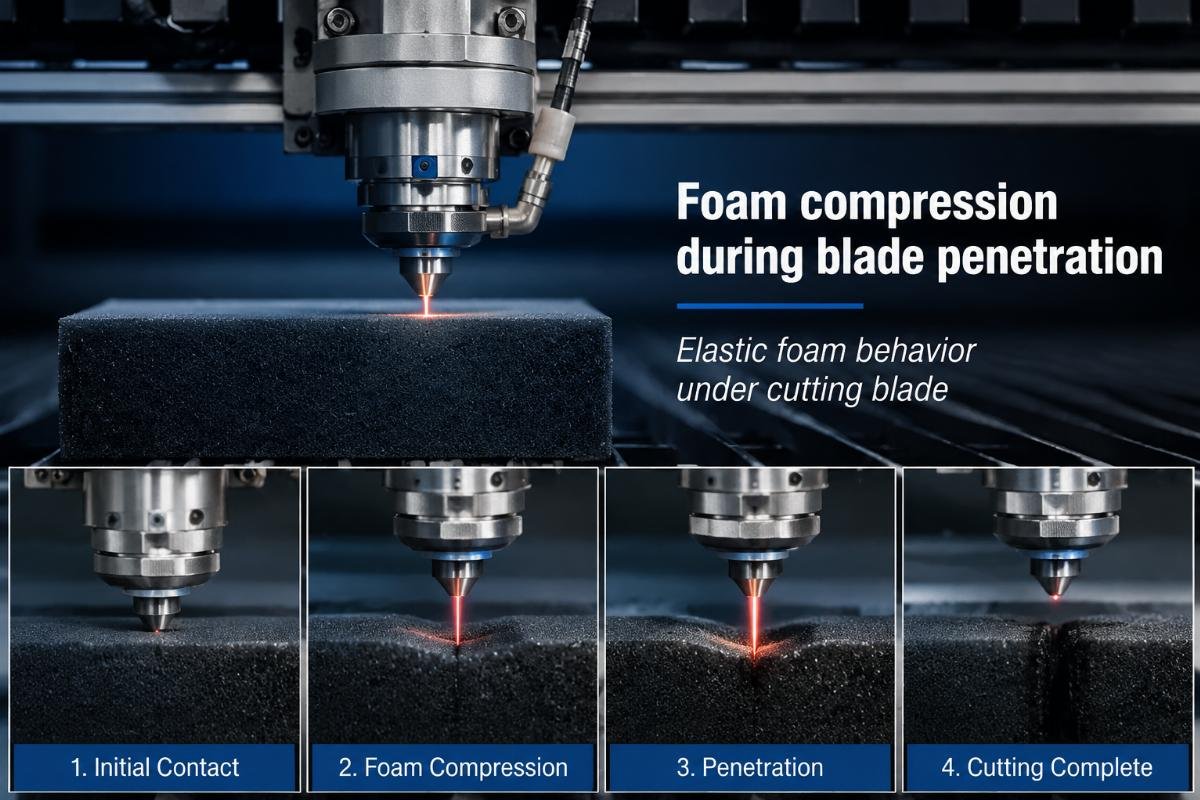
When a blade enters foam-bonded material, the foam compresses downward and outward. This compression stores elastic energy. As the blade moves forward, that stored energy rebounds against the blade's trailing edge. Meanwhile, the adhesive layer between foam and fabric experiences shear stress. If the fabric layer isn't held firmly enough, the foam's rebound motion pulls the fabric away from the cut line.
I remember commissioning a machine for a customer who was cutting 5mm polyurethane foam bonded to polyester fabric5. With their original setup, every cut showed a 2-3mm gap between the foam edge and fabric edge. The fabric was literally pulling away from the foam during the cut. This wasn't a blade sharpness issue—it was a system coordination problem.
The foam density affects how severe this behavior becomes. Denser foams store more elastic energy and rebound more forcefully6. Softer foams compress more easily but can be crushed by excessive presser force. The adhesive thickness matters too—thicker adhesive layers take longer to cool after friction heating, which extends the time window when delamination can occur.
When customers report edge quality issues, I ask three questions before looking at their blade: What's the foam density? How thick is the adhesive layer? What's the fabric weight? These material properties determine which modifications will actually solve the problem.
Key Material Variables That Drive Modification Decisions
| Material Property | Effect on Cutting | Modification Priority |
|---|---|---|
| Foam density (kg/m³7) | Higher density increases rebound force | Vacuum pressure adjustment |
| Adhesive layer thickness | Thicker layers retain heat longer | Blade speed and cooling time |
| Fabric weight (g/m²) | Heavier fabrics resist tension better | Presser roller force |
| Total material thickness | Affects blade depth engagement | Knife length and angle |
What Knife Parameters Need Adjustment for Foam Composites?
Changing the blade type is only the starting point. In the cases I've adjusted, I've found that three knife parameters need coordinated modification: blade geometry, cutting depth, and blade angle.
The blade must penetrate completely through all layers while minimizing lateral deflection that causes foam compression spreading. This requires selecting knife edge angles based on foam density, adjusting cutting depth to account for material compression, and sometimes changing blade thickness to resist deflection during high-rebound cutting.
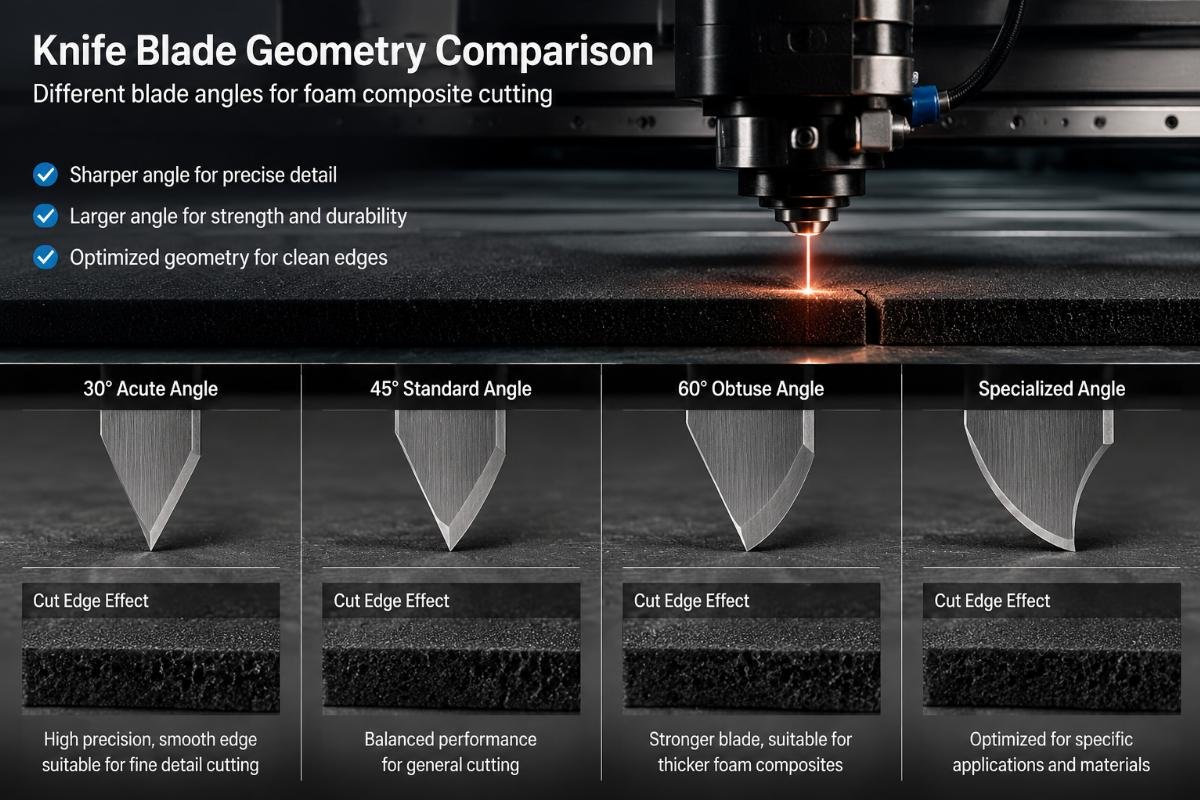
Most contract manufacturers start with oscillating knife blades8, which work fine for single-layer fabric or thin foam sheets. When foam and fabric are bonded together, the blade needs to slice through the fabric cleanly while pushing through compressed foam. A standard 45-degree blade angle9 often deflects too much when the foam rebounds against the blade side.
I've seen better results with 52-degree or even 60-degree blade angles for denser foams. The steeper angle creates a narrower blade profile that reduces the surface area the rebounding foam can push against. This minimizes lateral deflection. However, steeper angles also require more downward force, which brings the presser roller system into play.
Blade thickness is the parameter that surprises people. A customer once insisted on using a thinner blade because they thought it would reduce material resistance. The opposite happened—the thin blade flexed during cutting, creating wavy cut edges. We switched to a thicker blade with appropriate sharpening, and the edge quality improved dramatically. The thicker blade resisted deflection better even though it created more material resistance.
Cutting depth needs to account for foam compression. If your foam compresses 15% under presser roller force, you need to extend blade penetration beyond the uncompressed material thickness. I usually recommend test cuts at different depths to find the point where the blade fully penetrates without excessive cutting mat wear.
Blade Parameter Adjustments by Foam Type
| Foam Density Range | Recommended Blade Angle | Typical Blade Thickness | Depth Adjustment Factor |
|---|---|---|---|
| Low (20-40 kg/m³) | 45-50 degrees | 0.63-0.80 mm | +20% of compressed thickness |
| Medium (40-80 kg/m³) | 50-55 degrees | 0.80-1.00 mm | +15% of compressed thickness |
| High (80+ kg/m³) | 55-60 degrees | 1.00-1.27 mm | +10% of compressed thickness |
One thing I need to be clear about: these are starting points from customer cases, not laboratory-validated specifications. Material behavior varies with adhesive type, fabric construction, and environmental conditions. You'll need to test and adjust for your specific materials.
How Should Vacuum Pressure Be Adjusted for Foam-Bonded Materials?
The vacuum system is where most modifications fail. Contract manufacturers often focus entirely on the blade and forget that holding the material stable during cutting is just as critical as the cutting action itself.
Vacuum pressure must be increased enough to counteract foam rebound force without crushing the foam cells10 or causing fabric distortion. This requires zone-based pressure adjustment where the cutting area receives higher vacuum than surrounding material, and pressure settings must be tested across different foam densities to avoid cell collapse or insufficient hold-down.
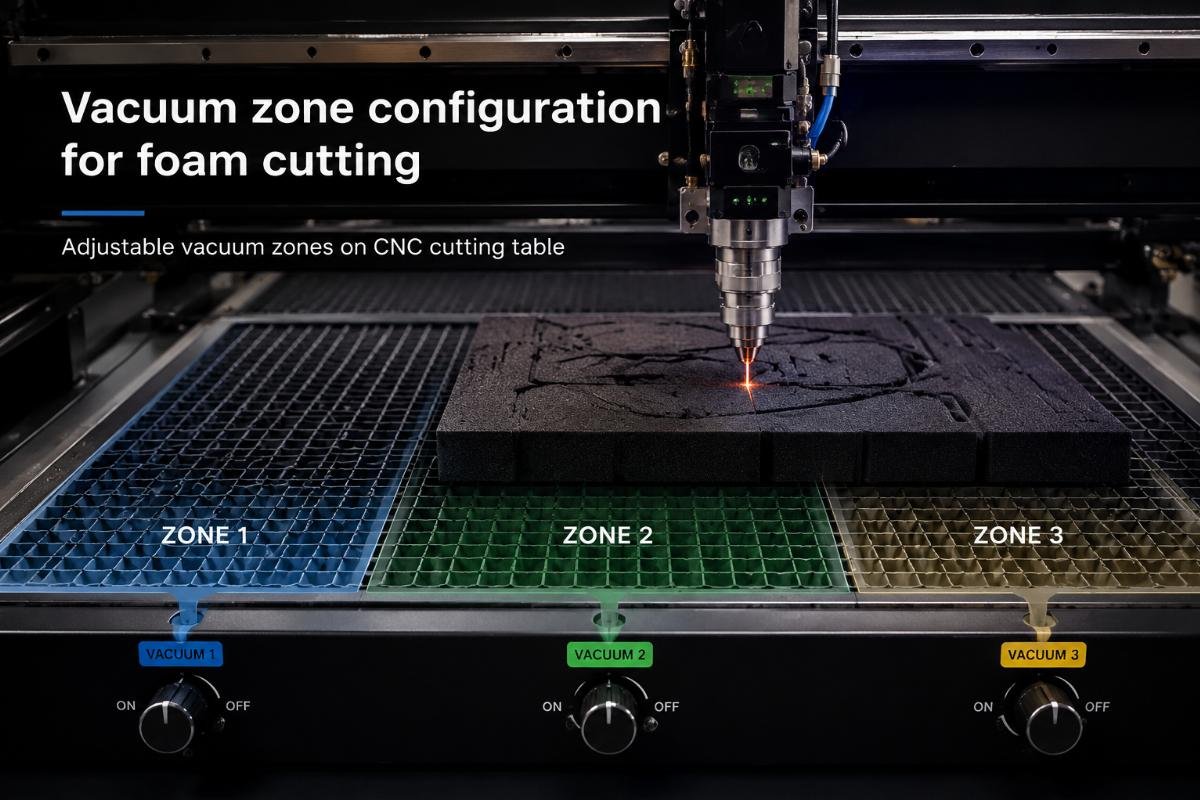
Standard fabric cutting uses relatively low vacuum pressure—just enough to keep the material from shifting. Foam composites need significantly higher pressure directly around the cut line to prevent the material from lifting as the blade passes through. When the foam rebounds, it pushes upward against the presser roller. If vacuum pressure is insufficient, the entire material layer lifts slightly, which allows the fabric to separate from the foam.
I worked with a customer who was cutting automotive headliner material—a three-layer composite with foam core, adhesive, and knit fabric face. Their standard vacuum setting was around 40% of maximum system capacity. We increased it to 65% in the cutting zone, and delamination defects dropped by about 70%. The stronger vacuum hold prevented the material lift that was causing separation.
However, excessive vacuum creates different problems. I've seen cases where customers cranked vacuum pressure to maximum and ended up crushing the foam cells. The crushed areas showed visible indentation after cutting, which made the parts unusable. Dense foams can handle higher vacuum without damage, but soft foams require careful pressure balancing.
Zone-based vacuum control is important for larger cutting tables. The area directly around the blade path needs higher vacuum than areas farther away. This focused hold-down provides stability where it matters without applying unnecessary force to the entire material sheet. Not all cutting equipment supports zone control, which is one limitation I mention when customers ask about modification feasibility.
When customers report edge quality issues despite blade changes, I check vacuum pressure first. If the material is lifting even slightly during cutting, no amount of blade adjustment will fix the delamination problem. The hold-down force must match the foam's rebound force.
Vacuum Pressure Guidelines by Foam Density
| Foam Type | Baseline Vacuum Level | Cutting Zone Increase | Risk to Monitor |
|---|---|---|---|
| Soft foam (20-40 kg/m³) | 45-55% max capacity | +10-15% | Cell crushing |
| Medium foam (40-80 kg/m³) | 55-65% max capacity | +15-20% | Fabric distortion |
| Dense foam (80+ kg/m³) | 65-75% max capacity | +20-25% | Insufficient hold-down |
What Role Do Presser Rollers Play in Preventing Delamination?
The presser roller system is the third critical component that gets overlooked. I've participated in equipment adjustments where we optimized the blade and vacuum but still had delamination problems. The issue was presser roller configuration.
Presser rollers must apply enough downward force to compress the foam sufficiently for blade penetration while preventing foam rebound immediately behind the blade. This requires adjusting roller pressure based on foam density, positioning the roller close enough to the blade to suppress rebound, and sometimes adding secondary rollers to extend the compression zone.
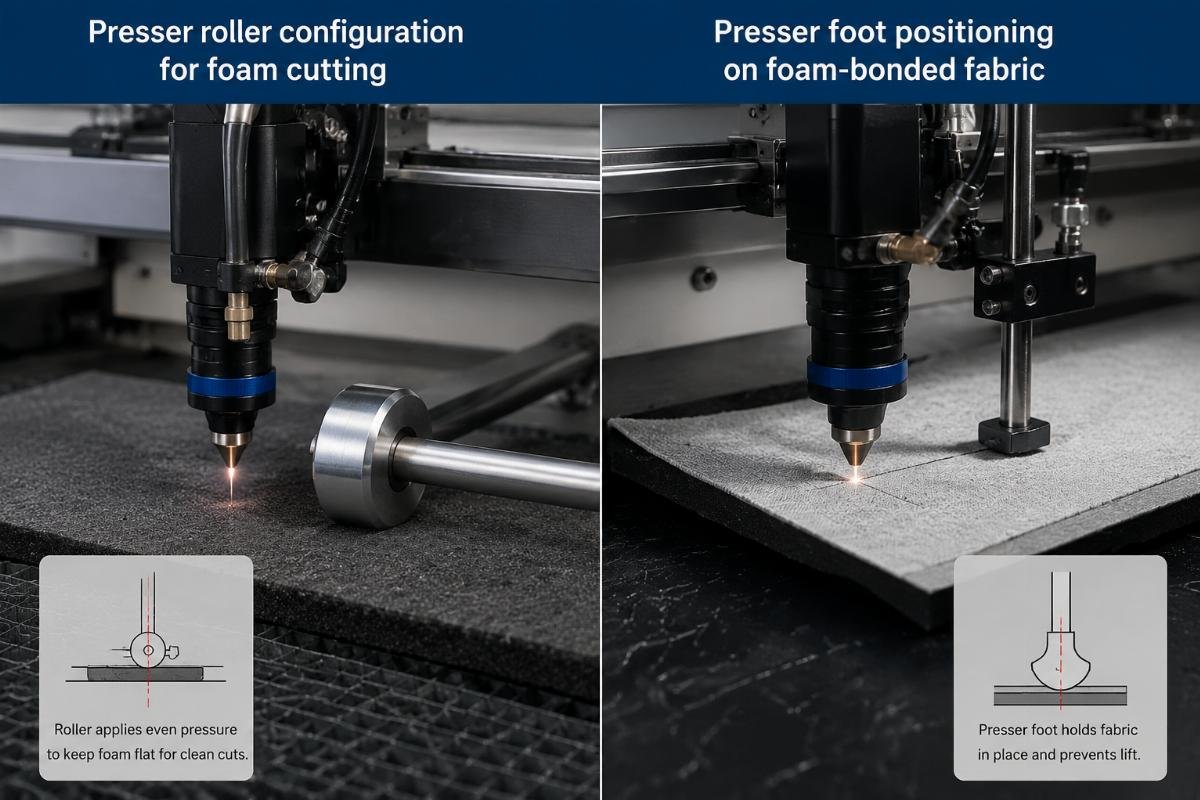
The presser roller's job is to flatten the material in front of the blade so the blade can penetrate all layers without fighting elastic resistance. For single-layer materials, this is straightforward—apply enough pressure to hold the material flat against the cutting surface. For foam composites, the roller must compress the foam to a stable thickness while the blade cuts through.
I've found that roller positioning relative to the blade matters more than most people realize. If the roller is positioned too far ahead of the blade, the foam has space to rebound before the blade reaches it. If positioned too close, the roller interferes with blade movement. In the cases I've adjusted, optimal positioning is usually 3-5mm ahead of the blade path for medium-density foams.
Roller pressure needs to match foam density. Soft foams require lighter pressure to avoid crushing. Dense foams need heavier pressure to compress enough for clean blade penetration. A customer once complained that their modified equipment was creating compressed trenches in the foam ahead of cuts. We reduced presser roller force by about 30%, and the problem disappeared. They had assumed more pressure was always better.
Some modifications require adding secondary presser rollers behind the primary blade. The secondary roller extends the compression zone, which helps prevent foam rebound immediately after cutting. This is especially useful for thicker foam composites where the cut edge wants to spring away from the blade.
One limitation I need to mention: not all equipment frames have the structural rigidity to support increased presser roller force. If your machine's frame flexes under heavier roller pressure, you'll get inconsistent cutting depth across the table. This is one case where equipment modification might not be cost-effective compared to purpose-built foam cutting machines.
Presser Roller Configuration Guidelines
| Material Characteristic | Roller Pressure Adjustment | Positioning Distance | Consider Secondary Roller |
|---|---|---|---|
| Soft, thick foam (>10mm) | Reduce by 20-30% | 4-6mm ahead | Yes, for materials >15mm |
| Medium foam (5-10mm) | Standard pressure | 3-5mm ahead | Optional |
| Dense, thin foam (<5mm) | Increase by 10-20% | 2-4mm ahead | Not usually needed |
| High fabric weight | Increase by 15-25% | 3-4mm ahead | If fabric tension is high |
How Can You Test Modifications Without Excessive Material Waste?
Contract manufacturers face a real trade-off between modification cost and delamination risk. Rushing adjustments without systematic testing often results in scrap rates that exceed the modification investment. I've seen customers waste thousands of dollars of material trying to dial in settings.
Effective modification testing requires creating sample sets that represent your material's variation range, adjusting one parameter at a time while holding others constant, measuring delamination occurrence rate rather than subjective edge quality, and documenting settings that work before moving to production runs.
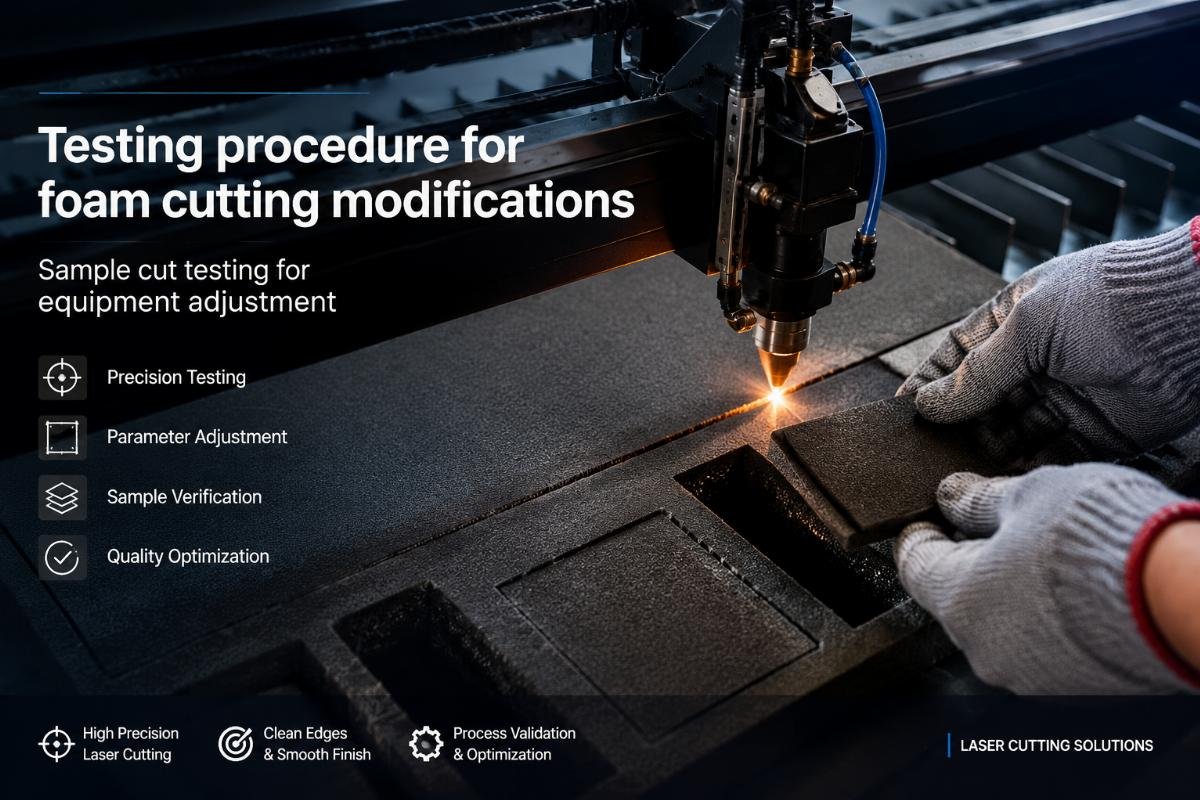
I recommend starting with small sample pieces that include your thinnest and thickest foam variants, your heaviest and lightest fabric weights, and if possible, samples that represent aging adhesive characteristics. These boundary cases will reveal whether your modification settings work across your actual production range or only for average materials.
Adjust parameters one at a time. Start with blade geometry, then vacuum pressure, then presser roller force. If you change everything at once and get good results, you don't know which changes mattered. If you get poor results, you don't know which parameter caused the problem. This sequential approach takes longer but saves material and troubleshooting time.
When customers report edge quality issues, I ask them how they're measuring results. "It looks better" or "the edges seem cleaner" aren't useful metrics. Count how many delamination occurrences happen per 10 meters of cutting. Measure the gap width between foam and fabric layers when separation does occur. These numbers tell you whether modifications are actually improving performance.
Document everything. I can't stress this enough. Write down blade type, angle, thickness, cutting depth, vacuum percentages by zone, presser roller force settings, and cutting speed for every test run. When you find settings that work, you'll want to replicate them. When you add new materials to your production mix, you'll want a starting point based on similar materials you've cut before.
One thing I've learned from customer cases: successful modifications require 3-5 adjustment iterations even with experienced guidance. If someone tells you they'll dial in your equipment in one session, be skeptical. Material behavior reveals problems that only show up during actual cutting.
Systematic Testing Procedure
- Baseline test: Cut samples with current equipment settings, measure delamination rate
- Blade adjustment: Change knife parameters only, repeat test, compare delamination rate
- Vacuum optimization: Adjust vacuum with new blade settings, test again
- Presser roller tuning: Modify roller force/position, final validation test
- Production verification: Run short production batch, confirm settings hold across material variation
When Is Equipment Modification Not Worth the Investment?
I need to address cases where modification isn't the right answer. Some contract manufacturers spend money adjusting equipment that fundamentally can't handle foam composites effectively. This is a difficult conversation, but I've seen enough failed modifications to know when to raise the flag.
Equipment modification becomes impractical when the base machine lacks sufficient vacuum capacity, the frame structure can't support increased presser roller force without flexing, the blade speed range doesn't include slow enough speeds for thick foam composites, or the material variation in your orders exceeds the equipment's adjustment range.
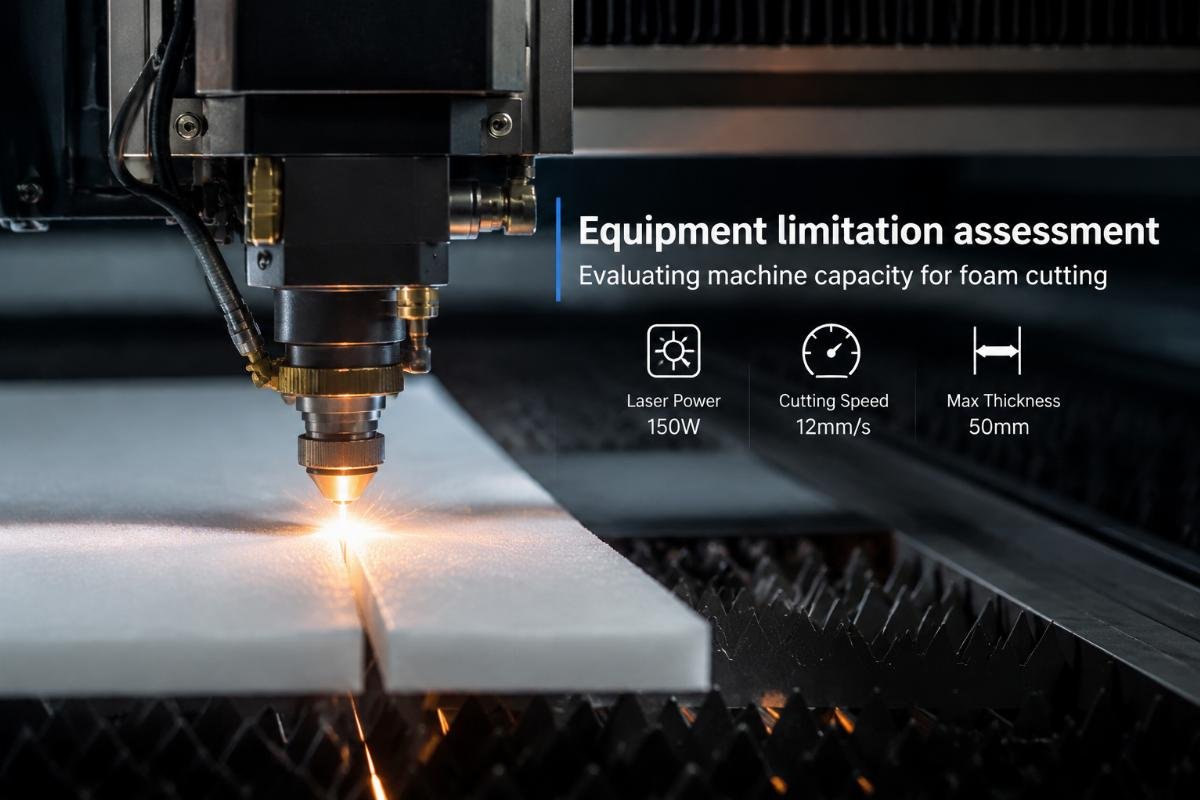
Vacuum system capacity is the most common limitation. If your cutting table's vacuum system runs at 80% capacity just to hold regular fabric, you don't have enough reserve capacity to increase pressure for foam composites. Adding more vacuum zones or upgrading the vacuum pump might cost more than the modification project budget.
Frame rigidity affects cutting consistency. I've worked with customers whose equipment frames visibly flexed when we increased presser roller force. The flex caused cutting depth variation across the table—parts cut on one side had different edge quality than parts cut on the other side. Reinforcing frame structure often requires machine disassembly and fabrication work that exceeds simple modification scope.
Some equipment has minimum blade speed limits that are too fast for thick foam composites. Foam cutting often requires slower speeds to allow heat dissipation and reduce friction melting of adhesive layers11. If your machine's slowest speed is still too fast, you'll get poor results regardless of other adjustments.
Material variation is a practical limitation that doesn't get enough attention. If your contract orders include foam densities from 25 kg/m³ to 90 kg/m³, fabric weights from 200 g/m² to 600 g/m², and adhesive thicknesses from 0.5mm to 2mm, you'll need to adjust settings for every order. The labor cost of constant adjustment might exceed the profit margin on smaller orders.
In these situations, I tell customers they need to consider purpose-built foam cutting equipment rather than modifying existing machines. The upfront investment is higher, but the operating cost and scrap rate are lower. This isn't a sales pitch—it's a practical assessment based on equipment capabilities.
When to Consider New Equipment Instead of Modification
| Limitation Factor | Modification Difficulty | Recommendation |
|---|---|---|
| Vacuum capacity <50% of foam composite requirement | Very high | Consider new equipment |
| Frame flex >1mm under increased presser force | High | Evaluate |
"Effective Elastic Behavior of Irregular Closed-Cell Foams - PMC", https://pmc.ncbi.nlm.nih.gov/articles/PMC6265794/. Research on cellular foam mechanics demonstrates that compression creates stored elastic energy that rebounds during cutting, affecting dimensional stability of composite materials. Evidence role: mechanism; source type: paper. Supports: The mechanical relationship between foam compression and material stability during cutting operations. Scope note: Studies may focus on compression testing rather than dynamic cutting conditions ↩
"Headliner Fabric | Headliner Material By The Yard - Midwest Fabrics", https://midwestfabrics.com/collections/headliner-fabric?srsltid=AfmBOopmRKXr0k3Vl9sA_LyJyL4qIlOkG5KhlvKh4erY5I1izE1myp2s. Automotive interior components such as headliners commonly use foam-backed fabric composites to provide cushioning, sound absorption, and aesthetic surface finish. Evidence role: case_reference; source type: other. Supports: The use of foam-backed fabric composites in automotive interior applications. Scope note: Construction methods and materials vary by manufacturer and vehicle segment ↩
"Viscoelastic Polyurethane Foams for Use in Seals of Respiratory ...", https://pmc.ncbi.nlm.nih.gov/articles/PMC8036923/. Studies of viscoelastic foam behavior show that localized compression stores elastic energy that releases as rebound force when pressure is removed or displaced. Evidence role: mechanism; source type: paper. Supports: The compression-rebound cycle of cellular foam materials under localized pressure. ↩
"Thermal Softening, Adhesive Properties and Glass Transitions in ...", https://bioresources.cnr.ncsu.edu/resources/thermal-softening-adhesive-properties-and-glass-transitions-in-lignin-hemicellulose-and-cellulose/. Tribological research indicates that friction between cutting tools and materials generates localized heat, and polymer-based adhesives exhibit reduced viscosity and bond strength at elevated temperatures. Evidence role: mechanism; source type: paper. Supports: The generation of frictional heat during cutting and its effect on adhesive thermal properties. Scope note: Temperature thresholds vary significantly by adhesive chemistry ↩
"Polyurethane Foam Composites Reinforced with Renewable ...", https://pmc.ncbi.nlm.nih.gov/articles/PMC8658850/. Polyurethane foam bonded to polyester fabric represents a common composite material configuration used in upholstery, automotive interiors, and packaging applications, typically joined through adhesive lamination or flame bonding processes. Evidence role: general_support; source type: other. Supports: The use of polyurethane foam-polyester fabric composites in manufacturing applications. ↩
"Review Study on Mechanical Properties of Cellular Materials - PMC", https://pmc.ncbi.nlm.nih.gov/articles/PMC11173958/. Materials science research on cellular foams shows that density correlates with elastic modulus and compression energy storage, with higher-density foams exhibiting greater resistance to deformation and higher rebound forces. Evidence role: mechanism; source type: paper. Supports: The correlation between foam density and elastic energy storage capacity. ↩
"[PDF] Foam Density and I.L.D. Values Chart - FoamOnline.com", https://foamonline.com/wp-content/uploads/2020/01/foam-firmness-ild-chart.pdf?srsltid=AfmBOoqcLlbK_STJTudWhqoVQ_9uhZkkWgJoggfUGJliTM21Y0aoSjf-. Foam density is standardly expressed in kilograms per cubic meter (kg/m³), representing the mass of foam material per unit volume and serving as a key specification for mechanical and physical properties. Evidence role: definition; source type: encyclopedia. Supports: The standard unit of measurement for foam density. ↩
"How does Oscillating Knife Cutter Work - YouTube",
. Oscillating knife systems use reciprocating vertical blade motion to cut materials, commonly employed in CNC cutting applications for textiles and flexible materials. Evidence role: definition; source type: encyclopedia. Supports: The definition and operating principle of oscillating knife cutting technology. ↩"Effects of Hardness, Blade Angle and the Micro-Geometry of ... - PMC", https://pmc.ncbi.nlm.nih.gov/articles/PMC10420138/. Cutting tool research indicates that blade edge angle affects cutting force distribution, material deflection, and edge quality, with different angles suited to different material properties. Evidence role: general_support; source type: paper. Supports: The role of blade angle in cutting mechanics and force distribution. Scope note: Optimal angles vary significantly by material type and cutting application ↩
"Deformation and Simulation of the Cellular Structure of Foamed ...", https://pmc.ncbi.nlm.nih.gov/articles/PMC9736430/. Research on cellular foam mechanics shows that compression beyond the elastic limit causes cell wall buckling and permanent structural collapse, reducing material thickness and altering mechanical properties. Evidence role: mechanism; source type: paper. Supports: The mechanism of permanent cellular structure damage in foams under excessive compression. ↩
"Understanding tool cutting-edge microstructure and deformation ...", https://www.sciencedirect.com/science/article/abs/pii/S0043164824002849. Research on adhesive thermal properties indicates that friction-generated heat can exceed glass transition or melting temperatures of polymer adhesives, causing temporary liquefaction or permanent thermal degradation. Evidence role: mechanism; source type: paper. Supports: The thermal conditions under which adhesives undergo melting or thermal degradation during cutting. Scope note: Critical temperatures vary widely based on adhesive chemistry ↩