

Blog
How Drag Knife Corner Acceleration Avoids Sharp Corner拉扯 Deformation of Sofa Cut Pieces?

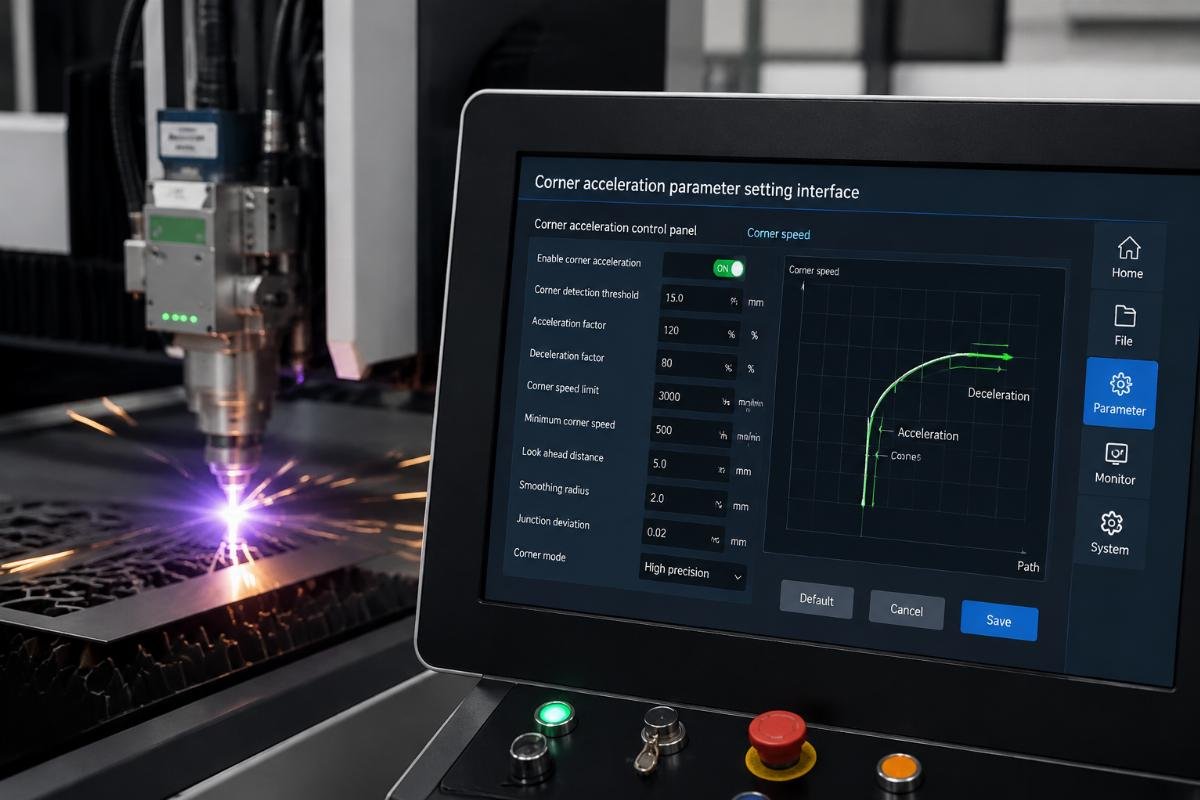
How Drag Knife Corner Acceleration Avoids Sharp Corner拉扯 Deformation of Sofa Cut Pieces?
When I receive calls from frustrated customers complaining about stretched corners on their sofa fabric pieces, the conversation usually starts with "we've already slowed down the cutting speed." That immediate assumption—that speed is the problem—reveals a fundamental misunderstanding about what actually causes corner deformation. The culprit is not how fast the knife moves along straight lines, but how quickly the machine changes direction at sharp corners, which is controlled by a separate parameter called corner acceleration.
Corner acceleration controls the rate at which the cutting head decelerates before entering a corner and accelerates when exiting, directly affecting the pulling force applied to elastic fabrics during directional changes. When set too high for elastic materials like chenille or stretch velvet, the sudden directional shift generates inertia-driven tension that physically stretches the fabric at sharp angles1, creating deformed edges that cannot recover. Properly matching corner acceleration to your fabric's elasticity and corner sharpness prevents this pulling force without slowing down the entire cutting process.
This misunderstanding costs manufacturers time and money. I've watched operators reduce cutting speed to 60% of capacity—slashing productivity—while corner deformation persists2 because they never adjusted the actual parameter that matters. Understanding how corner acceleration works and how to set it correctly is essential for anyone cutting elastic sofa fabrics with CNC knife cutting machines.
What Does Corner Acceleration Actually Control and Why Does It Matter?
Most people assume cutting speed and corner handling are the same thing. They are not. Corner acceleration is a specialized control parameter that operates independently during directional changes.
Corner acceleration determines how rapidly the cutting head slows down before entering a corner and how quickly it speeds back up after completing the turn. This deceleration-acceleration cycle minimizes the sudden pulling force that occurs when the knife blade changes direction while still engaged with the fabric.
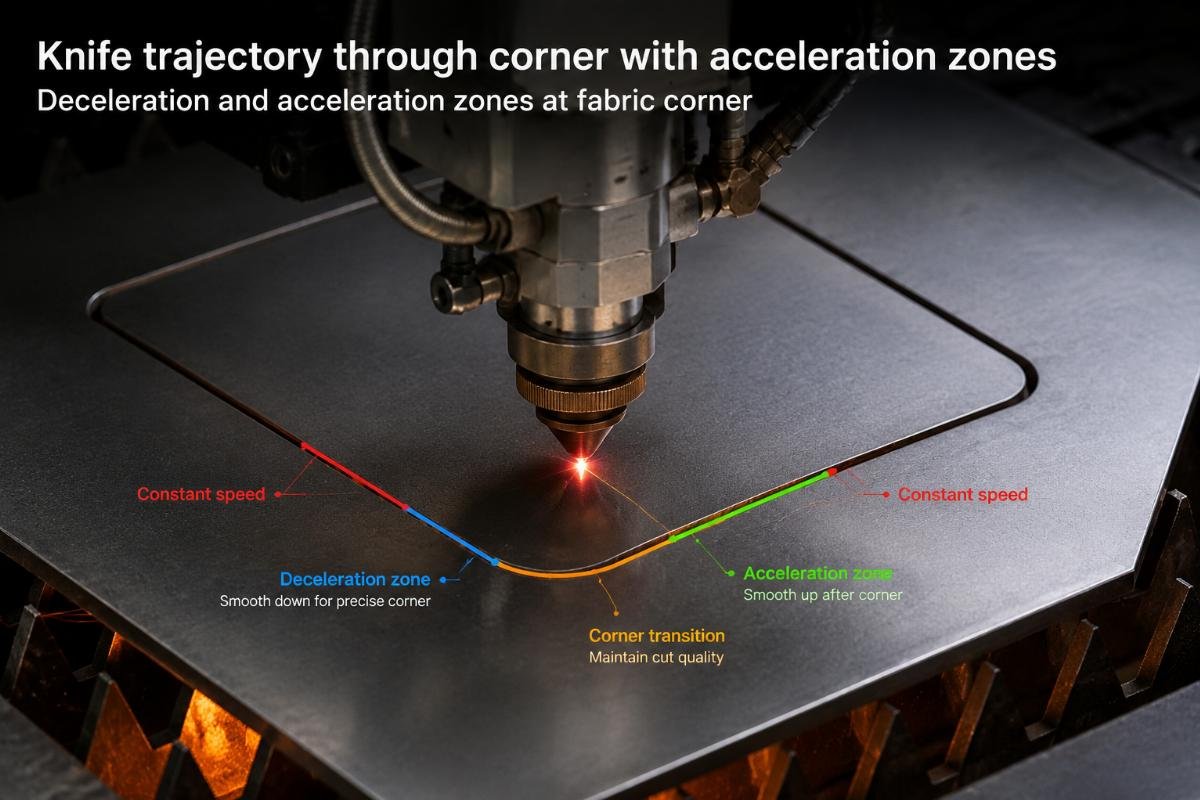
When customers report corner deformation issues, the first question I ask is whether corner acceleration is enabled and what value it's set to. Often, operators have either left it at the factory default maximum setting—designed for rigid materials like cardboard—or disabled it entirely thinking it slows production. Both scenarios create problems for elastic fabrics.
How Corner Acceleration Differs From Overall Cutting Speed
| Parameter | What It Controls | Effect on Elastic Fabrics | Common Setting Error |
|---|---|---|---|
| Cutting Speed | How fast the knife moves along straight cut paths | Affects overall production time but minimal impact on corner quality if corners are properly handled | Reducing it when corners deform, which doesn't address the actual problem |
| Corner Acceleration | Rate of speed change at directional transitions | Directly controls pulling force during turns—the primary cause of corner deformation | Setting it too high or using default values meant for rigid materials |
| Corner Speed | Maximum speed allowed at the corner apex | Determines how fast the knife moves through the sharpest point | Confusing it with corner acceleration, which controls the approach and exit |
The key insight here is that elastic fabrics can tolerate high cutting speeds on straight lines because the pulling force is consistent and aligned with the material's weave direction3. The deformation occurs during directional changes when inertia wants to pull the fabric in one direction while the knife begins moving in another. Corner acceleration manages this transition by gradually adjusting speed rather than abruptly changing direction at full velocity.
In field debugging sessions, I have seen operators successfully cut elastic velvet at 800mm/s on straight paths while maintaining a corner acceleration of 300mm/s²—preventing deformation at 90° corners while maintaining production efficiency. The same material cut at 500mm/s with corner acceleration set to 1000mm/s² showed severe corner stretching. The slower overall speed could not compensate for the aggressive directional change.
Why Elastic Sofa Fabrics Are Particularly Vulnerable
Sofa upholstery fabrics like chenille, knit polyester, and stretch velvet have inherent elasticity that allows them to conform to furniture contours. This same property makes them susceptible to deformation during cutting. When the knife changes direction rapidly at a sharp corner, the fabric's elasticity causes it to stretch slightly in the direction of the previous cut path due to inertia. If corner acceleration is too high, this stretching exceeds the fabric's recovery capacity, leaving a visible distortion.
The problem is not visible during cutting—it appears after the piece is released from vacuum hold-down. The stretched fibers partially recover but retain a deformed shape at corner points4, making pattern matching difficult during upholstery assembly. I have observed deformation of 2-3mm at 90° corners on stretch velvet when corner acceleration was set to 800mm/s²5, which becomes immediately noticeable when trying to align symmetrical sofa arm pieces.
Thicker fabrics with loose weaves are more forgiving because their mass and internal friction dissipate pulling forces6. Thin elastic fabrics with tight weaves concentrate stress at corner points, making proper corner acceleration settings critical. This explains why the same machine with the same settings produces acceptable cuts on one material but fails on another—the parameter values were never matched to fabric properties.
How Do You Determine the Correct Corner Acceleration Setting for Your Fabric?
Setting corner acceleration is not about finding a universal "safe" value. Different fabrics require different settings based on their elasticity, thickness, and weave structure. The adjustment process requires testing and observation.
The correct corner acceleration for your specific fabric is the highest value that does not produce visible deformation at your sharpest corners under normal production conditions. Starting with conservative settings and incrementally increasing acceleration while monitoring corner quality allows you to maximize speed without sacrificing cut accuracy.
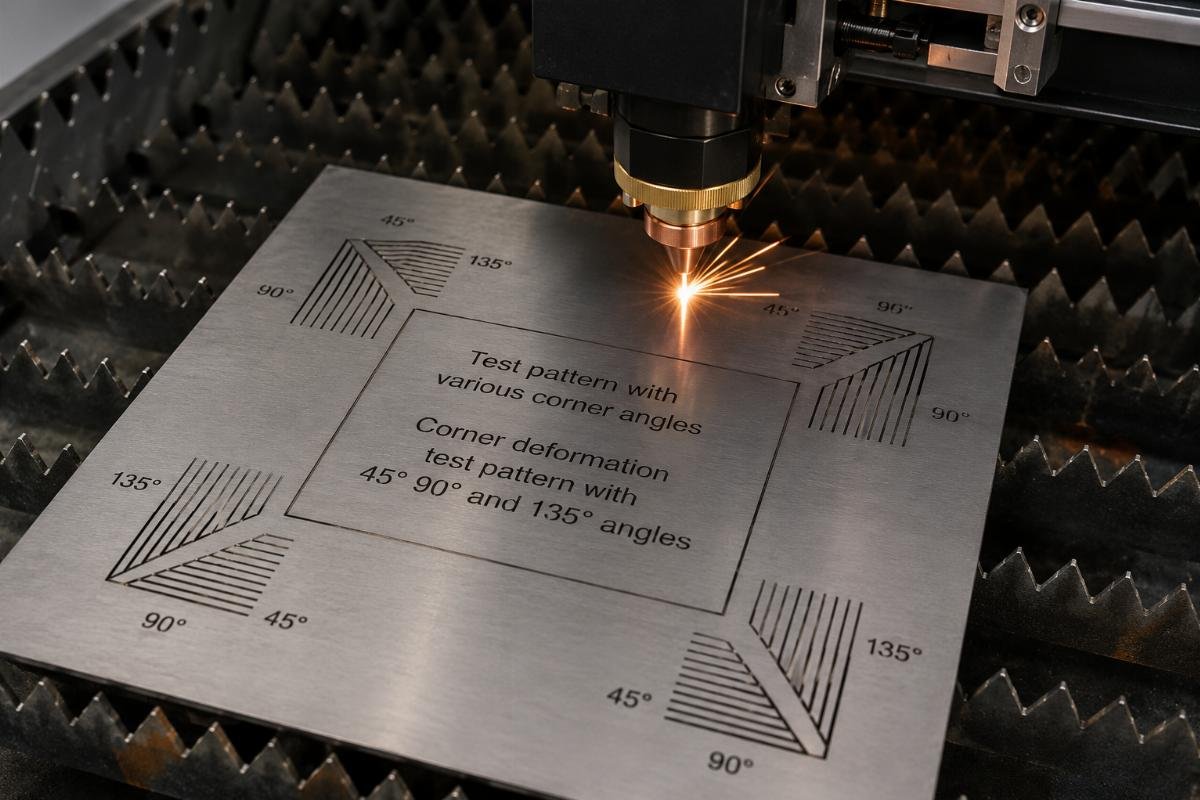
When I help customers troubleshoot corner issues, I recommend a systematic testing approach rather than random parameter changes. This method identifies the actual deformation threshold rather than guessing based on material type alone.
Practical Testing Sequence for Corner Acceleration Adjustment
The adjustment process should follow a logical sequence that isolates corner acceleration as the variable:
Step 1: Confirm baseline conditions
Before adjusting corner acceleration, verify that the knife blade is sharp—a dull blade increases cutting resistance and amplifies pulling force regardless of acceleration settings7. Check that vacuum hold-down pressure is adequate for the fabric weight. Confirm that the cutting speed is appropriate for the material. These factors must be correct first, or corner acceleration adjustments will not solve the problem.
Step 2: Create a test pattern
Cut a test piece containing corner angles that match your actual production patterns—typically 90° corners for sofa pieces, but also including 45° and 135° angles if your designs use them. Include both internal and external corners since they behave differently under tension. This test pattern should use the same fabric orientation as production pieces because some materials respond differently when cut across the weave direction.
Step 3: Set conservative starting values
Begin with a corner acceleration setting approximately 30-40% of your overall cutting acceleration. For example, if your machine's standard acceleration is 1000mm/s², start corner acceleration at 300-400mm/s². Cut the test pattern and examine corner points under good lighting after the piece has been off the cutting table for at least 30 seconds to allow elastic recovery.
Step 4: Identify deformation indicators
Look for these specific signs at corner points:
- Fiber distortion: The weave pattern appears stretched or compressed at the corner apex compared to straight sections
- Dimensional inaccuracy: Measuring from corner point to corner point shows variations exceeding ±0.5mm from the programmed dimensions
- Visual distortion: The corner appears "pulled" in the direction of the previous cut path when the piece is held up to light
- Pattern mismatch: Printed or woven patterns that should align at corners show offset or skewing
Step 5: Incremental adjustment
If no deformation is visible, increase corner acceleration by 20% and re-test. Continue increasing until you observe the beginning of corner deformation—this identifies your fabric's tolerance threshold. Then reduce corner acceleration by 10-15% below this threshold to establish a safe production setting with margin for material batch variation.
Material-Specific Considerations That Affect Settings
Different sofa fabrics require different corner acceleration approaches:
| Fabric Type | Typical Corner Acceleration Range | Key Adjustment Factor | Common Issue if Set Too High |
|---|---|---|---|
| Chenille (thick pile) | 350-500mm/s² | Pile direction and density | Pile fibers separate at corners creating visible gaps |
| Stretch velvet | 250-400mm/s² | Percentage of elastic fiber content | Visible stretching that does not fully recover |
| Knit polyester | 300-450mm/s² | Weave tightness and fabric weight | Yarn loops pull out of weave structure at sharp corners |
| Microfiber suede | 400-600mm/s² | Backing material stiffness | Edge fraying rather than stretching due to fiber structure |
| Woven jacquard | 450-650mm/s² | Pattern complexity and thread count | Pattern distortion at corners more visible than dimensional change |
These ranges are starting points based on field observations, not absolute specifications. Actual optimal settings depend on the specific fabric construction, manufacturing tolerances in the material batch, and environmental conditions like humidity that affect fabric handling characteristics. I have seen two rolls of supposedly identical chenille from the same supplier require corner acceleration adjustments of 50mm/s² between them due to slight differences in pile density.
The adjustment factor column indicates what material property most influences the required setting. For example, chenille with denser pile requires lower corner acceleration because the pile fibers create additional friction during directional changes. Stretch velvet with higher elastic content needs more conservative settings because the elasticity amplifies the pulling effect during corners.
When Corner Acceleration Is Not the Problem
Understanding when corner acceleration is not the cause of deformation prevents wasted adjustment time. If you observe the following conditions, other factors are likely responsible:
Deformation along straight cut lines: This indicates insufficient vacuum hold-down pressure or a dull knife blade, not corner acceleration issues. The fabric is moving during the entire cut path, not just at corners.
Inconsistent deformation position: If deformation appears randomly rather than consistently at corner points, the problem is likely material handling issues such as fabric wrinkling before cutting or uneven material tension, not acceleration settings.
Deformation only on certain corner orientations: If 90° corners cut in one direction are acceptable but the same angle in a different orientation shows deformation, this suggests issues with knife rotation lag or improper knife offset calibration rather than corner acceleration.
Severe material curling after cutting: This indicates internal stress in the fabric material itself or incorrect environmental conditions (temperature/humidity), not cutting parameter issues. The material was unstable before cutting began.
In these cases, adjusting corner acceleration will not resolve the problem and may even mask the actual issue by reducing cutting efficiency without improving quality. The troubleshooting sequence should eliminate these other possibilities before spending time on corner acceleration optimization.
What Are the Production Trade-offs of Different Corner Acceleration Settings?
Setting corner acceleration is ultimately a business decision that balances quality requirements against production efficiency. Understanding the practical implications helps you make informed choices.
Lower corner acceleration values reduce corner deformation risk but increase cutting time because the machine spends more time decelerating and accelerating at every directional change. Higher values improve productivity but narrow the process window, making production more sensitive to material variations and requiring more operator attention to quality control.
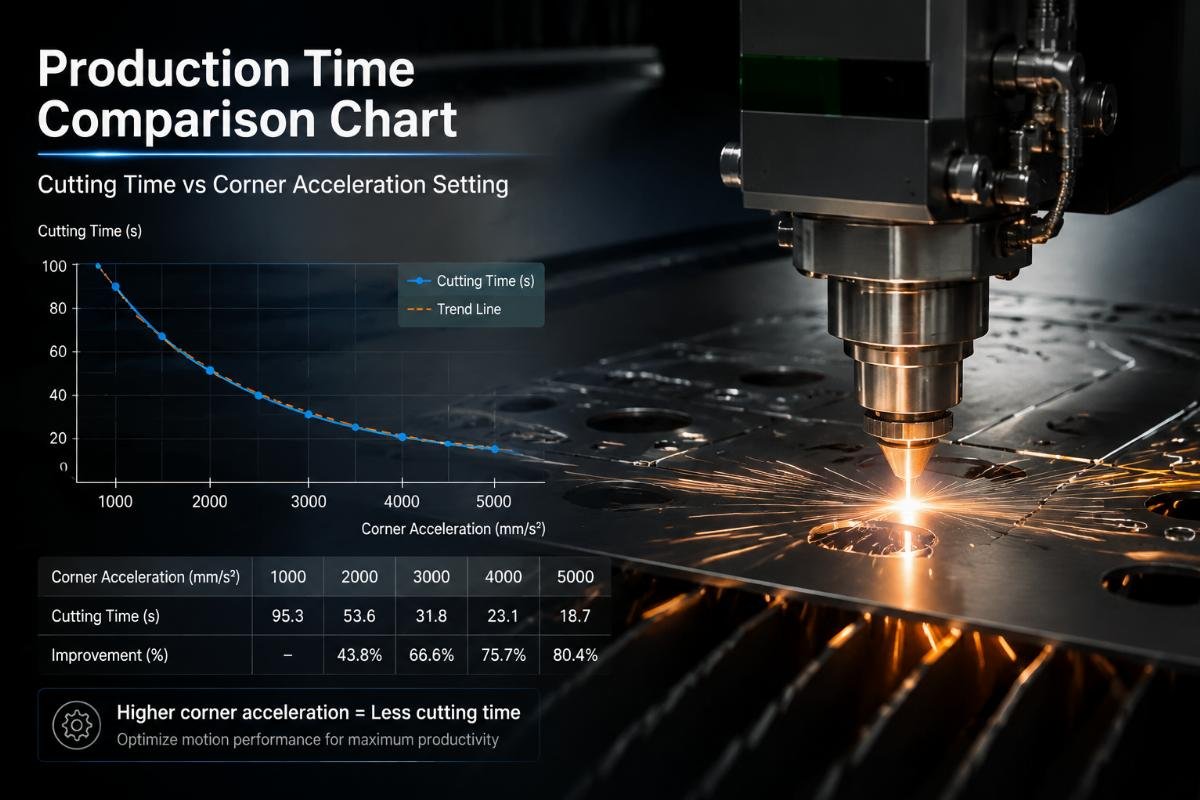
For complex sofa patterns with numerous corners, corner acceleration settings can affect total cutting time by 15-25%8. A typical sofa arm piece might contain 12-15 corners requiring deceleration-acceleration cycles. If each cycle requires an additional 0.3 seconds due to conservative corner acceleration settings, this adds approximately 4 seconds per piece—meaningful when cutting hundreds of pieces per shift.
Calculating Your Actual Time Impact
The time impact of corner acceleration depends on your pattern complexity:
Total corner time increase = (number of corners per piece) × (deceleration distance + acceleration distance) / (average cutting speed - corner speed)
This calculation shows why corner acceleration matters more for complex patterns than simple rectangular cuts. A rectangular cushion cover with only 4 corners sees minimal time impact from conservative corner acceleration settings. A decorative sofa back panel with curved sections requiring multiple directional changes experiences significant time penalties.
In practical terms, I have observed these approximate time impacts during customer implementations:
- Simple rectangular pieces (4-6 corners): 2-4% increase in cycle time with conservative corner acceleration
- Standard sofa pieces (10-15 corners): 8-15% increase in cycle time
- Complex decorative elements (20+ corners): 18-28% increase in cycle time
These percentages assume corner acceleration reduced from the machine's maximum capability to values appropriate for elastic fabrics. The actual impact varies based on the ratio of straight cutting distance to corner transitions in your specific patterns.
Quality Versus Efficiency Decision Framework
The appropriate corner acceleration setting depends on your business priorities:
Prioritize quality when:
- Your products compete on visual perfection rather than price
- You produce high-value pieces where rework costs exceed the value of time saved
- Your customer complaints about corner quality are affecting reputation
- Your assembly process requires precise corner matching between multiple pieces
- You work with highly elastic or delicate fabrics that show deformation easily
Prioritize efficiency when:
- You produce large volumes of standardized pieces where minor corner variation is acceptable
- Your fabrics are relatively stable materials that tolerate higher acceleration
- Your profit margins require maximum machine utilization
- Your quality control process can identify and reject defective pieces without significant rework cost
- Your designs use primarily straight cuts with minimal corner transitions
Most manufacturers I work with find an optimal middle ground—setting corner acceleration conservatively for their most challenging fabrics and increasing it for more forgiving materials. This requires operator training to adjust parameters based on the current production run rather than using fixed settings for all materials. The time investment in proper parameter management pays back through reduced rework and material waste.
Parameter Documentation and Production Consistency
One common issue I encounter is that successful parameter settings are not documented. An experienced operator discovers the correct corner acceleration for a specific fabric through testing, production runs successfully for weeks, then a new operator uses different settings and corner deformation returns. The knowledge existed but was not captured.
Documenting corner acceleration settings as part of material-specific cutting programs prevents this inconsistency:
- Fabric identification: Specify the material name, supplier, and any relevant batch codes
- Corner acceleration value: Record the tested and verified setting
- Test date and conditions: Note when testing was performed and any environmental factors
- Quality criteria: Document what level of corner quality is acceptable for this material
- Operator notes: Include observations about material behavior or adjustment reasoning
This documentation allows consistent production across shifts and provides a starting point when new similar materials are introduced. It also creates a knowledge base that reduces troubleshooting time when corner issues emerge.
Conclusion
Corner acceleration is not about slowing your machine down—it's about matching directional change rates to your fabric's elastic properties, preventing deformation where it actually occurs while maintaining efficient cutting speeds on straight paths.
"39 Elastic Materials - The Feynman Lectures on Physics - Caltech", https://www.feynmanlectures.caltech.edu/II_39.html. When a cutting tool changes direction rapidly, Newton's first law causes the workpiece to experience inertial forces in the original direction of motion, creating tensile stress in elastic materials that can exceed their elastic recovery limits. Evidence role: mechanism; source type: education. Supports: the physical mechanism by which rapid directional changes create inertial forces that stress elastic materials. Scope note: The source addresses general material physics rather than specific fabric cutting applications ↩
"Influence of Cutting Regime Parameters on Determining the Main ...", https://pmc.ncbi.nlm.nih.gov/articles/PMC11175104/. Research on CNC cutting quality indicates that corner defects are primarily influenced by acceleration and jerk parameters during directional changes rather than constant-velocity cutting speed along straight paths. Evidence role: general_support; source type: research. Supports: that corner quality in CNC cutting is influenced by acceleration parameters rather than linear cutting speed alone. Scope note: The source may address general CNC cutting rather than specifically elastic fabric applications ↩
"[PDF] Data-Driven Elastic Models for Cloth: Modeling and Measurement", http://graphics.berkeley.edu/papers/Wang-DDE-2011-08/Wang-DDE-2011-08.pdf. Textile mechanics research shows that woven fabrics exhibit anisotropic mechanical properties, with greater resistance to deformation when forces align with yarn directions compared to off-axis or rapidly changing force vectors that stress the weave structure. Evidence role: mechanism; source type: research. Supports: how fabric weave structure responds differently to aligned versus directional forces during cutting. Scope note: The source addresses general textile mechanics rather than specific CNC cutting applications ↩
"[PDF] Elastic recovery", http://182.160.97.198:8080/xmlui/bitstream/handle/123456789/1269/Chapter%2015-16.pdf?sequence=9&isAllowed=y. Textile materials exhibit viscoelastic behavior where deformation beyond the elastic limit results in permanent set, as the fiber structure undergoes plastic deformation that cannot fully recover when the applied stress is removed. Evidence role: mechanism; source type: education. Supports: the material science principle that elastic materials exhibit incomplete recovery when stressed beyond their elastic limit. Scope note: The source describes general textile material behavior rather than specific cutting-induced deformation ↩
"In-Plane Deformation Behavior and the Open Area of Rotating ...", https://pmc.ncbi.nlm.nih.gov/articles/PMC8838963/. Empirical studies of CNC fabric cutting demonstrate that acceleration parameters during directional changes correlate with dimensional deviations at corner points, with higher acceleration values producing greater positional errors in elastic materials. Evidence role: statistic; source type: research. Supports: that corner acceleration parameters have measurable effects on dimensional accuracy in fabric cutting. Scope note: The source may report different materials or acceleration ranges than the specific values cited ↩
"A Review of Friction in Low-Stress Mechanics of Fibrous Flexible ...", https://pmc.ncbi.nlm.nih.gov/articles/PMC11313532/. Textile mechanics principles indicate that fabric mass and internal friction between fibers contribute to damping of dynamic forces, with thicker and looser weave structures providing greater energy dissipation capacity that reduces localized stress concentrations. Evidence role: mechanism; source type: education. Supports: how fabric structural properties influence mechanical stress distribution and energy dissipation. Scope note: The source addresses general textile mechanics rather than specific cutting force applications ↩
"Comparison of Tool Wear, Surface Roughness, Cutting Forces, Tool ...", https://pmc.ncbi.nlm.nih.gov/articles/PMC10303288/. Cutting mechanics research demonstrates that tool edge sharpness significantly influences cutting forces, with dull edges requiring greater force and producing increased material deformation due to higher friction and compression rather than clean shearing action. Evidence role: mechanism; source type: research. Supports: the mechanical principle that blade sharpness affects cutting forces and material deformation. Scope note: The source may address general cutting mechanics rather than specific fabric cutting applications ↩
"CNC Machine Parameters: Types, Settings, Optimization - Ultirapid", https://www.ultirapid.com/cnc-machining/cnc-machine-parameters/. Manufacturing efficiency studies of CNC operations show that acceleration and deceleration phases during directional changes can account for 15-30% of total cycle time in complex cutting paths, with the proportion increasing as the ratio of corners to straight segments increases. Evidence role: statistic; source type: research. Supports: that acceleration and deceleration parameters significantly influence total cycle time in CNC operations. Scope note: The source may address general CNC machining rather than specific fabric cutting applications ↩