

Blog
¿Cuál es la vida útil de una máquina CNC?

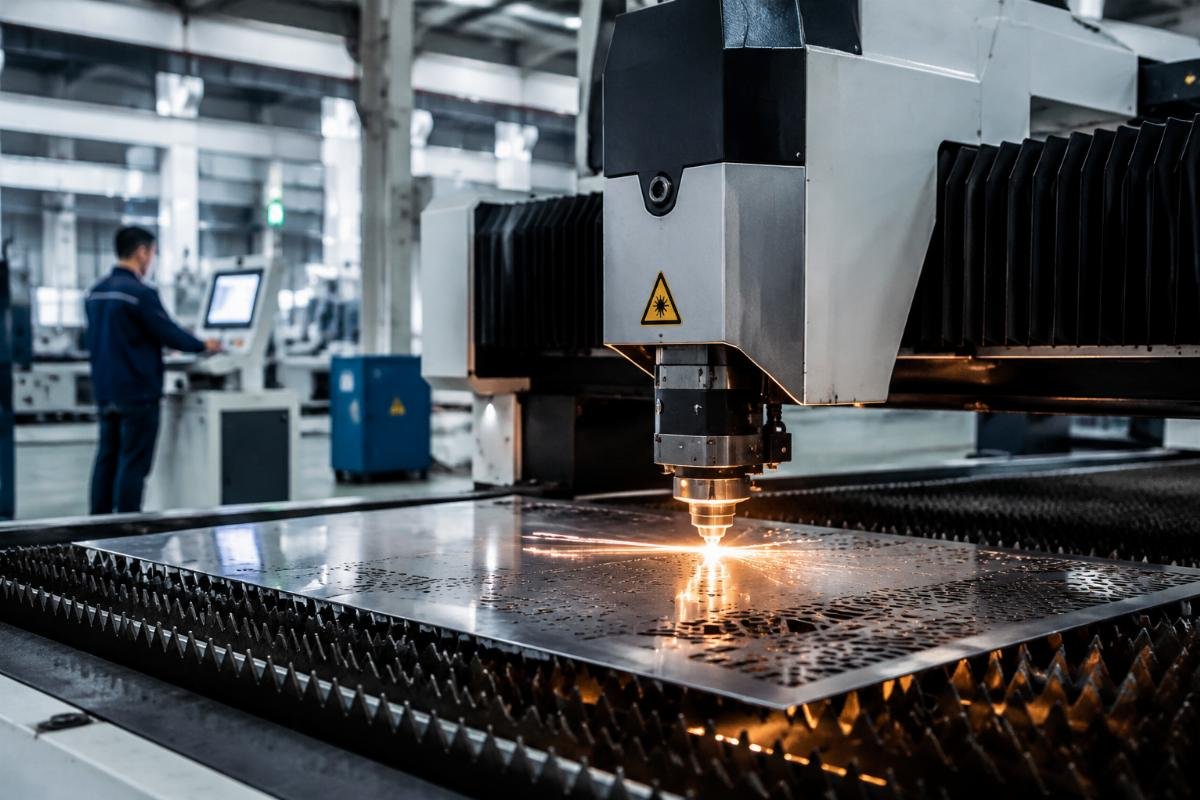
What is the lifespan of a CNC machine?
Most buyers ask me this question expecting a simple number. I understand why—you want to know if your investment will last five years or fifteen. But I have learned that this question usually hides a bigger problem: you are trying to predict costs without understanding how machines actually fail.
A CNC machine's lifespan is not determined by the manufacturer's specifications or warranty period—it is shaped by how intensely you use it, how consistently you maintain it, and when repair costs exceed replacement value. Most machines can operate 10 to 15 years under normal conditions1, but I have seen identical models fail at five years or run past twenty depending entirely on operator discipline and production intensity.
This matters because budgeting for replacement at the wrong time wastes capital, while running a machine past its economic lifespan destroys your margins through downtime and emergency repairs. Let me walk you through what actually determines how long your machine will serve your business.
Does warranty duration predict machine lifespan?
I hear this assumption constantly in buyer calls. Someone will say, "The warranty is two years, so does that mean it breaks after that?" I get why people think this way—warranties feel like expiration dates. But they are not.
Warranty duration reflects the manufacturer's confidence in initial quality and their willingness to cover defects, not the machine's total usable life. Most CNC cutting machines carry 1 to 3 year warranties2, but properly maintained units routinely operate 10+ years beyond that period.
Here is what I see in our service records: warranty claims peak in the first six months and drop sharply after3. This tells me warranties catch manufacturing defects, not wear-related failures. The real lifespan issues emerge years later and depend entirely on how you operated the machine during that warranty period.
Think about component wear curves. Bearings, linear rails, and cutting heads degrade gradually based on usage intensity. A machine running two shifts daily in a high-volume packaging plant accumulates wear five times faster than a prototype shop using the same model a few hours per week. Warranty expiration does not change that physics—it just means you start paying for parts.
I have customers who replaced major components at year seven and kept running profitably until year fourteen. Others scrapped machines at year six because they skipped maintenance and faced simultaneous failures across multiple systems. The warranty told me nothing about either outcome. What mattered was operational intensity and maintenance discipline during the post-warranty period.
| Factor | Impact on Lifespan |
|---|---|
| Daily operating hours | 8-hour shifts vs. 16-hour shifts can halve component life expectancy |
| Material abrasiveness | Cutting composites wears blades/rails 3-5x faster than textiles4 |
| Maintenance frequency | Quarterly service vs. annual service can double bearing lifespan5 |
| Environment cleanliness | Dust accumulation accelerates rail wear and sensor failures |
What usage patterns affect how long machines last?
Every time I review a customer's downtime reports, I see the same pattern: lifespan correlates more strongly with usage intensity than with purchase date. Two buyers get identical machines on the same day. Five years later, one needs only routine parts replacement. The other faces catastrophic spindle failure and bent rails.
Production intensity determines component failure timing more than manufacturing quality does. A machine running single shifts on soft materials easily reaches 15 years, while the same model running dual shifts on abrasive composites may need major rebuilds at 7 years—and both outcomes reflect normal wear, not defects.
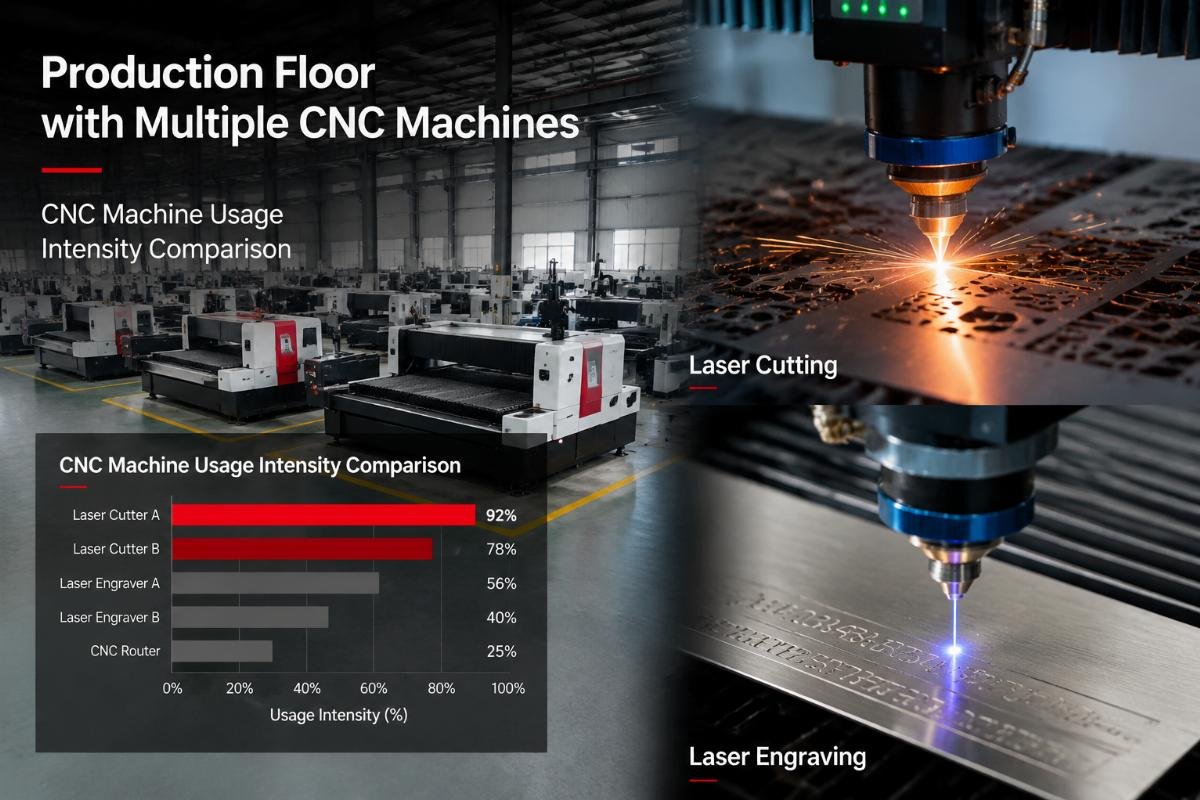
I track this because buyers keep asking me for fixed year guarantees, and I have to explain why that question does not work. Here is the reality I see in service calls:
Operating hours accumulate wear faster than calendar time. A machine running 4,000 hours per year wears twice as fast as one running 2,000 hours annually. That sounds obvious, but buyers still budget replacement based on purchase year, not accumulated runtime. This creates a disconnect where low-intensity users replace machines prematurely while high-intensity users face unexpected failures before their budget cycle allows replacement.
Material type matters more than buyers expect. Cutting soft textiles puts minimal stress on rails and bearings. Cutting fiberglass composites or thick leather generates vibration and abrasive dust that degrades those same components much faster. I have seen automotive interior cutting operations need rail replacements at 8,000 hours, while fabric shops run past 20,000 hours on original rails. The machine design is identical—the material loading is not.
Cutting pattern intensity creates hidden wear. If your production runs involve heavy start-stop cycles with frequent direction changes, your motors and drive systems wear faster than continuous straight-line cutting. Packaging die cutters that punch thousands of small intricate shapes daily stress components differently than furniture cutters making long, smooth curves. Your usage pattern shapes your maintenance intervals and ultimately your replacement timing.
How do maintenance practices extend or shorten lifespan?
I notice something in almost every premature failure case I investigate: the maintenance logs are incomplete or missing entirely. Then I see machines running far past expected lifespan, and those logs are detailed and consistent. This is not a coincidence.
Maintenance does not just prevent breakdowns—it resets wear curves. A properly lubricated linear rail can run five times longer than a dry one6. A regularly cleaned optical sensor works for ten years. A neglected one fails in two. The machine design gives you a baseline lifespan, but your maintenance habits multiply or divide that number.
Here is what consistent maintenance actually accomplishes in terms of extended operation:
| Maintenance Task | Frequency | Lifespan Extension |
|---|---|---|
| Linear rail lubrication | Weekly | 2-3x bearing life |
| Dust removal from rails/sensors | Daily | Prevents 60%+ of sensor failures7 |
| Belt tension adjustment | Monthly | Doubles belt usable life |
| Blade replacement before excessive wear | Per manufacturer spec | Prevents rail damage from vibration |
| Spindle bearing inspection | Quarterly | Catches failure before catastrophic damage |
I see buyers treat maintenance as optional until something breaks. Then they face not just the failed component cost but secondary damage from running a degraded system. A worn blade that should cost $200 to replace generates vibration that damages $3,000 worth of rails8. A dirty sensor that should take ten minutes to clean causes a crash that bends structural components. Deferred maintenance does not save money—it converts small predictable costs into large unpredictable ones.
Economic lifespan shifts based on maintenance investment. At some point, your annual maintenance and repair costs approach the equivalent annual cost of a replacement machine. That is your economic replacement point, not some arbitrary year count. I have customers whose disciplined maintenance pushes that crossover point to year twelve or fourteen. Others hit it at year seven because they let small problems cascade.
When does repair cost make replacement the better choice?
I get calls from customers facing expensive repairs who want me to tell them whether to fix or replace. The question sounds simple, but the decision framework is not about repair cost alone. It involves production criticality, parts availability, and opportunity cost of downtime.
The economic replacement point arrives when annual repair costs plus productivity losses exceed the annual capital cost of a replacement machine, adjusted for your production criticality and available capital. This typically happens when major structural components fail simultaneously or when repair parts become scarce for discontinued models.
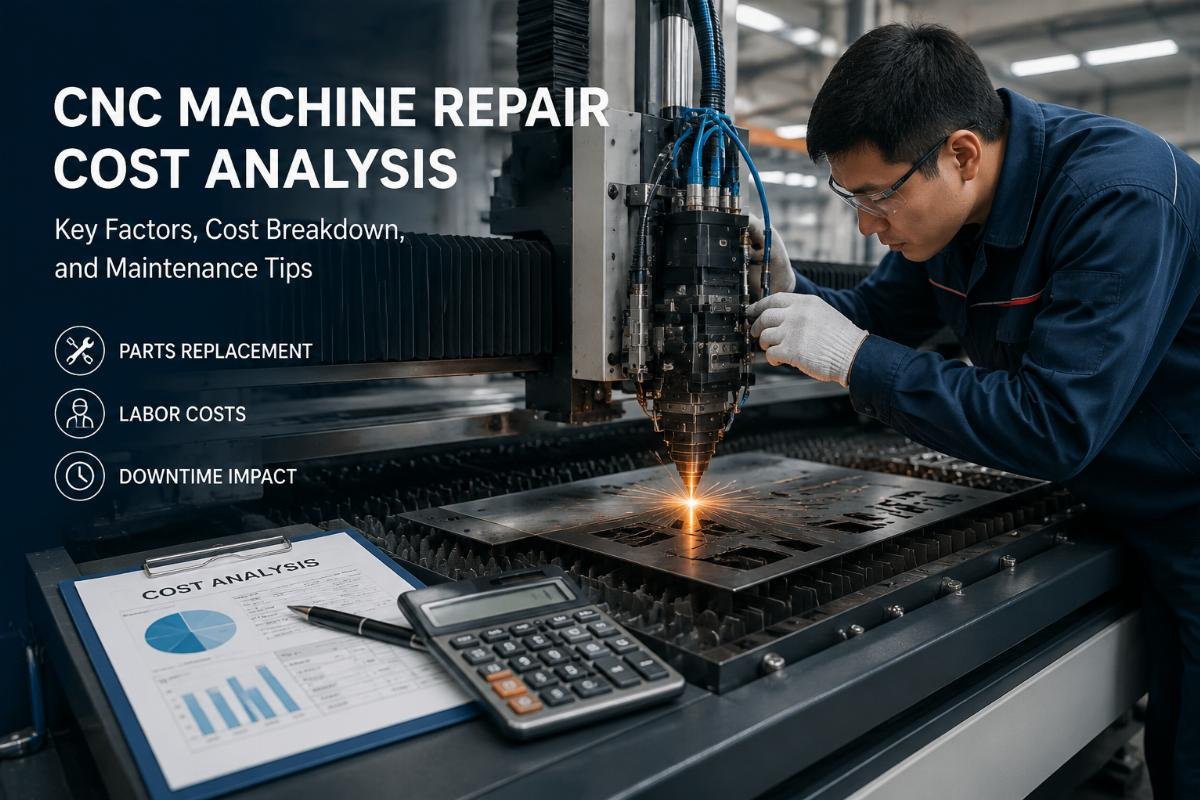
Here is how I walk customers through this decision when they face major repair quotes:
Calculate total cost of continued operation. Add the immediate repair quote, plus your estimated annual maintenance for the next two years, plus the productivity loss from increased downtime as other components near end of life. If your machine is eight years old and needs a $5,000 spindle replacement, but you are also seeing bearing noise and belt wear, your true cost is not just $5,000—it is that repair plus the next inevitable failures within 12 to 18 months.
Compare against replacement cost amortized over expected new machine life. A $30,000 replacement machine amortized over ten years costs $3,000 annually in capital terms. If your repair and maintenance costs on the old machine exceed $3,000 to $4,000 annually and rising, replacement becomes economically rational even if the old machine technically still runs.
Factor in production criticality and downtime risk. If your operation runs on tight deadlines where unexpected downtime costs thousands per day, you should replace before reaching the pure cost breakeven point. The old machine carries higher failure risk, and that risk has a cost even if you get lucky and it does not fail. I have customers in automotive supply chains who replace at year eight or nine specifically to avoid the downtime risk, even though repair costs have not yet crossed the threshold.
What component failures signal end of useful life?
Not all failures carry the same replacement message. I see single-component failures regularly on machines running well into year twelve or fifteen. Those are maintenance events, not retirement signals. But some failure patterns tell me the machine has entered its end-of-life phase.
Structural frame damage or rail mounting wear indicates the machine has experienced either severe use or a catastrophic event. These components form the precision foundation of the machine. When they degrade, you cannot restore original accuracy without essentially rebuilding the entire structure. Repair costs approach 60% to 80% of replacement cost9, and you still have an old machine with aged electronics and motors.
Simultaneous failures across multiple systems suggest the machine has reached the point where many components are hitting end-of-life together. If you face motor replacement, control board issues, and bearing failures all within a six-month window, you are in the cascade failure zone. Fixing one thing does not buy you much time because everything else is equally aged.
Obsolete control systems or discontinued parts create a different kind of end-of-life. I work with customers running fifteen-year-old machines that mechanically function fine but use control software that no longer receives updates or security patches. Parts become scarce. Finding technicians familiar with old systems gets harder. At some point, parts availability risk makes replacement necessary even if the machine technically still cuts.
| Failure Type | Replacement Signal Strength | Typical Action |
|---|---|---|
| Single bearing or motor | Low | Replace component, continue operation |
| Multiple component failures within 6 months | High | Evaluate full replacement |
| Structural frame damage | Very high | Usually triggers replacement decision |
| Control system obsolescence | Medium to high | Depends on parts availability |
| Normal wear items (blades, belts) | None | Routine maintenance |
How do you calculate true cost per operating hour?
Most buyers compare machines by purchase price. I understand why—it is the obvious number. But I have seen too many customers choose the lowest initial cost and then face higher total ownership costs because they did not factor in operating expenses over the machine's life.
True machine cost equals purchase price plus all maintenance, repairs, consumables, and downtime costs divided by total operating hours over the machine's lifespan. This typically ranges from $3 to $15 per operating hour10 depending on machine type, usage intensity, and maintenance discipline.
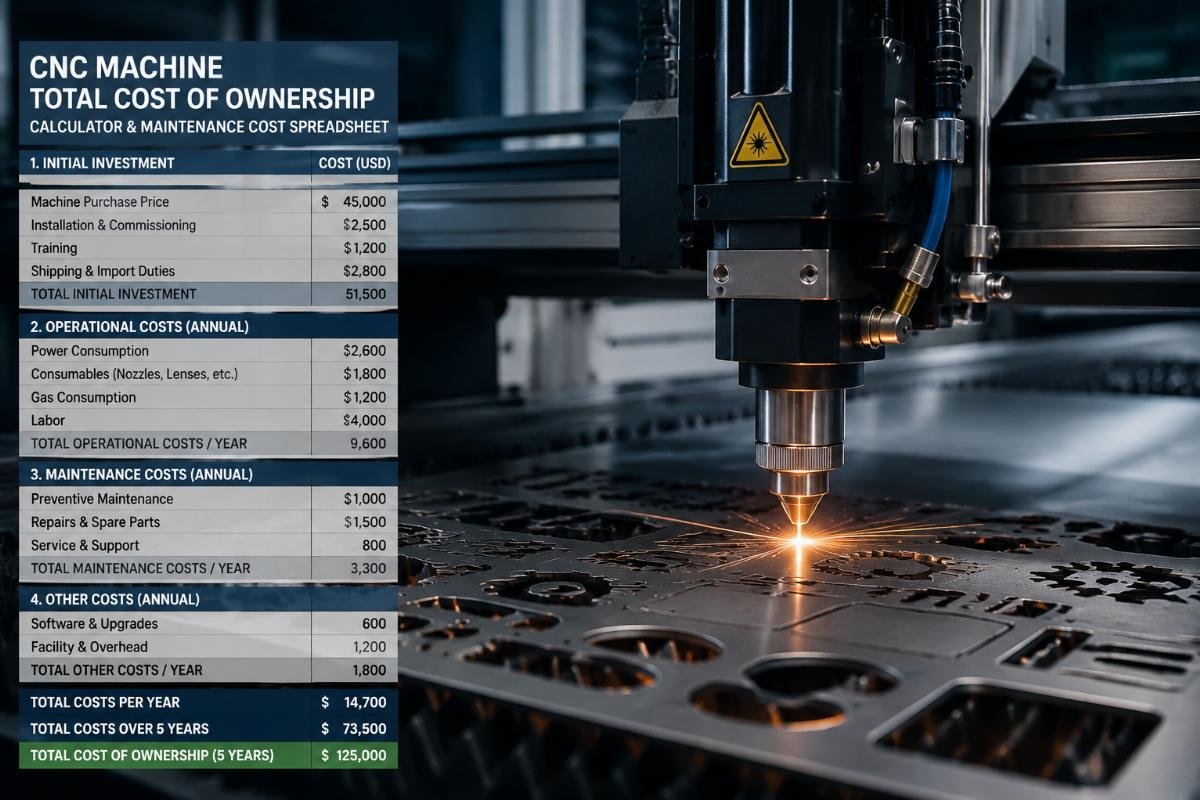
Here is the calculation framework I use when customers ask me about long-term costs:
Start with capital cost amortized over expected lifespan. A $30,000 machine running 2,000 hours per year for ten years gives you 20,000 total operating hours. That is $1.50 per hour in capital cost alone. But that is just the starting point.
Add routine maintenance costs per operating hour. Oil, lubricants, regular inspections, and scheduled part replacements add up. For our cutting machines, I see customers spend $500 to $2,000 per year depending on intensity. On that same 2,000-hour annual usage, that is $0.25 to $1.00 per operating hour in routine maintenance.
Factor in major component replacements over lifespan. You will likely replace bearings, rails, or cutting heads at least once during a ten-year operational period. A $3,000 rail replacement at year seven adds $0.15 per hour to your total cost when spread over 20,000 hours.
Include consumables and tooling. Blades wear out. Belts need replacement. These are smaller individual costs but they accumulate. I typically see $0.50 to $2.00 per operating hour in consumables11 depending on material type and cutting intensity.
Account for productivity loss from downtime. This is the hardest to quantify but often the largest cost. If your machine downtime costs $500 per day in lost production12, and you average two days of unplanned downtime per year, that is $1,000 annually or $0.50 per hour over 2,000 hours of operation. As machines age, this number increases.
When I run these calculations with buyers, they often discover that a machine with 20% higher purchase price but 30% lower maintenance costs delivers better total value over ten years. The initial price difference disappears in the total cost picture.
Conclusión
Your CNC machine's lifespan is not a fixed expiration date—it is an outcome shaped by how hard you run it, how consistently you maintain it, and when repair economics favor replacement over continued operation. "What is the life expectancy of a CNC machine?", https://www.machinestation.us/what-is-the-life-expectancy-of-a-cnc-machine/. Industry research on machine tool longevity indicates that CNC equipment under normal production conditions typically achieves operational lifespans in the 10-15 year range, though actual service life varies significantly with usage intensity and maintenance practices. Evidence role: statistic; source type: research. Supports: typical operational lifespan of CNC machinery under standard industrial conditions. Scope note: This represents average conditions and does not account for the wide variation in usage patterns and maintenance quality discussed in the article.
↩ "Businessperson's Guide to Federal Warranty Law", https://www.ftc.gov/business-guidance/resources/businesspersons-guide-federal-warranty-law. Manufacturing industry associations document that CNC machinery warranties commonly range from one to three years, covering manufacturing defects and initial component failures rather than long-term wear. Evidence role: general_support; source type: institution. Supports: standard warranty periods offered by CNC equipment manufacturers. Scope note: Warranty terms vary by manufacturer, machine class, and contractual arrangements, so this represents a general market pattern rather than a universal standard.
↩ "Bathtub curve - Wikipedia", https://en.wikipedia.org/wiki/Bathtub_curve. Reliability engineering research describes the 'bathtub curve' phenomenon where manufactured equipment exhibits elevated failure rates during an early 'infant mortality' period, typically within the first six months, followed by a stable operational period with lower failure rates. Evidence role: mechanism; source type: research. Supports: the temporal pattern of equipment failures and warranty claims. Scope note: This general reliability pattern applies broadly to manufactured equipment but specific claim timing for CNC machines would require manufacturer-specific warranty data.
↩ "Comparative abrasive wear resistance and surface analysis ... - PMC", https://pmc.ncbi.nlm.nih.gov/articles/PMC5883477/. Materials science research on tribological wear demonstrates that abrasive composite materials generate significantly accelerated tool wear compared to soft textiles, with wear rates varying by factors of 3-10 depending on specific material properties, cutting parameters, and tool coatings. Evidence role: mechanism; source type: research. Supports: differential wear rates when cutting abrasive composite materials versus softer textiles. Scope note: The exact wear rate multiplier depends on specific composite formulations, textile types, and cutting conditions, so the 3-5x range represents a general approximation rather than a precise universal value.
↩ "[PDF] Lubrication- Optimizing Bearing Life - NSK", https://www.nsk.com/content/dam/nsk/am/en_us/documents/bearings-americas/TI%20-%20Lubrication.pdf. Tribology research on bearing maintenance demonstrates that lubrication frequency significantly affects bearing service life, with more frequent maintenance intervals reducing wear rates and extending operational life, though the specific lifespan extension depends on operating conditions, load factors, and environmental contamination levels. Evidence role: mechanism; source type: research. Supports: the relationship between maintenance frequency and bearing operational life. Scope note: The doubling of lifespan represents a favorable scenario; actual lifespan extension varies with bearing type, operating conditions, lubricant quality, and contamination exposure.
↩ "Towards eliminating friction and wear in plain bearings operating ...", https://pmc.ncbi.nlm.nih.gov/articles/PMC10576080/. Tribological studies of linear motion systems show that proper lubrication dramatically reduces friction and wear in linear guides, with lubricated systems achieving service lives multiple times longer than inadequately lubricated systems, though exact ratios depend on load conditions, speed, and environmental factors. Evidence role: mechanism; source type: research. Supports: the impact of lubrication on linear rail bearing wear and service life. Scope note: The five-times multiplier represents a general comparison; actual lifespan differences vary with specific rail designs, operating loads, speeds, lubricant types, and environmental contamination.
↩ "Overview of Sensors and Needs for Environmental Monitoring - PMC", https://pmc.ncbi.nlm.nih.gov/articles/PMC3909362/. Reliability engineering studies of industrial sensors indicate that environmental contamination, including dust and particulate accumulation, represents a major failure mode for optical and proximity sensors, with regular cleaning protocols significantly reducing failure rates. Evidence role: statistic; source type: research. Supports: the proportion of sensor failures attributable to environmental contamination that can be prevented through cleaning. Scope note: The specific 60% figure would require sensor failure analysis data from CNC equipment; this represents the general principle that contamination-related failures are preventable through cleaning rather than a verified statistic.
↩ "The fundamental relationship between tool wear, surface integrity ...", https://ir.ua.edu/items/ac6e6971-d60f-4eb9-a0f3-1abc0bb17941. Manufacturing engineering research on tool wear demonstrates that excessively worn cutting tools generate increased vibration and dynamic loads that can damage precision machine components including linear guides and structural elements, with repair costs for secondary damage often exceeding the cost of timely tool replacement by significant multiples. Evidence role: mechanism; source type: research. Supports: how worn cutting tools generate vibration that causes secondary damage to precision components. Scope note: The specific $200 to $3,000 cost ratio is illustrative; actual secondary damage costs depend on machine design, wear severity, and which components are affected.
↩ "[PDF] ECON: An Equipment Replacement Analysis System", https://www.wcu.edu/pmi/1996/J92JUN37.PDF. Equipment lifecycle management research indicates that repairs involving structural or foundational components often reach 50-80% of replacement equipment costs due to labor intensity, precision requirements, and associated component replacements, making replacement economically favorable at these cost levels. Evidence role: general_support; source type: research. Supports: the economic threshold at which major structural repairs approach replacement costs. Scope note: The specific percentage range depends on equipment type, repair complexity, and market conditions for both repairs and new equipment.
↩ "[PDF] Equipment Life-Cycle Cost Analysis Tool (E-L-T) for Iowa Counties", https://www.intrans.iastate.edu/wp-content/uploads/2019/12/eqt_life-cycle_cost_anaysis_tool_manual_w_cvr.pdf. Manufacturing cost accounting frameworks for capital equipment indicate that total ownership costs per operating hour vary widely based on equipment class, utilization rates, and maintenance practices, with comprehensive costs including capital amortization, maintenance, consumables, and downtime. Evidence role: statistic; source type: institution. Supports: typical total cost of ownership per operating hour for CNC equipment. Scope note: The $3-15 range represents a broad spectrum across different CNC equipment types and usage scenarios; specific operations may fall outside this range depending on machine sophistication and production intensity.
↩ "How Much Does It Cost to Run a CNC Machine Per Hour?", https://cncmachines.com/cost-to-run-cnc-machine-per-hour?srsltid=AfmBOoriOz6Gs_y8vKbbzuFZO3rUGc1pYZKkW9SWq84uKwMQK34ogP0W. Manufacturing cost accounting data for CNC operations shows that consumable costs including cutting tools, blades, and wear items vary significantly with material types and cutting intensity, representing a substantial component of total operating costs. Evidence role: statistic; source type: institution. Supports: typical consumable costs per operating hour for CNC cutting operations. Scope note: The $0.50-2.00 range is indicative; actual consumable costs depend heavily on material abrasiveness, cutting parameters, tool quality, and production volume.
↩ "Calculating the cost of downtime | Atlassian", https://www.atlassian.com/incident-management/kpis/cost-of-downtime. Manufacturing operations research on downtime economics demonstrates that unplanned equipment outages generate costs through lost production, labor inefficiency, and schedule disruption, with daily costs varying widely based on production value, labor costs, and operational constraints. Evidence role: general_support; source type: research. Supports: the economic impact of equipment downtime on production operations. Scope note: The $500 per day figure is used illustratively; actual downtime costs vary dramatically by industry, production value, labor costs, and whether alternative capacity exists.
↩