

Blog
What tool is best for cutting thick cardboard?

What tool is best for cutting thick cardboard?
I've watched too many packaging shops buy the wrong cutting equipment because they asked the wrong question. They search "best tool for thick cardboard," order based on online reviews, then realize three months later their $15,000 laser cutter chars edges on coated board or their manual die press can't keep up with batch orders. The real problem? "Thick cardboard" means different things to different buyers, and "best tool" doesn't exist until you define three variables: your actual thickness range, your daily production volume, and your edge quality requirements.
There is no single best tool for cutting thick cardboard—the right equipment depends on whether you're cutting 3mm or 8mm material, whether you need 50 pieces per day or 5,000, and whether clean edges matter more than cutting speed. Manual rotary cutters work for prototyping thin board under 4mm, semi-automatic die cutters handle simple shapes at volume between 5-10mm, and CNC knife cutting machines dominate complex curves in the 3-6mm packaging sweet spot where laser charring and die setup costs don't make sense.
Most customers who contact us already wasted money on a tool that technically cuts their board but fails in actual production. I'll walk you through the real selection logic so you match equipment capability to your job requirements, not to generic "best of" rankings that ignore how your shop actually runs.
What thickness range actually counts as thick cardboard?
I ask every customer who inquires about "thick cardboard cutting" to send me their material samples. Half the time, what they call "thick" measures 2.5mm—regular E-flute corrugated1 that any rotary cutter handles. The other half sends 7mm triple-wall board2 and wonders why their desktop craft knife struggles. This confusion kills budgets because thickness determines equipment class, and equipment class drives cost by 10x increments.
Thick cardboard in industrial contexts means 3mm to 10mm3; anything below 3mm falls into standard cardboard that manual tools cut easily, while material above 10mm enters specialized heavy board territory requiring hydraulic die presses4 or industrial router systems that most small shops can't justify.
The 3-10mm range splits into three decision zones that don't overlap cleanly. Light thick cardboard from 3-5mm includes most packaging-grade corrugated and chipboard—this zone offers the most tool options because blade depth, motor torque, and vacuum hold-down requirements stay within consumer and light industrial equipment specs. Medium thick cardboard from 5-7mm covers display board, folding carton stock, and heavier corrugated where manual cutting becomes impractical but CNC automation isn't always necessary if you run simple shapes. Heavy thick cardboard from 7-10mm pushes into territory where only CNC knife systems with high-torque motors, die cutting presses with proper tonnage, or industrial routers maintain edge quality without excessive blade wear.
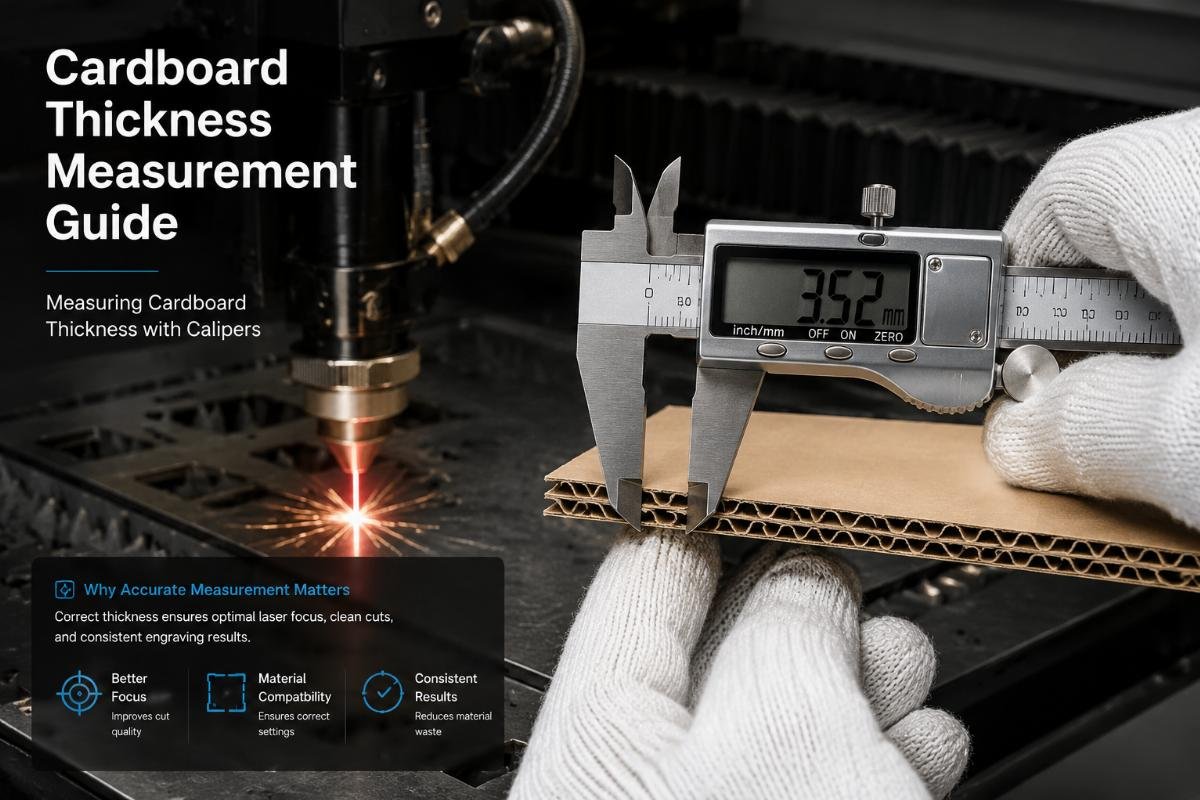
I've seen packaging plants specify "must cut 8mm board" in their RFQ, then ship us samples that measure 5.2mm. That 2.8mm difference changes whether they need a $25,000 CNC knife cutter or can get by with a $8,000 semi-auto platen press. Measure your actual material with calipers before you even start tool research—don't trust supplier descriptions like "heavy duty board" or "extra thick corrugated" because those terms carry no standard definition across regions or industries.
How thickness impacts tool selection across methods
| Thickness Range | Manual Rotary | Semi-Auto Die | CNC Knife | Laser Cutting | Router/Mill |
|---|---|---|---|---|---|
| 3-4mm | ✓ Works but slow | Overkill for volume | Ideal for curves | Clean but slow | Too aggressive |
| 5-6mm | ✗ Struggles | ✓ Good for simple shapes | ✓ Best overall | Edge charring risk | Works but noisy |
| 7-8mm | ✗ Can't cut clean | ✓ Need proper tonnage | ✓ High-power models | ✗ Burns coatings | ✓ Needs dust control |
| 9-10mm | ✗ No | ✓ Hydraulic press | ✗ Motor limits | ✗ No | ✓ With carbide bits |
The table shows why "best tool" questions fail—a manual rotary cutter that works perfectly for 3mm prototyping becomes useless at 7mm, while a CNC router that handles 10mm board creates excessive dust and noise for 4mm packaging work that a knife cutter does cleaner and faster.
Why do customers confuse cutting force with production capability?
A customer called us last month frustrated that their new semi-automatic die press "couldn't keep up" even though the manufacturer claimed it cuts 8mm board. I asked how many pieces they run daily. They said 800 sheets with 12 cutouts each. The press physically cuts their board fine—the problem is blade changes every 300 sheets, dust extraction clogs every 2 hours, and edge quality degrades halfway through the day. The tool has cutting force but lacks production readiness for their volume and quality tier.
Cutting force means the tool physically penetrates your material thickness; production readiness means it maintains edge quality, blade life, and throughput across your actual daily volume without constant intervention—a $3,000 manual press has enough force for 8mm board but will never sustain 500+ pieces per day that require tight tolerances.
Most tool specifications list "maximum cutting thickness" without mentioning how that maximum performs under continuous operation. A semi-auto platen press rated for 10mm board might achieve that spec with a fresh blade, optimal material moisture, and single-pass cutting. Run 200 sheets through it and blade deflection5 increases, cutting pressure becomes inconsistent, and edge quality drops below acceptable for packaging that needs clean fold lines. The press still cuts 10mm board, but now it produces scrap at a rate that kills your margin.
I've watched shops try to force manual processes to scale by adding operators. They'll buy three rotary cutters instead of one CNC system because "three $500 tools cost less than one $20,000 machine." True on the purchase order, but after you factor blade replacement frequency (manual cutters dull 5x faster on thick board), labor cost for three operators versus one CNC programmer, and scrap rate from hand-cutting inconsistency, the economics reverse within six months. Manual tools work for prototyping and one-offs; they collapse under batch production where setup time, blade life, and edge repeatability determine actual cost per piece.
Die cutting offers better production readiness than manual methods but hides costs in die fabrication and changeover time. If you run the same shape repeatedly—like box blanks or display standees—dies amortize quickly. If you change designs weekly or cut custom sizes per order, die setup costs exceed the cutting itself. A packaging plant that cuts 5,000 identical box templates per week should absolutely use die cutting for 6mm board because per-piece cost drops to pennies. A display prop shop that cuts 20 unique shapes per day will burn money on die fabrication that a CNC knife system handles with zero tooling cost beyond blade replacement.
Production readiness factors often ignored in tool specs
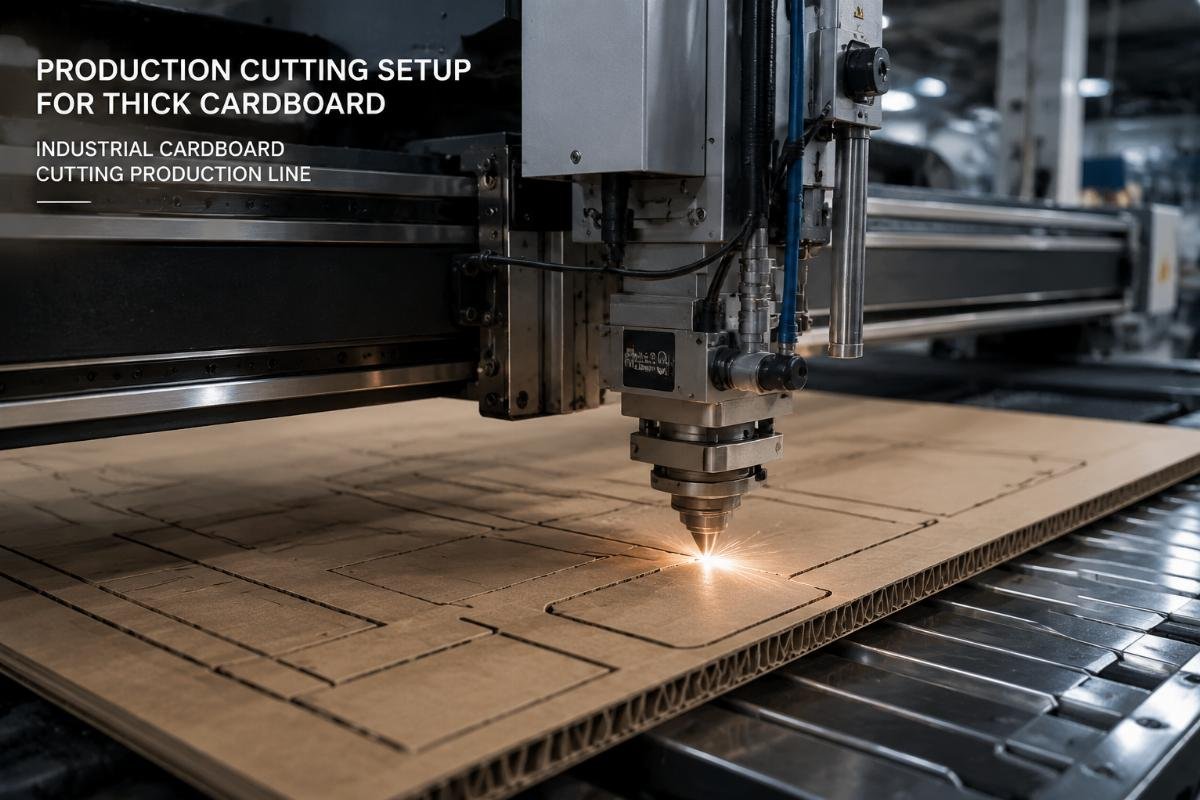
Equipment type alone doesn't determine production readiness—configuration matters as much as cutting method. A CNC knife cutter without automatic material feeding requires manual sheet loading that bottlenecks throughput below 100 pieces per hour. Add a conveyor feed system and the same machine scales to 400+ pieces per hour. Die presses without proper dust extraction create hazardous work environments that force frequent cleanup stops. Laser cutters without fume filtration on coated board quickly fail air quality regulations in enclosed facilities.
The production readiness question you should ask: Can this tool maintain my required edge quality at my required volume for 6-8 hours daily without manual intervention every 30 minutes? If the answer requires "with proper maintenance" or "if you change blades regularly," assume the tool will become a production bottleneck within three months.
What edge quality tier do you actually need?
I've received customer complaints about "poor cut quality" that made perfect sense once I saw their application. A furniture shop cutting prototype pieces from 5mm chipboard rejected a CNC knife cutter because edges showed minor fiber tear6 on inside curves. For prototypes that get sanded and painted, fiber tear doesn't matter—but they bought equipment based on packaging industry standards where fold lines can't have any tear or boxes fail QC. They needed a $12,000 machine but bought a $28,000 system with tolerances they'll never use.
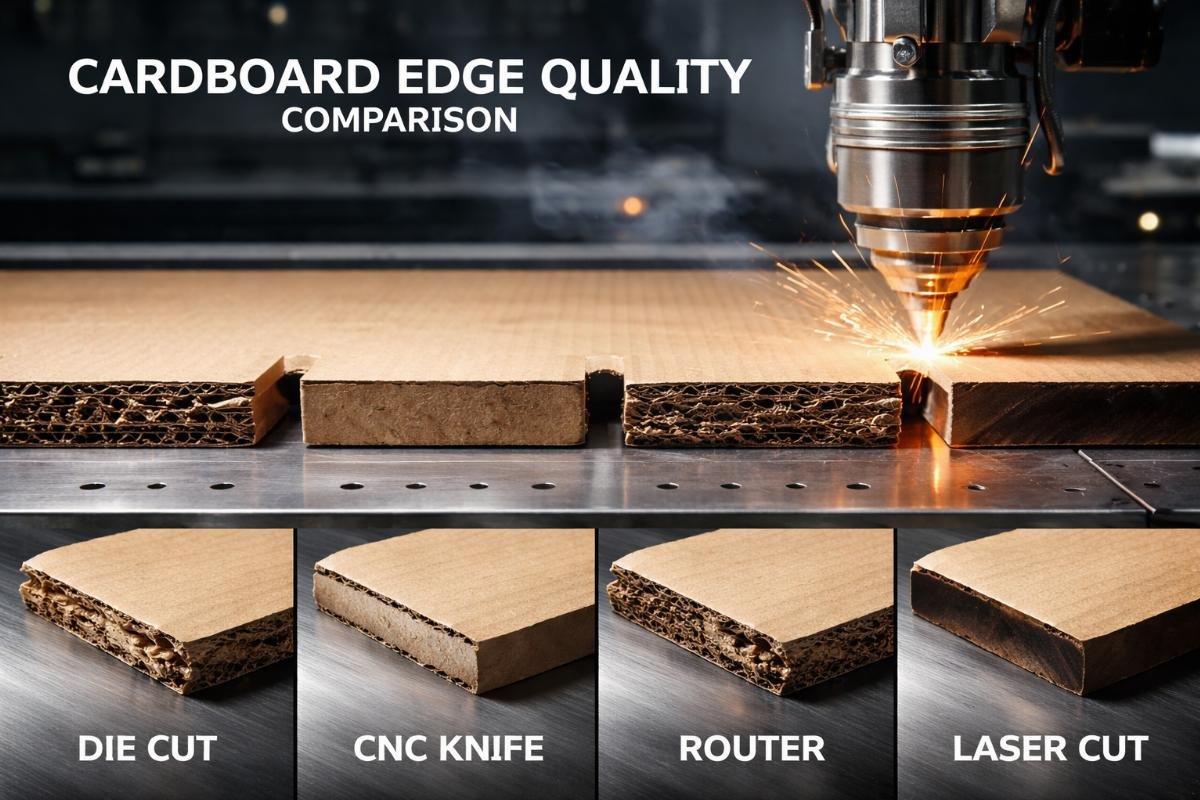
Edge quality for thick cardboard splits into three tiers: prototyping grade where visible fiber tear and dust are acceptable as long as pieces hold together, packaging grade where edges must be clean enough for folding and gluing without delamination, and display grade where edges face consumers and require zero visible defects—each tier changes which cutting method works and at what cost.
Prototyping grade edges tolerate more visible imperfections because the cardboard serves as a temporary form or gets covered in final assembly. Manual rotary cutters and basic knife systems produce prototyping grade edges on 3-5mm board with acceptable speed. Dust control doesn't matter much, slight fiber pullout on curves is fine, and you can cut thicker board by making multiple passes. If you're a design studio making mockups or a school theater program building stage props, prototyping grade equipment saves 60% on equipment cost versus packaging grade without sacrificing anything you actually need.
Packaging grade edges must support structural integrity and manufacturing processes downstream. Box blanks need clean fold lines without fiber tear that weakens creases. Carton stock requires smooth edges that accept glue without gaps. Insert pieces can't shed fiber dust that contaminates products. Most packaging manufacturers who search "thick cardboard cutting tools" actually need packaging grade edge quality, which eliminates manual methods and low-end CNC systems that can't maintain tolerances across production runs. CNC knife cutters with tangential blade rotation7 and proper vacuum hold-down produce packaging grade edges on 3-6mm board reliably; die cutting achieves packaging grade on 5-10mm board if dies are maintained correctly.
Display grade edges face consumers directly on point-of-purchase displays, retail standees, and premium packaging. Any visible fiber, dust residue, or rough texture fails QC. Laser cutting theoretically produces the cleanest edges but chars or discolors coated board that most display work uses. CNC knife cutting achieves display grade on 3-5mm board with sharp blades and optimized feed rates, but struggles above 6mm where blade deflection increases. Die cutting with steel rule dies8 can reach display grade on thicker board but requires expert die making and press setup most small shops lack.
Edge quality failure modes by cutting method
Different cutting methods fail edge quality in different ways, and understanding your failure mode helps you specify the right equipment. Manual rotary cutters create ragged edges on thick board because operators can't maintain consistent downward pressure through curves—the blade deflects and tears fibers instead of slicing cleanly. Die cutters produce crushed edges if press tonnage is too low or blade height is improperly set, where the board compresses before cutting, leaving a burnished appearance that rejects glue. Laser cutters char edges on any board containing recycled fibers or coatings that combust, creating a brown or black line visible on white stock.
CNC knife cutters fail edge quality through blade dullness and incorrect depth offset. As blades wear, they push fibers instead of cutting them, causing pullout on exit edges. If depth offset is too shallow, the blade doesn't fully penetrate and leaves a ragged bottom edge; if too deep, the blade scores the cutting table and dulls faster. Most shops running CNC knife systems on thick board change blades every 2-3 production days and recalibrate depth offset weekly to maintain packaging grade quality.
How do I decide between upgrading manual setup versus jumping to CNC automation?
A display fabricator contacted us six months ago asking whether to buy three more manual rotary cutters to increase capacity or invest in one CNC knife system. They cut 4-6mm chipboard for retail standees, running 15-20 unique designs weekly with volumes between 50-200 pieces per design. I asked what their current bottleneck was. They said design changes—every new standee required retraining operators on new cut patterns, and hand-cutting curves consistently took multiple attempts. That answer made CNC automation obvious because their constraint was setup time and repeatability, not raw cutting capacity.
The decision to jump from manual tools to CNC automation hinges on whether you're capacity-constrained or consistency-constrained—if you need more total cutting hours per day and run simple repeatable shapes, add manual capacity; if you need faster changeovers, complex curves, or tighter tolerances across batches, CNC automation pays back within months.
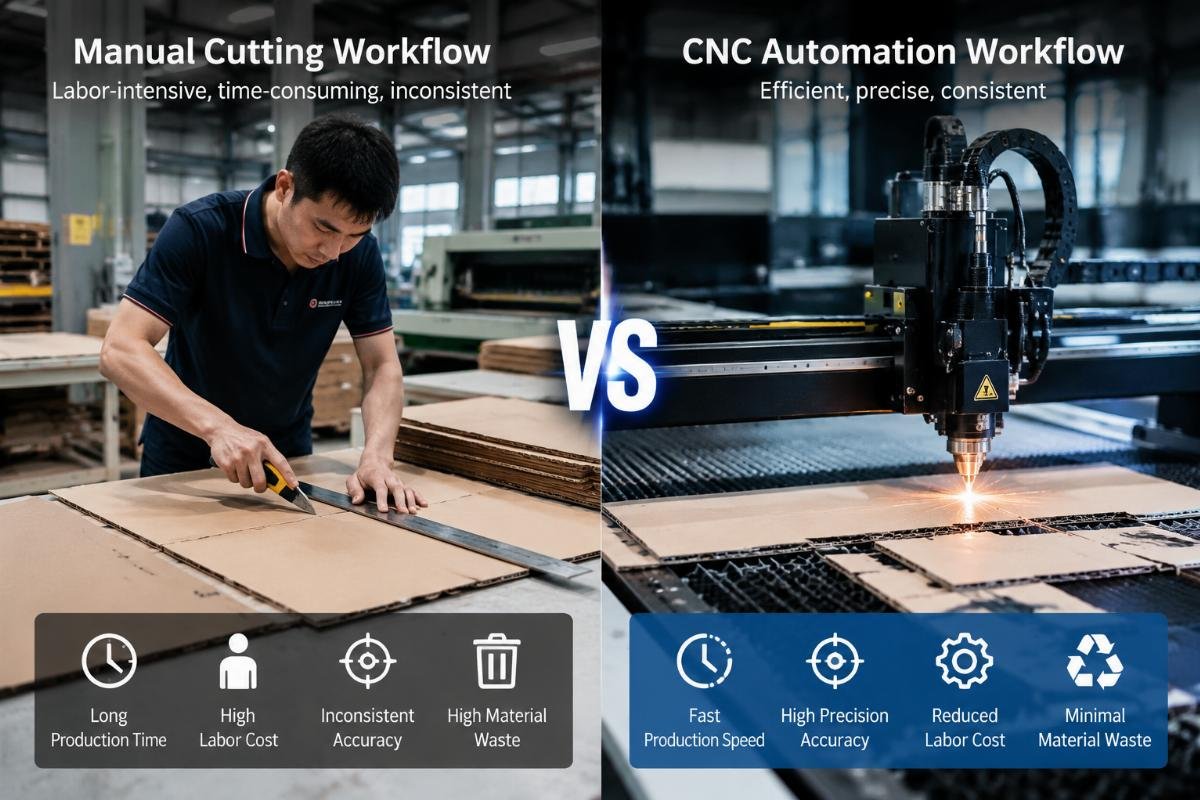
Shops that should stay manual longer than they think include low-volume custom fabricators who cut fewer than 50 pieces per day with high design variation. If every job is a one-off shape and your labor cost is low, the programming time for CNC automation might exceed the hand-cutting time for small batches. I've seen craft studios try to force CNC workflows onto projects that don't justify the setup—a 10-piece prototype run that takes 20 minutes to hand cut but requires 45 minutes of CAD file prep and nesting optimization before CNC equipment even starts cutting.
The break-even point for CNC automation arrives when one of three conditions hit: your current manual capacity can't meet order volume even with overtime, your scrap rate from hand-cutting inconsistency exceeds 8-10%9 and hurts margins, or you're losing quotes because manual lead times can't compete with automated competitors. At that point, CNC equipment transforms from "nice to have" into "survival requirement" because the market won't tolerate slower, less consistent production regardless of your price.
Die cutting occupies a middle position between manual and CNC that often gets overlooked. Semi-automatic die presses with quick-change tooling offer faster throughput than manual methods without the programming learning curve of CNC. If you run 5-8 standard shapes repeatedly with volumes above 500 pieces per month per shape, die cutting delivers ROI faster than CNC because setup time reduces to swapping dies instead of creating cut files. A packaging converter making 3,000 box blanks monthly in three standard sizes should investigate die cutting before jumping to CNC automation.
When CNC automation becomes cheaper than manual scaling
The math flips once you need more than two full-time operators dedicated to cutting. At US labor rates, two operators cost $60,000-80,000 annually including benefits. A mid-range CNC knife cutting system with automatic feeding costs $35,000-50,000 and requires one semi-skilled operator for loading and quality checks. Equipment depreciates over 5-7 years10 while labor cost compounds annually, making CNC cheaper after year two in most scenarios.
Beyond direct cost, CNC automation reduces scrap and rework that manual processes hide. I've audited packaging plants where hand-cutting scrap rates reached 12-15% on complex shapes with tight tolerances—operators made cut errors, mis-measured curves, or couldn't maintain consistent edge quality across production runs. That scrap cost disappeared from financial statements because management categorized it as "material usage variance" rather than process failure. Switch to CNC and scrap drops to 2-3% from programming errors and material defects, immediately improving margin by 8-10 percentage points.
Which cutting method dominates which thickness and application scenario?
After fielding hundreds of equipment inquiries, I've noticed that customers waste time comparing incompatible cutting methods because they don't understand each method's optimal zone. They'll ask "CNC knife versus laser for 7mm board" when the real answer is "neither—you need die cutting for that thickness at your volume." Each cutting method evolved to solve specific production constraints, and trying to force a method outside its zone creates the equipment regret stories I hear weekly.
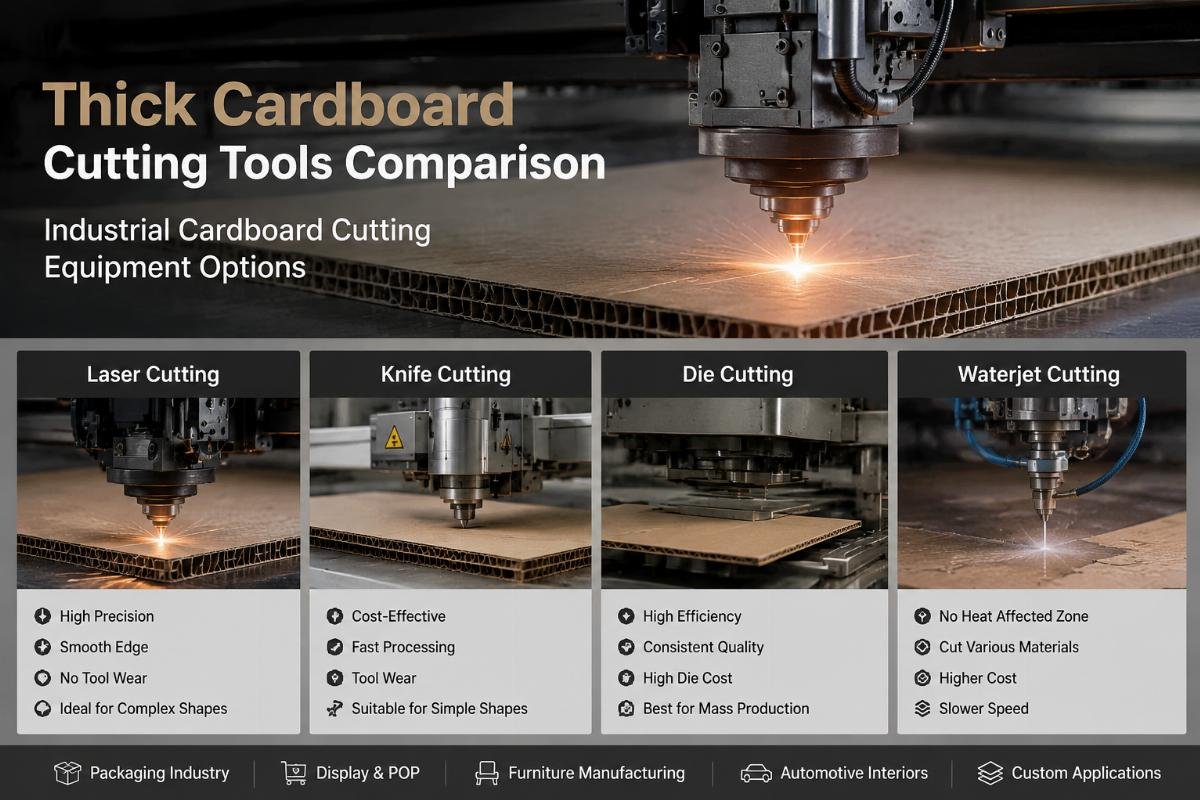
CNC knife cutting dominates 3-6mm packaging and display work with complex curves and frequent design changes where tooling costs must be zero; laser cutting suits prototyping and intricate patterns under 4mm where speed doesn't matter and edge charring is acceptable; die cutting wins for simple shapes above 5mm at volumes exceeding 500 pieces monthly where per-piece cost optimization matters more than design flexibility.
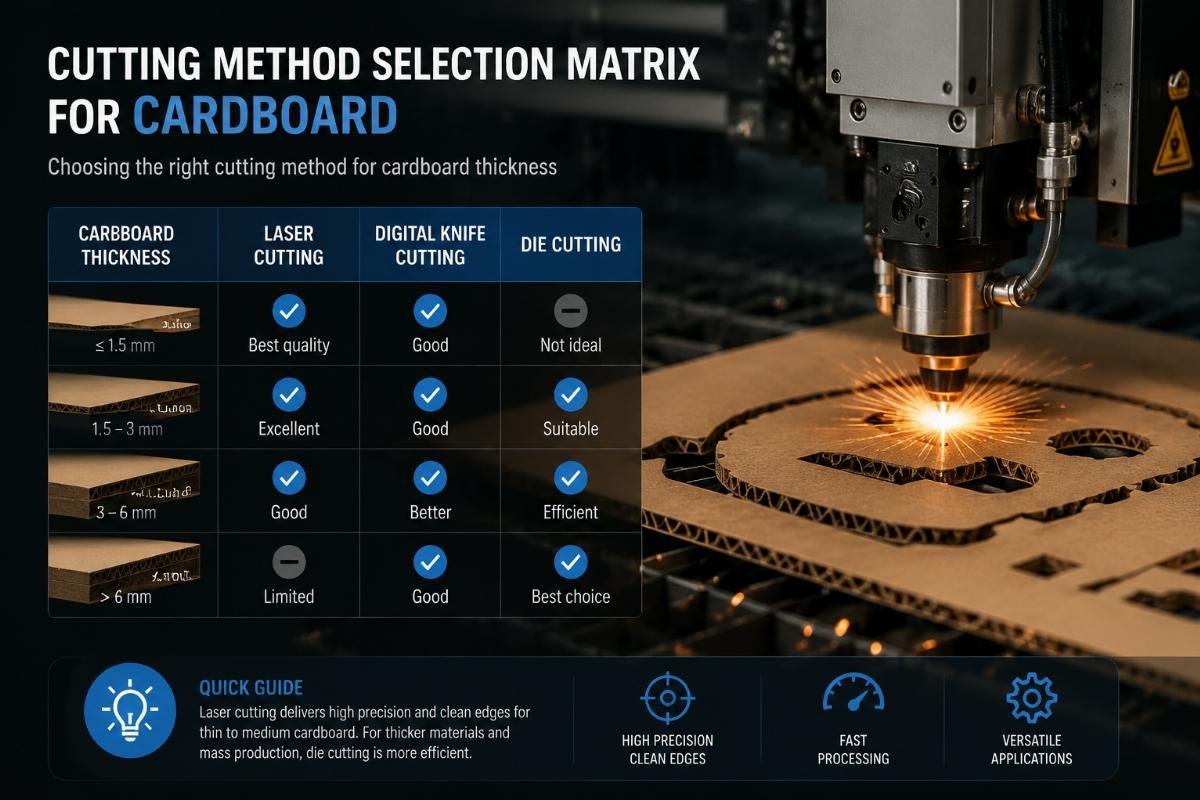
CNC knife cutting systems use oscillating or tangential blades11 controlled by computer paths, requiring no dies or molds. This makes them ideal for operations that change designs frequently—packaging prototypers, display manufacturers, or custom box makers who rarely run the same shape twice. Our CNC knife cutters handle 3-6mm corrugated and chipboard with clean packaging-grade edges at speeds around 800-1,200mm per second12, processing a full 1600x2500mm sheet in 3-8 minutes depending on design complexity. The limitation hits above 6mm where blade deflection increases and cutting force requirements exceed what oscillating knife motors deliver reliably. I don't recommend CNC knife systems for 8mm+ board unless you're willing to accept slower feed rates and more frequent blade changes.
Laser cutting burns through cardboard with
"[PDF] Specifications for Corrugated Paperboard - National Archives", https://www.archives.gov/files/preservation/storage/pdf/corrugated-board.pdf. E-flute corrugated board is defined by specific flute height and thickness parameters within industry classification systems. Evidence role: definition; source type: institution. Supports: the technical specifications and thickness characteristics of E-flute corrugated board. ↩
"[PDF] Specifications for Corrugated Paperboard - National Archives", https://www.archives.gov/files/preservation/storage/pdf/corrugated-board.pdf. Triple-wall corrugated board consists of multiple layers of fluted material, resulting in increased thickness and structural strength compared to single or double-wall constructions. Evidence role: definition; source type: institution. Supports: the construction and typical thickness range of triple-wall corrugated board. ↩
"[PDF] Specifications for Corrugated Paperboard - National Archives", https://www.archives.gov/files/preservation/storage/pdf/corrugated-board.pdf. Industry standards typically classify cardboard by thickness ranges, with specifications varying by application and material composition. Evidence role: definition; source type: institution. Supports: industry-standard thickness classifications for cardboard materials. Scope note: Standards may vary by region and specific industry segment ↩
"How to Calculate Hydraulic Press Force for Different Materials?", https://www.harsle.com/docs/calculate-hydraulic-press-force/?srsltid=AfmBOorA4atsujo3TFFIc9xpgV_LE0NYdZN7v6lJssw6L1o6qIfvlagi. Hydraulic press systems provide the sustained high tonnage necessary for cutting dense or thick materials where mechanical presses may lack sufficient force. Evidence role: mechanism; source type: education. Supports: the relationship between material thickness and required press force in cutting operations. Scope note: Specific thickness thresholds depend on material density and cutting die design ↩
"What Happened? Circular saw blade deflecting, the guide didnt ...", https://www.reddit.com/r/woodworking/comments/6gdb1m/what_happened_circular_saw_blade_deflecting_the/. Blade deflection occurs when lateral cutting forces exceed the blade's bending stiffness, with deflection magnitude increasing proportionally to cutting depth and material resistance. Evidence role: mechanism; source type: education. Supports: the relationship between material thickness, cutting forces, and blade deflection in cutting operations. ↩
"Inclined Fiber Pullout from a Cementitious Matrix: A Numerical Study", https://pmc.ncbi.nlm.nih.gov/articles/PMC5456588/. Fiber tear occurs when cutting forces exceed the interfiber bonding strength in paper-based materials, causing fibers to pull away from the cut edge rather than being cleanly severed. Evidence role: definition; source type: education. Supports: the mechanism and causes of fiber tear defects in cutting paper-based materials. ↩
"Tangential Knife Cutting Machine Controller - YouTube",
. Tangential cutting systems rotate the blade to maintain optimal cutting angle relative to the material direction, reducing drag forces and improving edge quality compared to fixed-orientation blades. Evidence role: mechanism; source type: education. Supports: how tangential blade rotation technology functions in CNC cutting systems. ↩"[PDF] Creating Accurate Machine Specs for Rotary Diecutters", https://steelrule.com/wp-content/uploads/2022/02/Creating-Accurate-Machine-Specs-for-Rotary-Diecutters.pdf. Steel rule dies consist of sharpened steel strips bent to shape and mounted in a base material, providing a cost-effective cutting tool for materials like cardboard and paperboard. Evidence role: definition; source type: education. Supports: the construction and function of steel rule dies in cutting operations. ↩
"A Complete Guide to Scrap Rate: Definition, Formula & Calculation", https://www.deskera.com/blog/scrap-rate/. Manufacturing operations commonly observe higher scrap rates in manual processes compared to automated systems due to operator variability and human error factors. Evidence role: statistic; source type: other. Supports: typical scrap rates associated with manual versus automated cutting operations. Scope note: Specific scrap rates vary widely by industry, material, operator skill level, and quality requirements ↩
"Manufacturing - Wikipedia", https://en.wikipedia.org/wiki/Manufacturing. Tax authorities and accounting standards typically classify manufacturing machinery and equipment with depreciation periods in the 5-7 year range, though specific schedules vary by jurisdiction and equipment type. Evidence role: general_support; source type: government. Supports: standard depreciation periods for industrial manufacturing equipment. Scope note: Actual useful life may differ from depreciation schedules; specific classifications depend on tax jurisdiction ↩
"how to use CNC Oscillating Knife cutting machine - YouTube",
. Oscillating blades use rapid vertical reciprocation to cut materials, while tangential systems rotate the blade orientation; each approach offers distinct advantages for different material types and cutting requirements. Evidence role: mechanism; source type: education. Supports: the mechanical differences between oscillating and tangential blade cutting systems. ↩"CNC Cardboard Cutting Machine", https://www.aolcutcnc.com/productshow/AOL_1625PAS_CNC_Cardboard_Cutting_Machine.html. CNC knife cutting systems for corrugated materials typically operate within specific feed rate ranges determined by material thickness, blade type, and required edge quality. Evidence role: statistic; source type: other. Supports: typical cutting speed ranges for CNC knife systems processing corrugated materials. Scope note: Actual speeds vary significantly based on equipment class, material properties, and design complexity ↩