

Blog
How Do Wholesalers Verify Diagonal Accuracy of Knife Cutting Machines Without Lab Equipment?

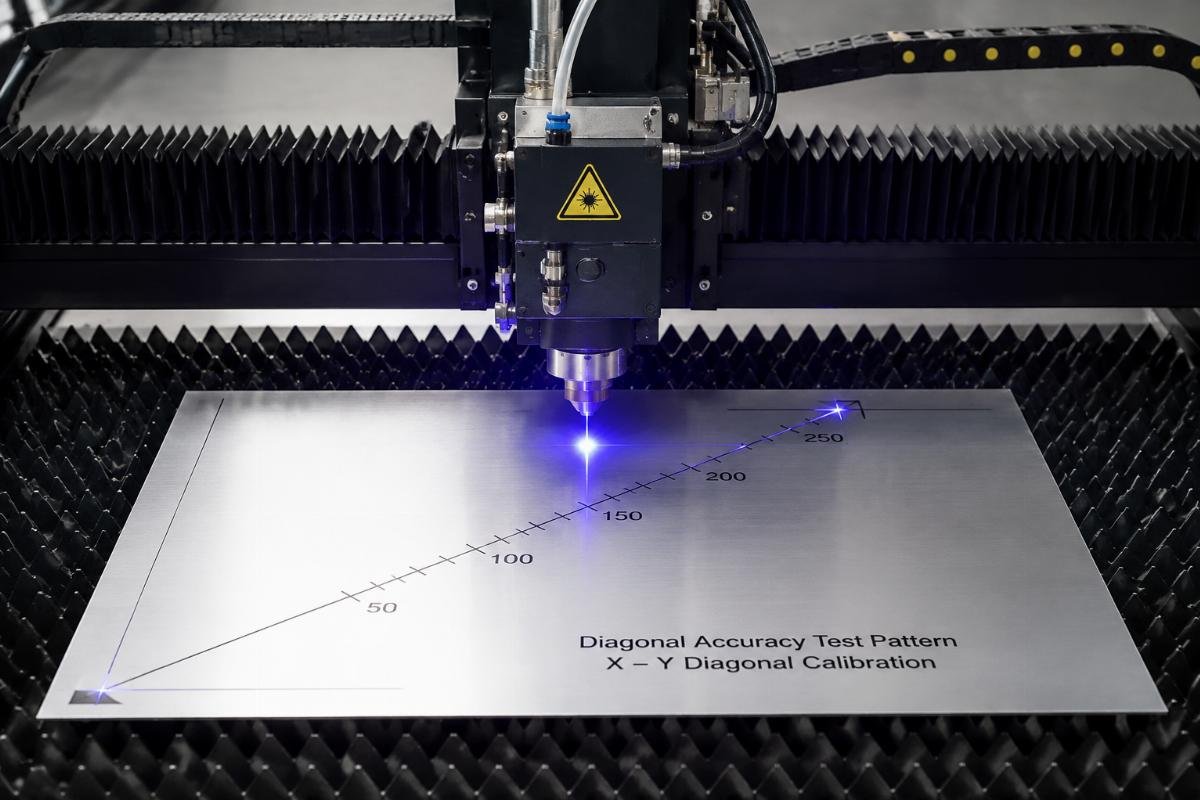
How Do Wholesalers Verify Diagonal Accuracy of Knife Cutting Machines Without Lab Equipment?
You just signed a purchase order for three knife cutting machines worth $150,000. The vendor promises ±0.2mm diagonal accuracy1. But when your client tests the first production run, corner misalignments ruin 200 car floor mats. Now you're stuck between an angry customer and a vendor blaming "improper operation."
Wholesalers can verify knife cutting machine diagonal accuracy on-site by cutting full-size diagonal test patterns on actual materials and measuring physical output deviations—not by checking machine parameters or using tape measures on the frame structure. This method reveals real cutting performance before acceptance.
Most wholesalers I work with make the same mistake during machine inspections. They measure the machine frame with tape measures or watch vendors demonstrate small sample cuts. Then three months later, they contact us because their end customers reject batches due to diagonal errors. Let me show you how to catch these problems before signing acceptance documents.
Why Do Standard Verification Methods Fail for Wholesalers?
I've guided over 40 wholesalers through knife cutting machine acceptance procedures. The most common complaint I hear is "the vendor's test looked perfect, but our customer's production has consistent diagonal errors."
Standard verification methods fail because they test machine structure instead of actual cutting output, and small demonstration samples hide cumulative errors that only appear across the full working area dimensions that real production requires.
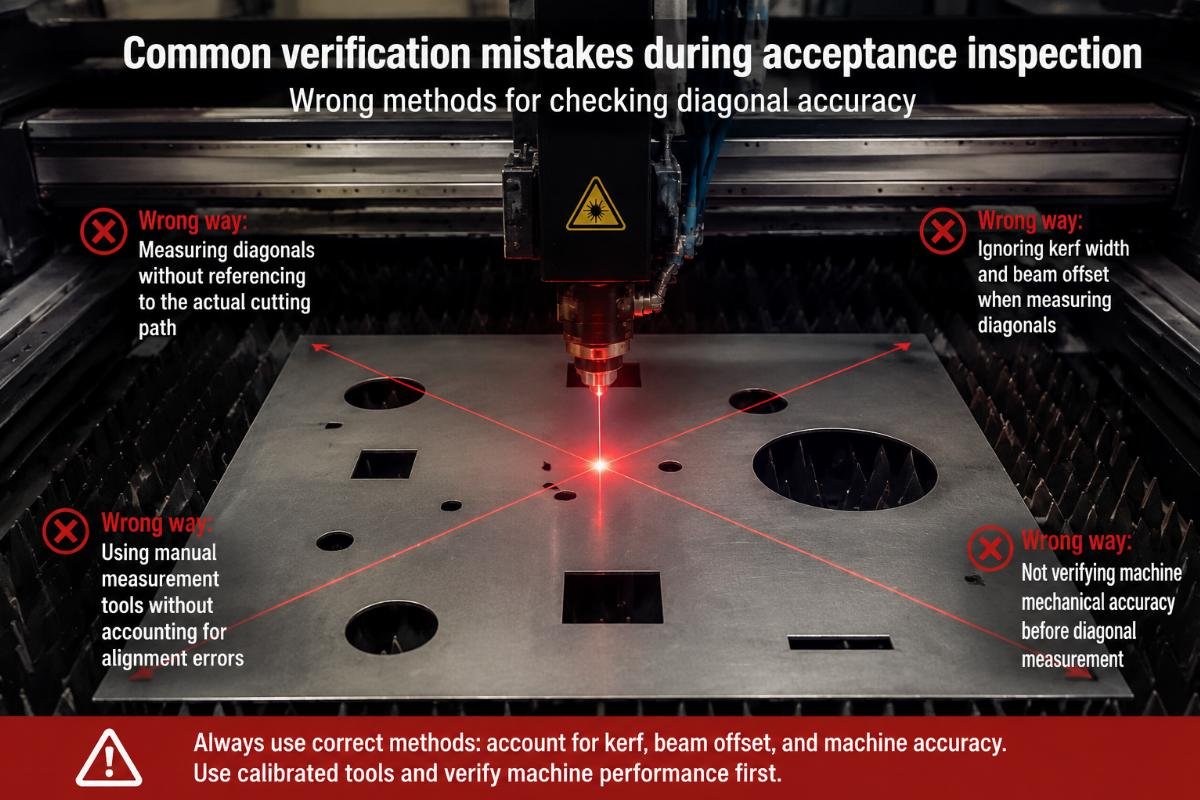
What Happens When You Measure the Machine Frame
Three weeks ago, a packaging materials distributor asked me to review their acceptance checklist. Their procedure included "measure frame diagonals with tape measure—difference must not exceed 1mm." I've seen this same mistake in dozens of wholesaler protocols.
Here's why this approach creates false confidence. When you measure corner-to-corner distances on the machine's aluminum frame, you're checking if the manufacturer assembled the structure square. But diagonal cutting accuracy depends on motion system performance—how precisely the cutting head follows programmed paths across the working area.
I witnessed an acceptance inspection where frame diagonals matched within 0.5mm, but the machine produced leather seat covers with 3mm corner misalignments. The frame was square. The motion system had backlash in the Y-axis belt drive that accumulated over long diagonal movements2.
| Frame Measurement | What It Actually Tests | What It Misses |
|---|---|---|
| Tape measure across corners | Mechanical frame assembly | Motion system precision |
| Edge-to-edge distances | Static structure squareness | Dynamic cutting path accuracy |
| Vendor-provided calibration report | Machine passed factory QC | Performance with your materials at your speeds |
Why Small Sample Tests Miss Critical Problems
Last month, a machinery trading company contacted us after their client rejected a complete order. During acceptance, the vendor cut a 500mm×500mm test square. All corners aligned perfectly. But when the customer started cutting 2400mm×1600mm automotive carpet pieces, opposite corners were off by 4-5mm.
Small samples hide cumulative positioning errors. Modern knife cutting machines use belt or rack drive systems3. Each motor step accumulates tiny positioning variations4. Over 500mm distance, these variations cancel out or stay within tolerance. Over 2400mm diagonal distance, they compound into visible misalignments.
I always tell wholesalers: your end customer won't cut demo samples. They'll run full-sheet materials at production speeds for 8-hour shifts. Your verification must match their real conditions.
What Test Patterns Actually Reveal Machine Performance?
Based on acceptance cases we've handled, effective verification requires cutting test patterns that stress the machine's full working area. These patterns convert abstract accuracy specifications into measurable physical results.
Full-area diagonal test patterns reveal cumulative positioning errors, motion system synchronization problems, and material-specific cutting behavior that small samples never expose—giving wholesalers physical evidence of machine performance before final payment.
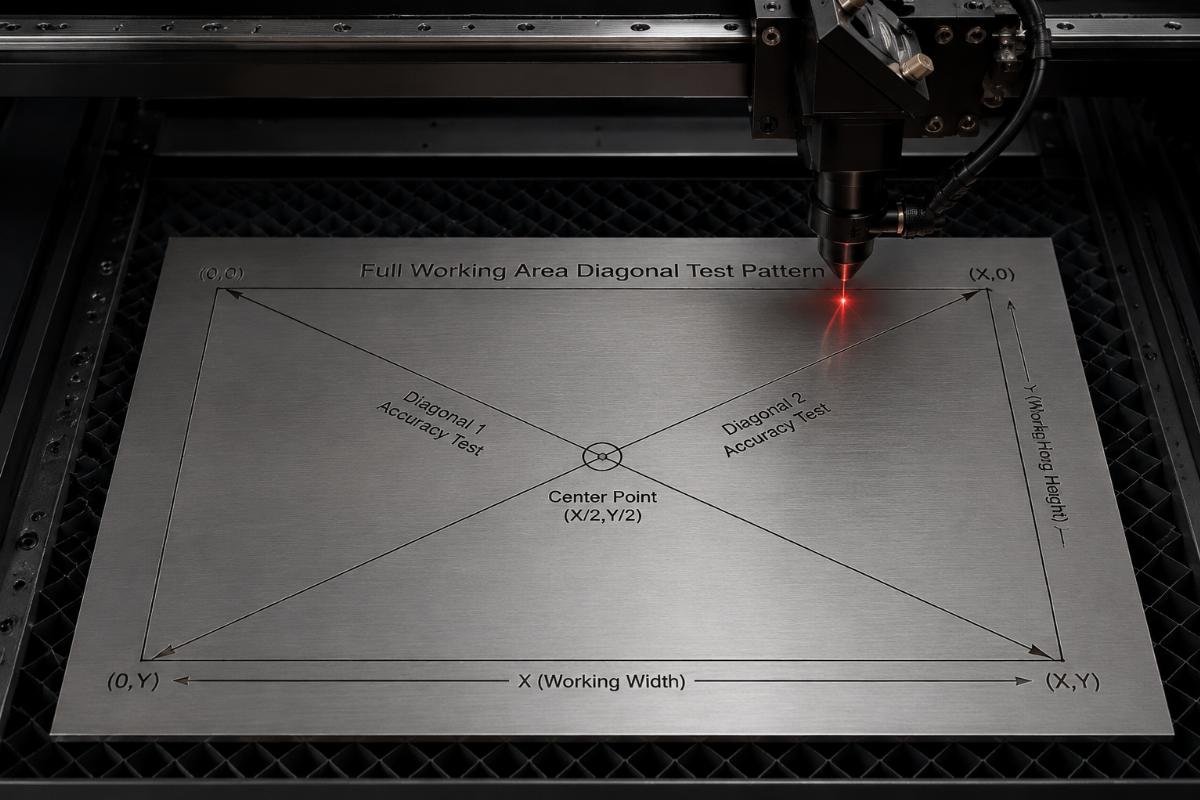
The Cross-Diagonal Rectangle Test
This is the verification method I recommend most often. Cut a rectangle that fills 80-90% of the working area, then add diagonal lines corner-to-corner. For a 1600mm×2500mm machine, cut a 1400mm×2200mm rectangle with crossed diagonals.
Here's what this test reveals. First, measure the corner-to-corner distances of the rectangle. If opposite diagonals differ by more than 0.5mm (using materials like cardboard or vinyl), the machine has motion synchronization problems5 between X and Y axes.
Second, cut the internal diagonals. Start from one corner, cut to the opposite corner without lifting the blade. Do this for both diagonals. Now inspect where the two diagonal cuts intersect at the center. They should cross at a single point. If the intersection spreads into a gap or if the cuts don't meet, the machine has backlash or belt tension issues.
| Test Element | Measurement Method | Acceptable Deviation | What Problems It Reveals |
|---|---|---|---|
| Rectangle corner-to-corner | Measure both diagonals with steel ruler | <0.5mm difference | Motion system synchronization |
| Diagonal cut intersection | Visual inspection and ruler | Cuts cross at single point | Cumulative positioning error |
| Corner right angles | Square tool or measure both sides from corner | <0.3mm deviation in 300mm | X/Y axis perpendicularity |
The Nested Square Pattern
For wholesalers who supply customers cutting multiple sizes, I suggest this pattern. Cut three squares: one at full working area, one at 60% size, one at 30% size. All three should be concentric—sharing the same center point.
After cutting, measure each square's diagonals. Then check if the smaller squares sit perfectly centered within the larger ones. Measure from each edge of the small square to the corresponding edge of the large square. All four gaps should be equal.
This test catches problems that vary across the working area. I've seen machines where the outer square is perfect but the inner squares shift 2-3mm off-center. This indicates the motion controller loses position accuracy at specific coordinate ranges.
How Do You Measure Physical Output Without Precision Tools?
In our verification guidance work, wholesalers always ask: "I don't have coordinate measuring machines or laser interferometers. How can I get accurate measurements?" Here are the practical methods we've proven in field inspections.
Wholesalers can achieve sufficient measurement accuracy using steel rulers, carpenter's squares, and overlay comparison methods—techniques that reveal deviations larger than 0.5mm, which is the threshold where diagonal errors cause visible quality problems in most flexible material applications.

The Steel Ruler Comparison Method
Buy a 2-meter steel ruler (not a tape measure—tape measures flex and give inconsistent readings). For measuring rectangle diagonals, place the ruler along one diagonal and mark the exact endpoints with a pencil. Then move the ruler to the opposite diagonal and compare.
I teach wholesalers this technique: don't try to read exact millimeter values. You're looking for difference between the two diagonals. If you can't see a gap when comparing the ruler positions, the difference is under 0.5mm—acceptable for most applications.
For the diagonal intersection test, use a machinist's square. Place one edge along each cut. If both cuts are straight and meet at a point, the intersection is good. If you can slide a 0.5mm feeler gauge through the gap where they should intersect, the machine has accuracy problems.
The Overlay Registration Test
This method works well for wholesalers who don't trust their measuring skills. Cut two identical test patterns on the same material type. Stack them precisely aligned at one corner. Now walk around and check the other three corners.
If the machine has good diagonal accuracy, all four corners should align within 0.5mm. If opposite corners shift 2-3mm, you've found cumulative error. This test is especially valuable because it shows consistency—can the machine repeat the same cutting path accurately?
| Measurement Tool | What You're Checking | Detection Threshold | When To Use This Method |
|---|---|---|---|
| Steel ruler | Diagonal length difference | 0.5mm and above | Verifying rectangle squareness |
| Machinist's square | Line intersection alignment | 0.3mm gap detection | Checking diagonal cut meeting point |
| Overlay comparison | Corner registration between identical cuts | 0.5mm shift visible to eye | Testing machine repeatability |
| Feeler gauge set | Gap at intersections or corners | 0.1mm increments | When customer requires tight tolerance documentation |
What Accuracy Numbers Should You Expect?
Wholesalers often ask me: "What's good enough?" The answer depends on your customer's application and the material type being cut.
For packaging materials (cardboard, corrugated), ±1mm diagonal deviation is typically acceptable6. For fabric cutting in apparel or upholstery, ±0.5mm is the standard7. For automotive interior parts or technical textiles, you need ±0.3mm or better8.
But here's the critical point I always emphasize: these tolerances apply to full working area cutting. If a vendor quotes ±0.1mm accuracy, ask them "over what distance?" A machine might hold ±0.1mm over 500mm but drift to ±1.5mm over 2000mm diagonal cuts.
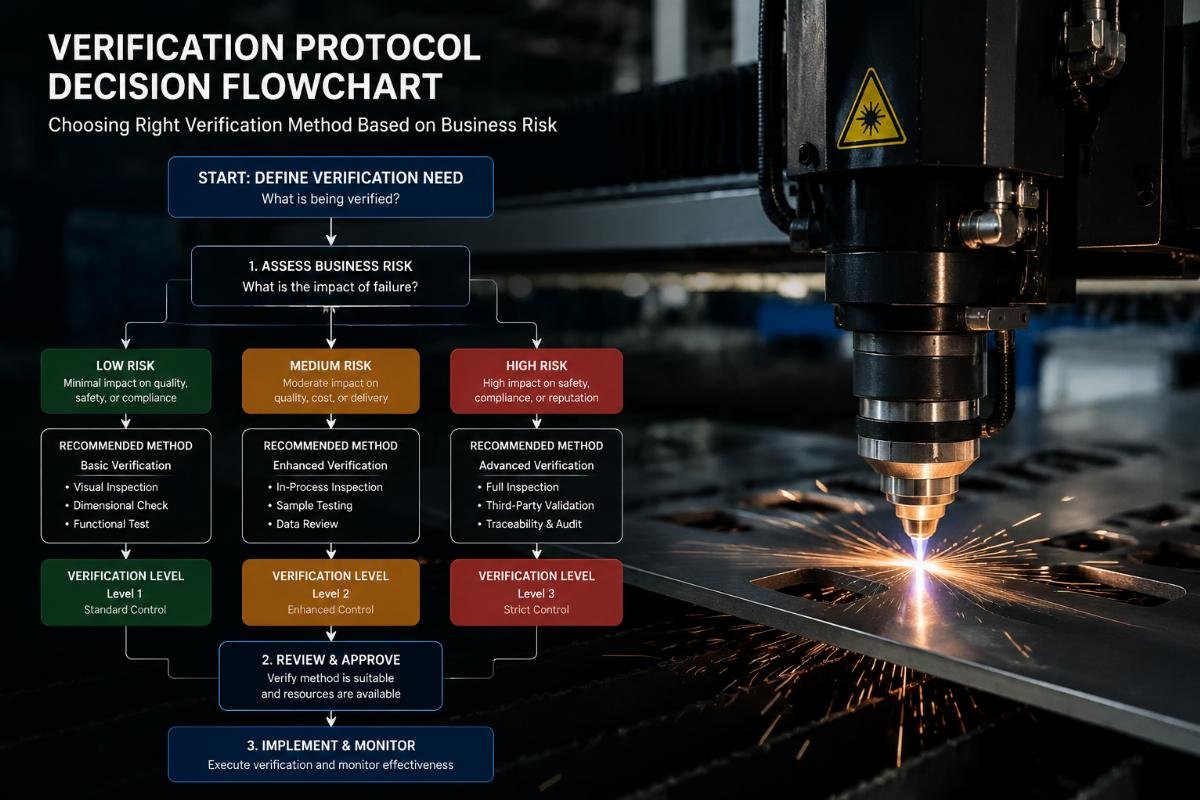
What Verification Protocol Matches Your Wholesale Business Model?
Different wholesaler types face different decision risks. A small trading company ordering one machine for resale needs a different verification approach than a distributor building technical specifications for multiple client projects.
Wholesalers should scale verification complexity to match their investment risk and customer precision requirements—from basic visual inspection for low-margin trades to documented measurement protocols for high-value customer relationships where precision disputes create financial liability.
Quick Verification for Small Trading Orders
If you're a trading company buying 1-2 machines for immediate resale, and your end customer hasn't specified tight tolerances, use this simplified protocol.
Cut one full-area rectangle with crossed diagonals on the customer's actual material. Do the overlay test—cut the same pattern twice and stack them. Inspect all four corners visually. If corners align within what looks like 1mm (roughly the width of a credit card edge9), accept the machine.
This takes 30 minutes and catches major problems. I've seen this quick test reveal 5mm diagonal errors that the vendor's demo samples completely hid. Will it catch ±0.3mm deviations? No. But if you're selling into non-critical applications, it gives you basic confidence the machine functions as claimed.
Standard Protocol for Distribution Businesses
Distributors who supply multiple customers need more documentation. You're building reputation and repeat business. Here's the verification protocol I recommend.
First, prepare test patterns for three size ranges: small (500mm×500mm), medium (1200mm×1200mm), and full working area (90% of maximum). Cut each pattern on three material types your customers commonly use—one rigid (cardboard), one semi-flexible (vinyl), one very flexible (fabric or leather).
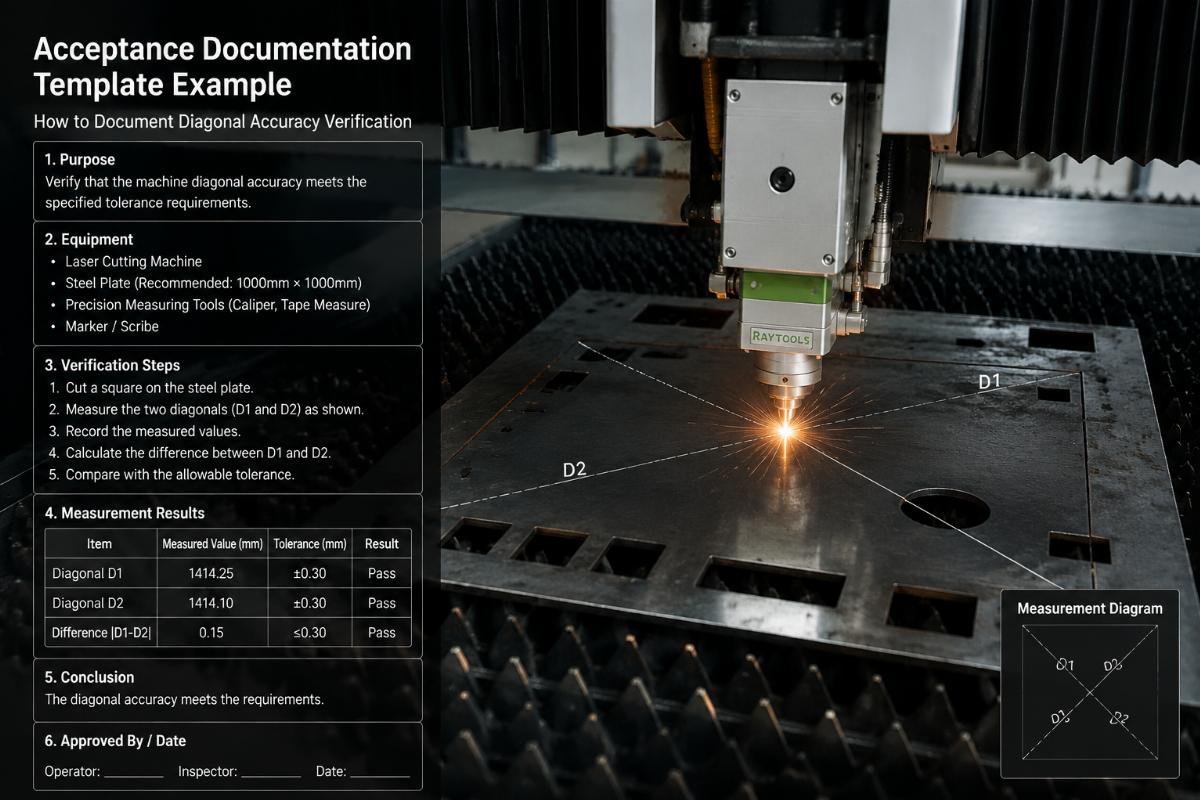
Measure all rectangle diagonals with steel ruler. Record the measurements in a simple table. Take photos of the diagonal intersections. Create a one-page acceptance report with your measurements and photos. This gives you evidence if customers later report accuracy problems.
| Wholesaler Type | Investment Risk | Verification Time | Documentation Needed | Acceptable Deviation Range |
|---|---|---|---|---|
| Small trader (1-2 units) | $30k-60k | 30 minutes | Photos of test cuts | ±1.0mm visual inspection |
| Regional distributor | $150k-300k | 2 hours | Measurement table + photos | ±0.5mm measured with ruler |
| Technical equipment supplier | $500k+ | Half day | Full protocol with material-specific tests | ±0.3mm documented with multiple samples |
Detailed Protocol for Manufacturing End-User Wholesalers
Some wholesalers are actually manufacturing companies buying cutting equipment for their own production. You face the highest risk—if the machine doesn't meet your process requirements, you've disrupted your entire operation.
For this situation, I recommend engaging a third-party verification service or asking the vendor to perform acceptance testing at their facility before shipping. Cut full production patterns at actual production speeds. Run at least 50 pieces and measure corner registration on every tenth piece.
Check if accuracy degrades over time. Does the first piece match the fiftieth piece? Motion systems can lose accuracy as they heat up during extended operation10. This only shows up in production-length testing.
How Do You Document Results to Protect Against Future Disputes?
I've mediated several disputes where wholesalers and vendors argued about who was responsible for accuracy problems discovered months after installation. Clear documentation at acceptance prevents these situations.
Effective documentation requires timestamped photos of physical test outputs, written measurement tables signed by both parties, and explicit acceptance criteria agreed before testing—creating evidence that establishes baseline machine performance at time of delivery.
What Photos Actually Prove Performance
Take photos that show the full context. One photo should show the entire test pattern on the cutting bed with a ruler for scale. Take close-up photos of each corner showing how precisely the cuts align. Most important: photograph the diagonal intersection point with a ruler placed across it.
I always tell wholesalers: include a written card in each photo showing the date, machine serial number, and material type. This prevents disputes about when testing occurred or what machine was tested.
One distributor learned this lesson hard way. They had photos of perfect test cuts, but no date stamps or machine identification. When their customer complained six months later, the vendor claimed the photos were from a different machine or taken under different conditions.
Creating Acceptance Criteria Agreement
Before testing, write down specific pass/fail criteria and have both parties sign. Use language like this: "Rectangle diagonals must match within 1.0mm over full 1600mm×2500mm working area when cutting 2mm corrugated cardboard at 1200mm/min speed."
This eliminates subjective judgment. Either the test passes or it fails. No arguing about whether 1.5mm is "acceptable" or whether the vendor can blame your material or cutting speed.
| Documentation Element | What It Must Include | Why This Protects You | Common Documentation Mistakes |
|---|---|---|---|
| Test pattern photos | Full pattern + close-ups with date card | Proves what was cut at acceptance | No scale reference, no date stamp |
| Measurement table | All diagonal measurements with tool used | Establishes baseline performance | Vague descriptions like "corners aligned" |
| Material specifications | Type, thickness, manufacturer | Prevents disputes about test conditions | "We used cardboard" without specifics |
| Signed criteria sheet | Pass/fail thresholds for each test | Makes acceptance objective not subjective | Verbal agreements not written down |
What Happens When Tests Fail?
I've handled multiple acceptance procedures where tests revealed accuracy problems. Here's how to manage failed verification professionally.
First, document exactly which test failed and by how much. "Rectangle diagonals differ by 2.3mm" is actionable. "Corners don't line up well" is not.
Second, give the vendor opportunity to adjust and retest. Many accuracy problems come from improper machine setup or material handling issues. Request adjustment and schedule retest for next day.
Third, if problems persist after adjustment, enforce your purchase contract. Most contracts include accuracy specifications. Failed acceptance testing is legitimate grounds to reject delivery or demand vendor-provided solutions.
What Common Vendor Responses Hide Real Problems?
In our verification guidance work, we encounter the same vendor deflection tactics repeatedly. Knowing these responses helps wholesalers stay focused on objective test results instead of accepting excuses.
Vendors typically blame failed accuracy tests on material properties, operating speed, or "improper testing methods"—responses designed to shift responsibility away from machine performance issues that verification testing specifically reveals.

"You're Using The Wrong Material"
Last year, I supported a furniture parts distributor whose machine failed diagonal testing. The vendor immediately claimed: "You can't test accuracy with leather—it stretches. Use our special testing material."
This response is a red flag. If your customers will cut leather, the machine must deliver accuracy on leather. Testing on "special material" that behaves better than production materials just hides problems.
I told that distributor: "Ask the vendor to demonstrate the same test pattern on their special material, then on your leather. If the special material shows perfect accuracy but leather shows 3mm errors, the machine can't handle leather—which means it doesn't meet your requirements."
"That's Not How You Test Industrial Equipment"
Some vendors push back on practical testing methods. "You need laser interferometer to measure accuracy properly. Your steel ruler method is too crude."
Here's my response to wholesalers who hear this: "Laser interferometers measure machine positioning precision11—how accurately the controller moves to commanded coordinates. You need to verify cutting accuracy—how precisely the blade cuts actual materials. Those are different things."
Material deformation, blade deflection, and cutting speed effects don't appear in laser measurements12 but show up in physical cutting results. Your practical tests reveal real-world performance that specification sheets miss.
| Vendor Response
"Knife cutting machine: Applications and Comparisons", https://www.trustercnc.com/application-and-comparison-of-knife-cutting-machine-in-various-industries/. Industrial CNC cutting systems for flexible materials typically specify positioning accuracy in the range of ±0.1mm to ±0.5mm depending on machine class and application requirements, with diagonal accuracy representing a key performance metric for evaluating motion system squareness. Evidence role: general_support; source type: institution. Supports: that precision cutting machines are commonly specified with sub-millimeter accuracy tolerances. Scope note: Source addresses general CNC cutting accuracy rather than the specific ±0.2mm figure cited ↩
"Can backlash give a cumulative error? - MechMate", http://www.mechmate.com/forums/showthread.php?t=2438. Backlash in belt drive systems arises from belt tooth engagement clearance, belt stretch, and pulley-to-shaft clearances, creating lost motion that affects positioning accuracy particularly during direction reversals and can manifest as cumulative error in complex motion paths involving multiple axis movements. Evidence role: mechanism; source type: education. Supports: that backlash and belt compliance in drive systems contribute to positioning errors. ↩
"DYSS Cutter X9 Series", https://en.dyss.com/x9_series. Belt and rack-and-pinion drive systems represent the two dominant motion control architectures in industrial knife cutting machines, with belt drives offering cost advantages and rack systems providing higher rigidity for precision applications. Evidence role: mechanism; source type: education. Supports: that belt and rack drive systems are standard motion architectures in knife cutting machines. Scope note: Source describes general CNC motion systems rather than knife cutting machines specifically ↩
"A Method of Calculating Motion Error in a Linear Motion Bearing Stage", https://pmc.ncbi.nlm.nih.gov/articles/PMC4325210/. Positioning errors in motion control systems accumulate through mechanisms including backlash in drive components, belt stretch, thermal expansion, and servo following errors, with total deviation typically scaling with travel distance in the absence of closed-loop correction. Evidence role: mechanism; source type: education. Supports: that positioning errors in motion systems can accumulate over travel distance due to backlash, thermal expansion, and mechanical compliance. ↩
"[PDF] On the Detection of Synchronization Errors - CECS", https://cecs.uci.edu/technical_report/TR04-13.pdf. Diagonal measurement comparison serves as a practical method for detecting perpendicularity errors between orthogonal axes in machine tools, with diagonal length differences indicating squareness deviation that may result from mechanical misalignment, motion synchronization errors, or geometric errors in the machine structure. Evidence role: mechanism; source type: education. Supports: that differences in diagonal measurements indicate perpendicularity errors between machine axes. Scope note: Source explains the diagnostic principle but does not validate the specific 0.5mm threshold cited ↩
"Corrugated - Wikipedia", https://en.wikipedia.org/wiki/Corrugated. Packaging industry cutting tolerances vary by application, with structural packaging generally accepting ±0.5mm to ±1.5mm deviations while display packaging and folding cartons may require tighter ±0.3mm to ±0.5mm tolerances depending on assembly requirements. Evidence role: expert_consensus; source type: institution. Supports: that packaging applications typically work with looser tolerances than technical or apparel applications. Scope note: Source provides ranges rather than confirming the specific ±1mm figure as standard ↩
"Basic Technical SOP for Cutting Section in Apparel - Academia.edu", https://www.academia.edu/8823186/Basic_Technical_SOP_for_Cutting_Section_in_Apparel. Apparel and upholstery cutting operations typically require positioning accuracy of ±0.3mm to ±0.7mm to ensure proper seam alignment and pattern matching, with tighter tolerances needed for technical textiles and looser tolerances acceptable for non-critical applications. Evidence role: expert_consensus; source type: institution. Supports: that textile cutting applications require tighter tolerances than packaging due to assembly and pattern matching requirements. Scope note: Source provides a range that includes but is not limited to the ±0.5mm figure cited ↩
"Basic Tolerances and Cut Feature Relationships | SendCutSend", https://sendcutsend.com/blog/basic-tolerances-and-cut-feature-relationships/?srsltid=AfmBOorouZCjFHeQx0MgPymHR-RauSap0qFLZInaP2Fp1XVGv-DDJkC7. Automotive interior component manufacturing typically specifies cutting tolerances of ±0.2mm to ±0.5mm for trim parts, with tighter tolerances required for visible surfaces and components requiring precise fit to adjacent parts or mounting features. Evidence role: expert_consensus; source type: institution. Supports: that automotive interior components require tight cutting tolerances due to fit and finish requirements. Scope note: Source addresses automotive component tolerances generally rather than specifically validating the ±0.3mm threshold ↩
"ISO/IEC 7810 - Wikipedia", https://en.wikipedia.org/wiki/ISO/IEC_7810. ISO/IEC 7810 specifies ID-1 card dimensions (standard credit card size) with a thickness of 0.76mm, providing a readily available reference for visual estimation of sub-millimeter dimensions, though the card edge thickness may appear slightly larger due to rounded corners and manufacturing tolerances. Evidence role: definition; source type: institution. Supports: that standard credit cards have a defined thickness that can serve as a dimensional reference. Scope note: Standard thickness is 0.76mm rather than the 1mm approximation used in the article ↩
"[PDF] ELIMINATION OF THERMAL DRIFT IN MEASURING THE ... - astrj.com", https://www.astrj.com/pdf-78669-19204?filename=Elimination-of-Thermal-Dr.pdf. Thermal effects represent a significant source of positioning error in precision motion systems, with heat generation in motors, bearings, and drive components causing dimensional changes that can produce positioning drift of 10-100 micrometers per degree Celsius depending on machine geometry and materials. Evidence role: mechanism; source type: paper. Supports: that thermal expansion in motion system components causes positioning drift during operation. ↩
"Laser Interferometers: The Key to High-Precision CNC Machine ...", https://www.rootsmetrology.com/blog/laser-interferometers-the-key-to-high-precision-cnc-machine-calibration/. Laser interferometry serves as the reference method for measuring linear positioning accuracy in machine tools according to ISO 230-2, providing sub-micrometer resolution for evaluating positioning error, repeatability, and backlash in motion systems. Evidence role: definition; source type: institution. Supports: that laser interferometry is a standard method for measuring machine tool positioning accuracy. ↩
"The difference between machining accuracy and positioning accuracy", https://www.practicalmachinist.com/forum/threads/the-difference-between-machining-accuracy-and-positioning-accuracy.345383/. Machine tool positioning accuracy measured under no-load conditions does not fully predict workpiece accuracy, as cutting forces induce tool deflection, workpiece deformation, and thermal effects that create additional errors not captured by kinematic positioning measurements. Evidence role: mechanism; source type: education. Supports: that machine positioning accuracy differs from actual workpiece accuracy due to process forces and material behavior. ↩