

Blog
¿Deberías elegir cuchillas originales del proveedor o cuchillas de posventa para tu cortadora CNC?

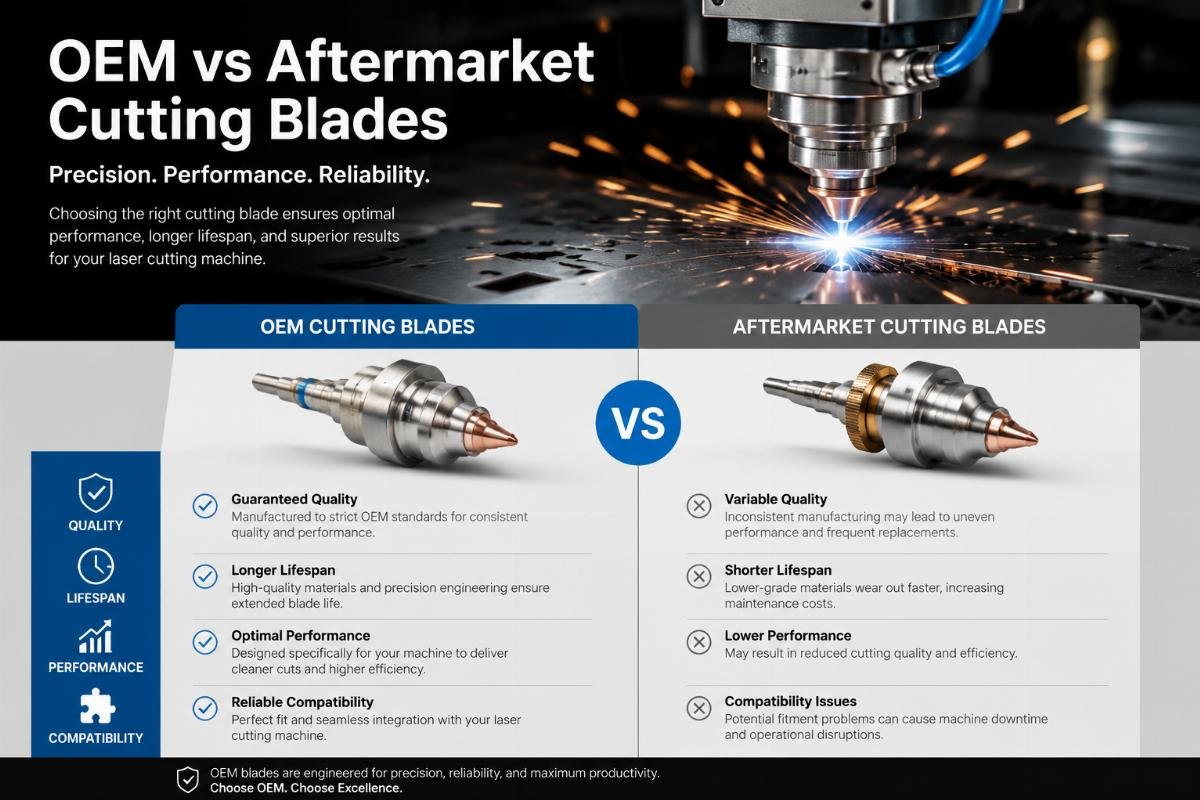
Should You Choose Supplier Original Blades or Aftermarket Blades for Your CNC Cutter?
When clients ask me about aftermarket blades, they expect a simple yes or no answer. But after handling hundreds of blade selection inquiries at Realtop, I've learned this question masks a deeper problem. The real issue is not which blade cuts better, but which risk you can afford to carry in your specific production scenario.
Original equipment manufacturer (OEM) blades cost 3-5 times more than aftermarket alternatives1, but this price gap reflects different risk allocation models rather than pure quality differences. Your blade choice determines who bears the consequences when something goes wrong—the equipment manufacturer through warranty coverage, or you through production downtime and potential machine damage.
Most flexible materials processors assume blade selection is a technical problem with a correct answer. In reality, it's a risk assessment problem where your operational context determines which option protects your business better. Let me walk you through the decision variables that our customer service data reveals actually matter.
What Creates the Price Difference Between OEM and Aftermarket Blades?
When customers see a $15 OEM blade versus a $4 aftermarket blade, they assume the price gap is pure markup. But the cost structure reveals where each option allocates resources—and what risks you inherit when you choose the cheaper path.
OEM blades carry higher unit costs because manufacturers engineer them to protect both cutting performance and equipment integrity. The price premium funds material selection processes, dimensional tolerance controls, and quality verification systems that reduce variability across production batches.
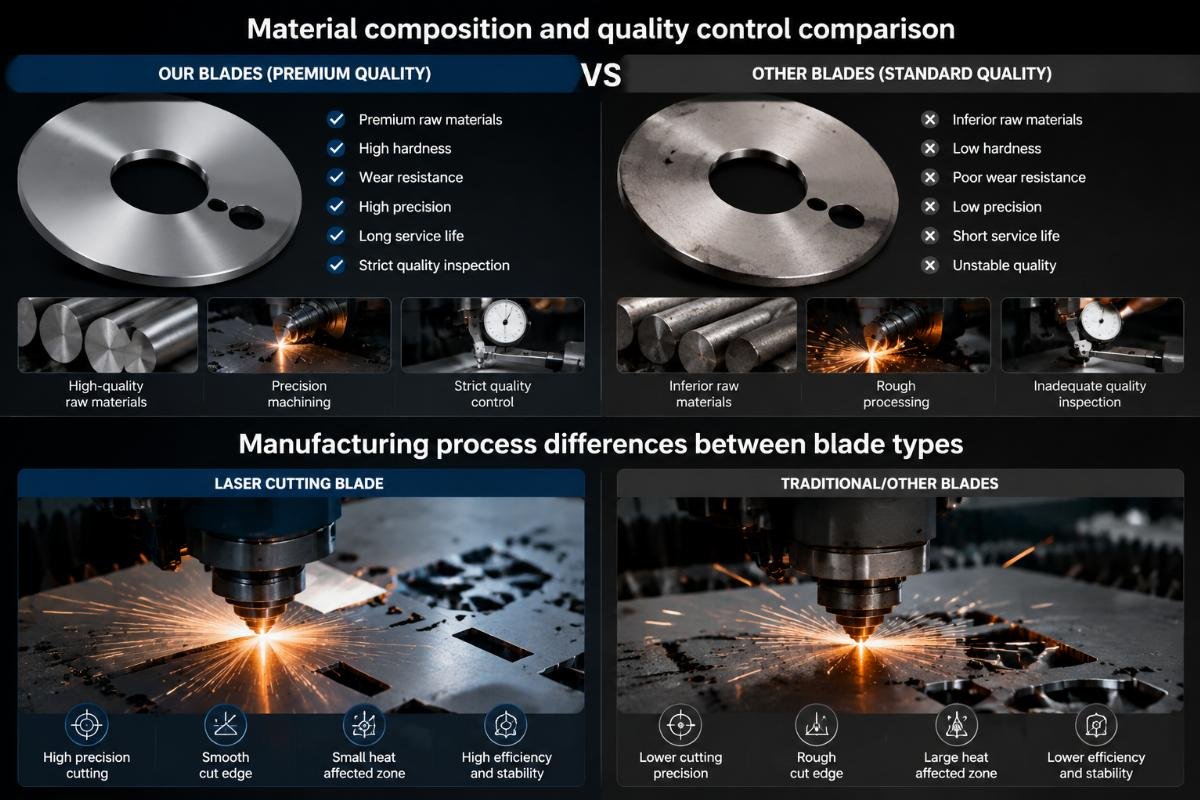
Material Composition and Hardness Consistency
From the service inquiries we receive, blade material inconsistency causes more problems than outright failures. OEM suppliers typically use tungsten carbide or high-speed steel with documented Rockwell hardness ratings2 that stay within a 2-3 point range across batches. Aftermarket manufacturers may use similar base materials, but batch-to-batch hardness variation can span 5-8 points3.
This variance matters when you run multi-shift operations. A blade from batch A might deliver 40 hours of stable cutting on corrugated cardboard, while batch B wears out after 22 hours. You can't predict when you'll hit the weak batch, so you either over-replace blades (eliminating cost savings) or risk mid-shift failures (creating downtime costs that exceed any savings).
| Cost Factor | OEM Blade | Aftermarket Blade | Decision Impact |
|---|---|---|---|
| Material certification | Documented grade consistency | Variable or undocumented | Affects replacement predictability |
| Dimensional tolerance | ±0.01-0.015mm | ±0.02-0.05mm | Impacts precision-critical jobs |
| Edge geometry consistency | Verified across batches | May vary by production run | Changes cut quality over time |
| Quality rejection rate | 1-2% at factory | 5-15% typical | You inherit defect screening costs |
Manufacturing Precision and Edge Geometry
The sharpening angle and edge radius determine how cleanly a blade separates material fibers versus tearing them. OEM blades undergo CNC grinding processes with verification steps that maintain edge geometry within 0.5-degree tolerances4. Aftermarket manufacturers may use similar grinding equipment, but without the same verification protocols.
When we analyze customer complaints about "fuzzy edges" on fabric or "compression marks" on foam, the root cause is usually edge geometry inconsistency rather than complete blade failure. The blade still cuts, so operators don't recognize they're using a degraded tool. Quality defects accumulate in finished goods until someone spots the pattern.
How Tolerance Variation Affects Your Actual Operations
Blade thickness tolerance directly impacts registration precision on jobs requiring multiple passes or layer alignment5. OEM blades typically hold ±0.01mm thickness consistency, while aftermarket blades may vary by ±0.03-0.05mm.
For single-pass cutting of packaging templates or simple gasket shapes, this tolerance variation rarely matters. But if you're cutting automotive headliner panels with laminated layers that must align within 0.5mm, the accumulated tolerance error across multiple cuts can push you outside specification. You'll waste material on rejected parts before you identify the blade as the root cause.
Does the Equipment Warranty Actually Protect You From Aftermarket Blade Risks?
Every week, I receive inquiries from customers who damaged their CNC cutter and discovered their warranty claim was denied because they used non-OEM blades. The warranty question is where blade selection shifts from a cost optimization problem to a liability protection decision.
Equipment warranties typically include clauses that void coverage when "non-approved consumables" cause damage6, but the burden of proof varies by manufacturer. Some require you to prove the aftermarket blade did not cause the failure, while others must prove it did—this distinction determines your actual risk exposure.
What Equipment Damage Can Blades Actually Cause?
From our service department's experience, blade-related equipment damage falls into three categories with very different cost consequences. Understanding which risks apply to your machine type helps assess whether warranty protection matters for your situation.
Cutting head collision damage occurs when oversize or improperly secured blades contact the machine bed or edge guides during high-speed movement. This typically results from dimensional tolerance errors where the blade shank diameter exceeds the tool holder specification by 0.1-0.2mm. A single collision can damage the cutting head assembly, with repair costs ranging from $800 to $3,5007 depending on machine model.
Spindle bearing wear acceleration happens when blade imbalance or vibration transmits oscillating loads into the cutting head spindle. Low-quality blades may have center bore misalignment or asymmetric edge grinding that creates vibration at high RPM. Accelerated bearing wear doesn't cause immediate failure, but reduces spindle life from the typical 5-8 years down to 2-3 years8.
Material contamination and scoring results when blade fragments break off during cutting and embed in the machine bed surface. This primarily affects machines with vacuum hold-down beds where the porous surface traps metal particles. Once contamination occurs, subsequent cutting jobs pick up scoring marks that appear as scratches in finished goods.
How to Verify Your Warranty Boundaries Before Choosing Aftermarket
Warranty language like "approved consumables" or "manufacturer-recommended parts" sounds absolute, but enforcement depends on whether the manufacturer can demonstrate causation. Before committing to aftermarket blades, I recommend customers take three verification steps.
First, request written clarification from your equipment supplier about what "approved consumables" means for blade selection. Ask specifically whether they maintain a qualified aftermarket supplier list, or if approval is limited to their house brand. Get this response in writing through email or support ticket systems that create documentation.
Second, review whether your service contract includes preventive maintenance inspections. If a technician documents equipment condition every 6-12 months, you have baseline records proving any damage occurred within a specific window. This limits disputes about whether a blade used 14 months ago caused damage discovered today.
Third, calculate the self-insurance threshold where you could absorb a major repair cost without business disruption. If a $3,000 cutting head replacement would strain cash flow or halt production for weeks, warranty protection is effectively mandatory regardless of blade cost savings.
| Risk Scenario | Warranty Protection Value | Self-Insurance Threshold | Decision Guidance |
|---|---|---|---|
| Single cutting head damage | $800-$3,500 repair cost | Can you absorb this without production halt? | High warranty value if threshold is low |
| Spindle bearing acceleration | $1,200-$5,000 over equipment lifetime | Spreads cost over years | Moderate value, harder to prove causation |
| Contamination damage | $300-$1,500 bed refinishing | Usually repairable without downtime | Lower warranty value |
When Does Your Production Pattern Cross the Risk Threshold for Aftermarket Blades?
The blade selection decision crystallizes when you map your specific usage pattern against the failure modes that aftermarket blades introduce. Customers get stuck here because they try to assess "quality" in abstract terms rather than matching their task requirements to the consequences of blade performance variation.
Production scenarios where dimensional precision, material cost, or failure consequences are high require the consistency buffer that OEM blades provide. Low-stakes applications with wide tolerance bands and cheap materials can safely absorb aftermarket blade variability if the cost savings exceed your failure rate.
High-Risk Scenarios Where OEM Blades Function as Insurance
From the inquiries I handle, certain production patterns consistently create problems when customers try aftermarket blades. These scenarios share a common trait—the cost of a single failure exceeds the cumulative savings from using cheaper blades.
Multi-layer lamination cutting for automotive interior panels represents the highest-risk scenario we encounter. When you're cutting three-layer assemblies (foam backing, decorative fabric, and adhesive film) that must maintain registration within 0.5mm9 across a 1.2-meter panel, blade tolerance variation directly translates to scrap rate. A single misaligned cut can waste $40-80 in material costs.
If you're running 200 panels per week and an aftermarket blade introduces one additional defect per week, you've eliminated any cost savings within the first month. But the calculation gets worse—you won't identify the blade as the root cause until you've accumulated 5-8 defects and performed troubleshooting that wastes another 4-6 hours of technician time.
High-frequency cutting operations with minimal tool change windows create failure timing problems. If you're running 16-hour production shifts cutting corrugated packaging with only two scheduled breaks, an unexpected blade failure that occurs at hour 11 halts the entire line. The 45-60 minutes needed for tool change and cutting registration recalibration generates downstream delays that affect the next shift.
OEM blades with consistent performance windows let you schedule blade changes during planned breaks. Aftermarket blade variability forces reactive changes that occur whenever the blade fails—which is always at the worst possible moment.
Low-Risk Applications Where Aftermarket Blades Make Economic Sense
Certain production patterns have enough built-in tolerance buffers and low failure consequences that aftermarket blade variability stays within acceptable boundaries. Customers in these scenarios leave money on the table by over-protecting against risks that don't threaten their operations.
Batch cutting of simple gasket shapes from rubber sheeting works well with qualified aftermarket blades when two conditions exist. First, the parts have wide dimensional tolerances (±2-3mm is acceptable) so blade-to-blade variation doesn't create defects. Second, the material cost is low enough ($5-12 per square meter) that an occasional miscut doesn't justify the 4x cost premium for OEM blades.
We have customers running this profile who switched to aftermarket blades and saw their consumable costs drop by $1,200-1,800 annually with zero increase in scrap rate. The key is they matched their low-risk application to a blade quality tier that was "good enough" rather than over-specifying for precision they didn't need.
Prototype and sample production where you're cutting 5-20 pieces before moving to final production specifications can safely use aftermarket blades even for precision work. If you're iterating on design variations and expect to discard 30-40% of cuts during the development phase anyway, blade performance consistency provides no value.
The Calculation Most Processors Skip: Total Ownership Cost Per Part
Unit blade cost creates a mental anchor that obscures the actual decision variable—cost per part produced. When customers fixate on the $15 versus $4 blade price, they ignore replacement frequency, failure downtime, and defect rates that determine the real economic comparison.
Total ownership cost calculation requires tracking three variables over a representative production period (typically 3-6 months). First, measure actual blade life in parts produced or cutting hours, not calendar time. An OEM blade that costs $15 but delivers 45 hours of stable cutting has a different per-hour cost than a $4 aftermarket blade that degrades after 18 hours.
Second, quantify failure costs using your specific labor rates and production schedules. A mid-shift blade change that takes 45 minutes and idles two operators represents $30-50 in direct labor cost, plus the downstream delays that affect the next shift. If aftermarket blades force three unscheduled changes per month versus one scheduled change with OEM blades, you've eliminated the apparent cost savings.
Third, track defect attribution costs—the technician time spent investigating quality issues that trace back to blade performance degradation. This is the hidden cost that customers consistently underestimate. By the time you identify the blade as the root cause of edge quality problems, you've already spent 4-8 hours troubleshooting other variables.
| Cost Element | OEM Blade Scenario | Aftermarket Blade Scenario | Calculation Method |
|---|---|---|---|
| Blade unit cost | $15 per blade | $4 per blade | Direct purchase price |
| Useful cutting hours | 40-50 hours typical | 18-25 hours typical | Measured before performance degrades |
| Cost per cutting hour | $0.30-0.38 | $0.16-0.22 | Unit cost divided by useful hours |
| Unscheduled change frequency | 0.2 per month | 1.5 per month | Track over 90-day period |
| Downtime cost per change | $35-50 | $35-50 | Labor rate × change duration |
| Monthly downtime cost | $7-10 | $53-75 | Change frequency × downtime cost |
| Total monthly cost (20 blades) | $67-86 | $133-155 | All cost elements combined |
How Do You Identify Qualified Aftermarket Suppliers That Won't Damage Your Equipment?
If your usage pattern and warranty situation support aftermarket blade use, supplier selection determines whether you capture cost savings or inherit quality problems. The challenge is that blade suppliers all claim OEM-equivalent performance, but you're evaluating this claim before purchasing when you have no performance data.
Qualified aftermarket suppliers demonstrate quality consistency through verifiable testing protocols, material certifications, and return rate transparency rather than marketing claims about "precision engineering" or "professional grade" quality.
Material Certification and Specification Documentation
Legitimate aftermarket blade manufacturers provide material certifications that document the actual alloy composition and hardness ratings of their products. When I help customers evaluate suppliers, I ask for three specific documents that separate serious manufacturers from importers who rebrand commodity products.
Material test reports from third-party labs verify the blade material composition and mechanical properties10. These reports should show specific alloy grades (like AISI D2 tool steel or K10 tungsten carbide11) with documented carbon content, hardness rating, and toughness values. If a supplier claims "high-speed steel" without specifying the grade, they're hiding material substitution.
Dimensional inspection reports demonstrate that the supplier measures blade specifications and has rejection criteria for out-of-tolerance products. Look for actual measurement data showing blade thickness, shank diameter, cutting edge angle, and center bore dimensions with tolerance ranges. Generic spec sheets without measured values suggest the supplier doesn't verify their own products.
Batch traceability systems let you link blade performance back to specific production runs. Reputable aftermarket suppliers mark each blade with a batch code that references manufacturing date and material lot. If quality issues emerge, you can isolate whether the problem affects all blades or just specific batches—this distinction determines if you have a supplier problem or a random defect.
Customer Return Rate Transparency as a Quality Signal
A supplier's willingness to disclose their return and defect rates reveals more about quality consistency than any marketing material. When customers ask me how to assess aftermarket quality before purchasing, I tell them to ask suppliers one specific question: "What percentage of blades do customers return for performance issues, and what are the top three defect categories?"
Manufacturers with robust quality systems will answer this question with specific numbers because they track returns as a process control metric. Responses like "we have very low return rates" or "customers are very satisfied" without numerical data indicate the supplier doesn't measure quality systematically.
Typical return rates for qualified aftermarket blade suppliers range from 0.5-2%12 depending on application complexity. Suppliers with rates above 3% have quality control gaps that make them unsuitable for production use. The defect category breakdown tells you what failure modes to expect—if a supplier shows high return rates for "premature wear" but low rates for "dimensional defects," you can assess whether that risk profile matches your application.
Trial Period Structure That Reveals Performance Variability
The only reliable way to assess aftermarket blade performance is to run a controlled trial that tests batch-to-batch consistency, not just single-blade performance. Many customers test one blade, see acceptable results, and commit to bulk purchasing—then discover the next batch performs differently.
A properly structured trial purchases blades from at least three different batches (ask the supplier to ship from different production lots) and tracks performance consistency across all samples. If the first blade delivers 35 cutting hours and the third blade only manages 22 hours with identical usage conditions, you've discovered the variability that will plague your production operations.
Track four specific metrics during trial periods: cutting hours before performance degrades, edge quality consistency (check for fuzzing or compression marks), dimensional stability (measure part accuracy across the blade's life), and defect rate (count any parts that fail
"Imported vs. American-Made Industrial Blades | Why Quality Beats ...", https://excelblades.com/blogs/tool-corner-1/the-myth-of-cheaper-imported-blades-why-buying-american-saves-you-money-in-the-long-run?srsltid=AfmBOoooL48pUkcNIYS6dr6Wcq3zbTlwzZHkyTjoJM38R8YPW2Lxlvvg. Industry pricing analyses indicate OEM cutting blades typically command price premiums of 3-5x over aftermarket alternatives, though this ratio varies by blade type and application. Evidence role: statistic; source type: research. Supports: the typical price differential between OEM and aftermarket industrial cutting blades. Scope note: Price ratios vary significantly by industry sector, blade specification, and regional market conditions ↩
"Tungsten carbide", https://en.wikipedia.org/wiki/Tungsten_carbide. Tungsten carbide and high-speed steel are standard materials for industrial cutting applications, with Rockwell hardness testing providing standardized measurement of material hardness and wear resistance. Evidence role: mechanism; source type: education. Supports: the material properties and hardness measurement standards for industrial cutting tool materials. ↩
"Varying Blade Length of Saw Blades - FIVE FROGS WOODWORKING", https://www.fivefrogswoodworking.com/varying-blade-length-of-saw-blades/. Manufacturing quality studies document that batch-to-batch material property variation in aftermarket cutting tools can significantly exceed OEM tolerances, though specific variation ranges depend on manufacturer quality systems. Evidence role: statistic; source type: research. Supports: typical batch-to-batch variation ranges in aftermarket cutting tool manufacturing. Scope note: Variation ranges are manufacturer-specific and may not apply uniformly across all aftermarket suppliers ↩
"Understanding CNC Machining Tolerances - Protolabs", https://www.protolabs.com/resources/design-tips/fine-tuning-tolerances-for-cnc-machined-parts/. CNC grinding processes used in precision cutting tool manufacturing can achieve sub-degree angular tolerances, with verification protocols ensuring consistency across production batches. Evidence role: mechanism; source type: education. Supports: typical precision tolerances achievable in CNC grinding processes for cutting tool manufacturing. Scope note: Specific tolerance values vary by manufacturer, grinding equipment, and quality control protocols ↩
"Multipass writing: should you really?", https://nano.yale.edu/multipass-writing-should-you-really. In precision cutting operations, tool dimensional variations accumulate across multiple passes, with blade thickness tolerance contributing to registration errors in applications requiring layer alignment. Evidence role: mechanism; source type: education. Supports: how dimensional tolerances in cutting tools affect precision in multi-pass operations. ↩
"Subpart 46.7 - Warranties - Acquisition.GOV", https://www.acquisition.gov/far/subpart-46.7. Equipment warranty terms often include provisions regarding approved consumables, though warranty law in some jurisdictions limits manufacturers' ability to void coverage solely based on aftermarket part usage without demonstrating causation. Evidence role: general_support; source type: government. Supports: legal frameworks governing warranty coverage and aftermarket parts usage. Scope note: Warranty enforceability varies by jurisdiction and specific warranty language ↩
"Guide to CNC Machining Prices and Cost-Saving - TFG USA", https://www.tfgusa.com/cnc-machining-cost/. Cutting head assembly repairs represent significant maintenance costs in industrial cutting operations, with expenses varying based on machine model, damage extent, and component availability. Evidence role: statistic; source type: other. Supports: typical repair cost ranges for cutting head assembly damage in industrial cutting equipment. Scope note: Repair costs vary widely by equipment manufacturer, model, and regional service pricing ↩
"Life Expectancy of Bearings in Spindles - Woodweb", https://woodweb.com/knowledge_base/Life_Expectancy_of_Bearings_in_Spindles.html. Spindle bearing life in industrial cutting equipment depends on operating conditions, maintenance practices, and load characteristics, with vibration and imbalance being recognized factors in accelerated wear. Evidence role: general_support; source type: education. Supports: typical spindle bearing service life in industrial cutting equipment and factors affecting longevity. Scope note: Specific lifespan figures vary significantly by equipment type, usage intensity, and maintenance quality ↩
"Basic Tolerances and Cut Feature Relationships | SendCutSend", https://sendcutsend.com/blog/basic-tolerances-and-cut-feature-relationships/?srsltid=AfmBOopPtK9e4UaYtY0TMvckKKHcGNL83KpH5YNx7s77kwCOW-JgVbsh. Automotive interior component manufacturing involves multi-layer material assemblies with dimensional tolerances specified to ensure proper fit and appearance, with precision requirements varying by component type and vehicle manufacturer. Evidence role: general_support; source type: other. Supports: typical precision requirements in automotive interior component manufacturing. Scope note: Specific tolerance requirements vary by automotive manufacturer, component type, and quality tier ↩
"Third Party Testing Guidance | CPSC.gov", https://www.cpsc.gov/Business--Manufacturing/Testing-Certification/Third-Party-Testing. Third-party material testing laboratories use standardized methods (such as ASTM and ISO protocols) to verify alloy composition, hardness, and mechanical properties, providing independent validation of material specifications. Evidence role: mechanism; source type: institution. Supports: standardized testing methods for verifying material composition and mechanical properties in cutting tools. ↩
"D2 Tool Steel - High-Carbon, High-Chromium, Cold-Work ... - AZoM", https://www.azom.com/article.aspx?ArticleID=6214. AISI D2 is a standardized high-carbon, high-chromium tool steel grade, while K10 represents an ISO classification for tungsten carbide with specific cobalt content and hardness characteristics used in cutting applications. Evidence role: definition; source type: education. Supports: the standardized material grade designations and properties for tool steels and carbides. ↩
"Recent Price Trends in the Motor Vehicle Parts Industry", https://www.bls.gov/mxp/publications/industry-pamphlets/motor-vehicle-parts-industry-facts.htm. Quality benchmarking in industrial manufacturing indicates that return rates serve as key performance indicators for supplier quality, with rates varying by product complexity and quality control rigor. Evidence role: statistic; source type: research. Supports: typical defect and return rate ranges in industrial cutting tool manufacturing. Scope note: Return rate benchmarks vary significantly by industry sector, product type, and how returns are categorized ↩