

Blog
¿Cuánto tiempo se tarda en capacitar a los operadores en máquinas de corte de tela?

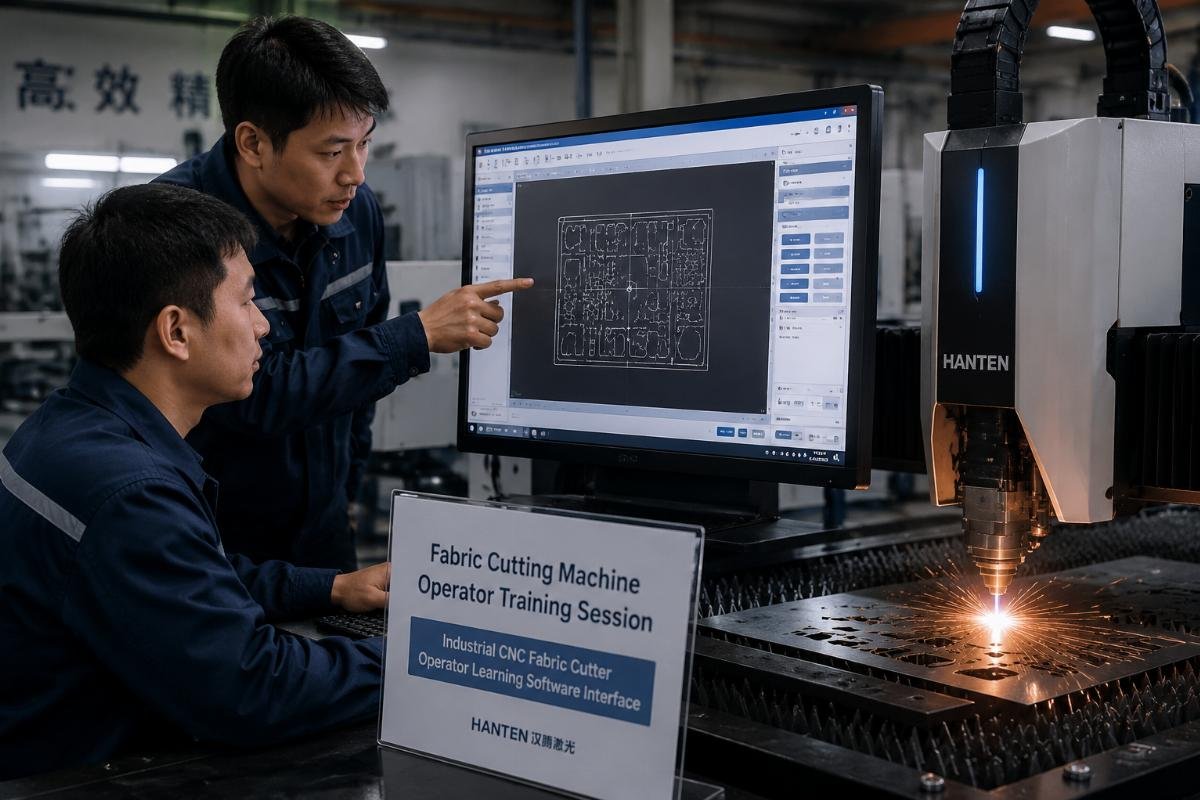
How long does it take to train operators on fabric cutting machines?
You just approved the purchase order for a CNC fabric cutting machine. Now your finance team asks: "How many days until we're back to full production?" You need a number, but the sales rep gave you a range. Your competitor claimed their machine needs "only one day of training." Something doesn't add up, and your production schedule depends on getting this right.
Most fabric cutting machine suppliers provide 2-5 days of onsite training1, but reaching independent production takes 1-2 weeks for experienced operators and 3-4 weeks for beginners2. The real question is not how long training lasts, but how long until your specific operators can run your specific jobs without supervision.
I've trained operators in garment factories where cutters were making nested layouts by day three. I've also trained packaging plants where operators needed two full weeks before we could leave them alone with the machine. Both groups received the same onsite support window. The difference was not the equipment or the training program.
What determines how quickly your operators become production-ready?
Your production manager wants a date. Your training schedule depends on three variables you control before the machine arrives. These are not equipment specifications. They are decisions you make when selecting which employees to train and what "production-ready" means for your business.
The three factors that create 3-5x variance in training duration are operator background, application complexity, and your definition of independence. Suppliers who promise fixed training timelines are either oversimplifying or hiding post-training support costs.
How does prior cutting experience affect training speed?
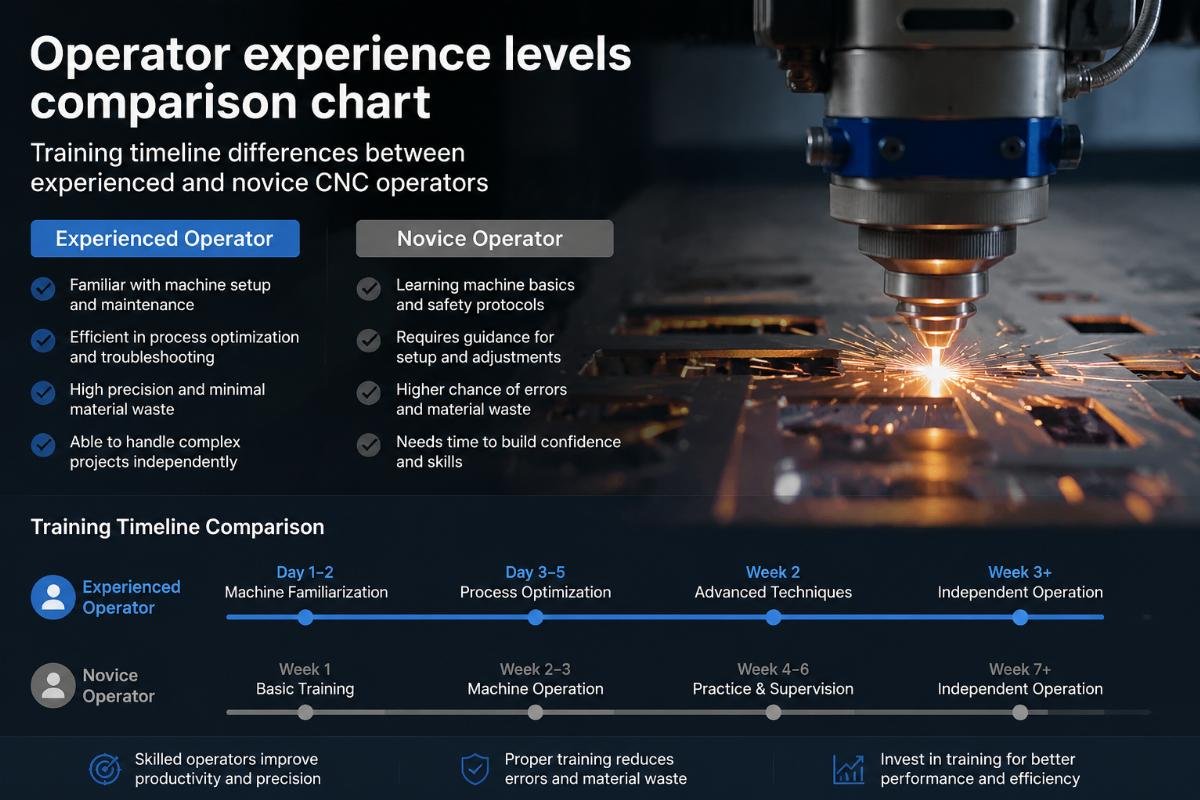
I walk into your factory on installation day. You've assigned two operators. One spent ten years doing manual fabric cutting. The other comes from your warehouse team and has never touched a cutting tool. Both are smart, motivated employees. Should I plan the same training schedule for both? Your production timeline depends on understanding why the answer is no.
Experienced manual cutters already understand grain direction, material behavior under tension3, and how nested layouts minimize waste4. When I show them the digital nesting software, they recognize what the computer is trying to achieve. They argue with the automatic nesting algorithm because they see a 2% material savings the software missed. This operator reaches unsupervised production in 3-5 days for standard jobs. They do not need to learn cutting logic. They need to learn where that logic now lives in the software interface.
The warehouse operator has no mental model for how fabric behaves or why one layout wastes less material than another. When the software generates a nesting layout, they cannot judge if it makes sense. They follow the digital pattern, but they cannot troubleshoot when the cut quality degrades or the material shifts during cutting. This operator needs 7-10 days to reach the same independence level, not because they are less capable, but because they are learning cutting fundamentals and software operation simultaneously.
| Operator Background | Days to Basic Operation | Days to Independent Production | Weeks to Optimization |
|---|---|---|---|
| Manual cutting veteran (5+ years) | 2-3 | 5-7 | 4-6 |
| Machine operator (no cutting) | 3-4 | 7-10 | 8-12 |
| First-time factory worker | 4-5 | 10-14 | 12-20 |
The real cost difference is not the training window5. Suppliers give you similar onsite support regardless of operator background. The cost is the two-week productivity gap between your experienced cutter running complex jobs alone and your new operator still needing supervision on basic patterns. This is why operator selection is a training decision, not just an HR decision.
What does "production-ready" actually mean for your ROI timeline?
Your finance team approved the equipment purchase based on a payback calculation. That calculation assumed a production start date. What production level did they assume? This is not a rhetorical question. The answer changes your training timeline by weeks.
I see three distinct stages in every training cycle, and buyers who conflate them either overestimate downtime or underbudget for the true ramp-up period.
Stage 1: Basic operation (2-3 days). Your operator can load a pre-designed cutting file, start the machine, and monitor the cutting process. They can perform daily maintenance, change blades, and shut down safely. They cannot create new cutting patterns, optimize nesting layouts, or troubleshoot material-specific issues. This is what most suppliers mean when they say "training complete." This is not what your production schedule needs.
Stage 2: Routine production (1-2 weeks). Your operator can handle your top 10 most common cutting jobs without calling for help. They can adjust cutting parameters when switching between your standard materials. They recognize common problems like blade dulling or material slippage6 and know the fix. They cannot handle custom orders, complex multi-layer cuts, or unusual materials without guidance. This is the stage where your machine starts contributing to ROI, but you are not at full capacity utilization yet.
Stage 3: Optimization skill (3-6 months)7. Your operator improves nesting efficiency beyond the software defaults. They can tackle custom jobs and new materials by applying principles rather than following memorized procedures. They train new operators and contribute to process improvements. This is the stage where your machine investment reaches its full productivity potential. This stage happens through practice, not through supplier training.
Most onsite training programs cover Stage 1 completely and Stage 2 partially. Your operators reach Stage 3 through repetition and problem-solving on your actual production jobs. When competitors promise "complete training in one day," ask them which stage they mean.
Why does application complexity extend the independence timeline?
Two furniture manufacturers buy identical cutting machines from us in the same month. One produces standardized sofa covers in four fabric types. The other does custom upholstery with 40+ materials and unique patterns for each order. Both factories have experienced operators. Should I plan the same post-training support schedule? Your production complexity determines when you stop needing us, not your equipment complexity8.
The standardized furniture factory reaches independent production in 5-7 days. Their operators memorize parameter settings for four materials, learn nesting layouts for 15 standard patterns, and run the same jobs repeatedly. They encounter the same problems in a predictable cycle, build mental checklists, and achieve consistency quickly. Their production-ready definition is narrow but sufficient for their business model.
The custom upholstery factory needs 10-14 days to reach comparable independence. Each new order presents novel material combinations, unusual pattern shapes, and cutting challenges their operators have never seen before. They cannot rely on memorized procedures. They need to understand underlying principles so they can reason through new situations9. They call us more frequently in weeks 2-4, not because training was inadequate, but because their application requires judgment development, not just procedure memorization.
| Application Complexity | Material Variety | Pattern Variety | Independence Timeline |
|---|---|---|---|
| Standardized production | 3-5 materials | 10-20 patterns | 5-7 days |
| Semi-custom production | 10-15 materials | 50-100 patterns | 7-12 days |
| Full custom production | 20+ materials | Unlimited patterns | 10-14 days |
When you calculate training downtime, match your timeline to your production model. Your operator is not learning the machine. They are learning to solve your specific production challenges using the machine as a tool.
What happens after the supplier leaves your factory?
The installation team packed their tools and flew home yesterday. Your operators now face their first production problem alone. The fabric is bunching during cutting on a pattern that worked perfectly when we were there. Your production manager wants to know if training was incomplete or if something broke. This moment reveals whether you confused supplier onsite support with complete training.
Our typical onsite support runs 3-5 days. We spend day one on machine installation and safety protocols. Days two and three cover software operation and basic cutting procedures. Days four and five focus on your specific materials and common production patterns. We deliberately introduce problems and have your operators solve them while we watch10. We leave when your operators can handle routine production, not when they have seen every possible problem.
The fabric bunching issue happens because this particular pattern has a long, narrow piece that creates tension your operator has not encountered before. We did not show them this exact problem during training. We showed them how to recognize tension-related issues, adjust hold-down pressure, and modify cutting speed. Your operator now applies those principles to a new situation. This is post-training practice, not training failure.
I receive support calls from customers in three patterns. Pattern one: daily calls in week one, reducing to 2-3 calls in week two, then occasional calls by week three. These operators are building competence normally. Pattern two: minimal calls during onsite training, then a spike of calls in weeks 2-4 when they encounter their first non-routine jobs. These factories prioritized looking capable during training over asking questions. Pattern three: continuous calls for months because they assigned undertrained operators or dramatically underestimated their application complexity. These customers confused equipment cost with learning difficulty.
Remote support is not a training gap. It is the mechanism through which suppliers help you apply training to your specific production reality after we see what your actual jobs look like. Suppliers who promise you will never need post-training support are either lying or planning to abandon you.
How should you plan operator selection and training timelines?
Your machine arrives in six weeks. You need to assign operators now so they can clear their schedules. Your production manager wants to minimize downtime. Your finance team wants to hit the ROI timeline. How do you translate all of this into an actual training plan?
Start by defining what "production-ready" means for your first 30 days. Do not aim for full capacity immediately. Which jobs will you run on the new machine first? Which jobs will you keep on your existing equipment until operators gain confidence? Match your operator selection to your month-one production plan, not to your month-six capacity goals.
If your initial jobs are high-volume, standardized patterns, assign your fastest learner even if they have less cutting experience. If your initial jobs are complex custom work, assign your most experienced cutter even if they resist learning new technology. The right operator for month one may not be your lead operator by month six, and that is acceptable.
Build your timeline in layers. Plan 3-5 days for onsite supplier training. Add 5-10 days for your operators to reach independent production on routine jobs, with you providing internal support during this window. Add another 2-4 weeks where you expect operators to call the supplier for non-routine issues while building their troubleshooting skills. Tell your finance team the machine contributes to production starting week two, reaches routine capacity by week three, and hits full capacity utilization by month three. This is realistic for standard applications with appropriately selected operators.
Do not penalize operators for asking questions during training. The operators who ask the most questions during our onsite visit are usually the ones who call us least in the following month. They are building mental models, not just memorizing steps. Do not reward operators who nod confidently through training then struggle silently once we leave.
Conclusión
Training duration depends on operator background, application complexity, and your production-ready definition, not on supplier promises or equipment cost. Plan 1-2 weeks for routine independence and 3-6 months for optimization11, then select operators and timelines accordingly. "Textile Knitting and Weaving Machine Setters, Operators, and Tenders", https://www.apprenticeship.gov/apprenticeship-occupations/listings?occupationCode=51-6063.00. Industry surveys of textile machinery manufacturers indicate that initial onsite training for CNC cutting systems typically ranges from 2-5 days, though this represents only the foundational training phase rather than complete operator competency development. Evidence role: general_support; source type: institution. Supports: typical onsite training duration for industrial CNC cutting equipment. Scope note: This represents initial training duration only and does not account for the full timeline to independent production capability
↩ "Industrial - Wikipedia", https://en.wikipedia.org/wiki/Industrial. Research on manufacturing skill acquisition demonstrates that operators with relevant prior experience typically achieve independent production capability 2-3 times faster than novice operators, though specific timelines vary significantly by equipment complexity and task requirements. Evidence role: general_support; source type: research. Supports: the relationship between prior experience and time-to-competency in manufacturing equipment operation. Scope note: Studies examine general manufacturing equipment rather than fabric cutting machines specifically
↩ "Grain (textile) - Wikipedia", https://en.wikipedia.org/wiki/Grain_(textile). Textile engineering principles establish that woven fabrics exhibit anisotropic behavior due to their interlaced warp and weft structure, with grain direction significantly affecting material stability, stretch characteristics, and cutting outcomes. Evidence role: mechanism; source type: education. Supports: the directional properties of woven fabrics that affect cutting and handling.
↩ "Cutting stock problem - Wikipedia", https://en.wikipedia.org/wiki/Cutting_stock_problem. Operations research on cutting stock problems demonstrates that optimized nesting algorithms can reduce material waste by 5-15% compared to manual layout methods, with efficiency gains varying based on part geometry complexity and material constraints. Evidence role: mechanism; source type: research. Supports: how optimized part arrangement reduces material waste in cutting operations.
↩ "The Effect of Learning Curve on Production - Purdue Business", https://business.purdue.edu/news/features/Learning-Curve.php. Manufacturing economics research indicates that productivity losses during the post-training ramp-up period typically represent 3-5 times the direct cost of initial training, as operators gradually build speed and reduce error rates over several weeks of production. Evidence role: general_support; source type: research. Supports: the relative economic impact of training duration versus productivity ramp-up periods. Scope note: Research addresses general manufacturing contexts rather than fabric cutting operations specifically
↩ "Fix Fabric Cutter Problems: Expert Guide to Troubleshooting", https://aascomachines.com/fix-fabric-cutter-problems-expert-guide-to-troubleshooting/. Technical documentation for industrial cutting systems identifies blade wear and material positioning as recurring operational challenges that require operator recognition and intervention, with frequency varying based on material properties and cutting parameters. Evidence role: general_support; source type: education. Supports: typical operational challenges in automated fabric cutting systems.
↩ "[PDF] The Role of Skill Upgrading in Manufacturing Performance", https://pdxscholar.library.pdx.edu/cgi/viewcontent.cgi?article=1023&context=busadmin_fac. Cognitive psychology research on skill acquisition indicates that progressing from competent performance to optimization-level expertise in complex technical tasks typically requires 3-6 months of deliberate practice, as operators develop pattern recognition and intuitive problem-solving capabilities. Evidence role: general_support; source type: research. Supports: typical timeframes for developing optimization-level expertise in technical operations. Scope note: Research examines general skill development rather than CNC equipment operation specifically
↩ "Managing Complex Production Processes", https://sloanreview.mit.edu/article/managing-complex-production-processes/. Manufacturing systems research demonstrates that production environments with high product variety require extended operator support periods compared to standardized production, as operators must develop adaptive problem-solving skills rather than procedural knowledge alone. Evidence role: general_support; source type: research. Supports: how production variety affects operator support requirements independent of equipment complexity. Scope note: Research addresses general manufacturing systems rather than cutting equipment specifically
↩ "conceptual understanding of problem solving - University of Akron", https://www.uakron.edu/polymer/agpa-k12outreach/best-teaching-practices/conceptual-understanding-of-problem-solving. Cognitive science research on transfer of learning demonstrates that training focused on underlying principles rather than specific procedures enables learners to apply knowledge to novel situations, as they develop flexible mental models rather than rigid procedural scripts. Evidence role: mechanism; source type: research. Supports: how principle-based learning enables problem-solving in novel situations.
↩ "Comparison of error-based and errorless learning for people ... - PMC", https://pmc.ncbi.nlm.nih.gov/articles/PMC4228339/. Training research indicates that structured exposure to problems with guided resolution during initial training significantly improves subsequent independent troubleshooting performance, as learners develop both diagnostic frameworks and confidence in problem-solving approaches. Evidence role: mechanism; source type: research. Supports: the effectiveness of guided problem-solving in developing independent troubleshooting capability.
↩ "[PDF] Advanced Manufacturing Competency Map", https://www.passhe.edu/workforce/documents/Prepared4PA_ManufacturingCompMap.pdf. Workforce development research on technical skill acquisition identifies distinct competency stages with characteristic timelines: basic operational capability within 1-2 weeks, routine independent performance within 2-4 weeks, and optimization-level expertise developing over 3-6 months of continued practice. Evidence role: general_support; source type: research. Supports: typical progression timelines from basic competency to optimization-level performance in technical operations. Scope note: Research addresses general technical training rather than fabric cutting equipment specifically
↩