

Blog
What supplier safety guard certification standards should I verify before buying knife cutting machines?

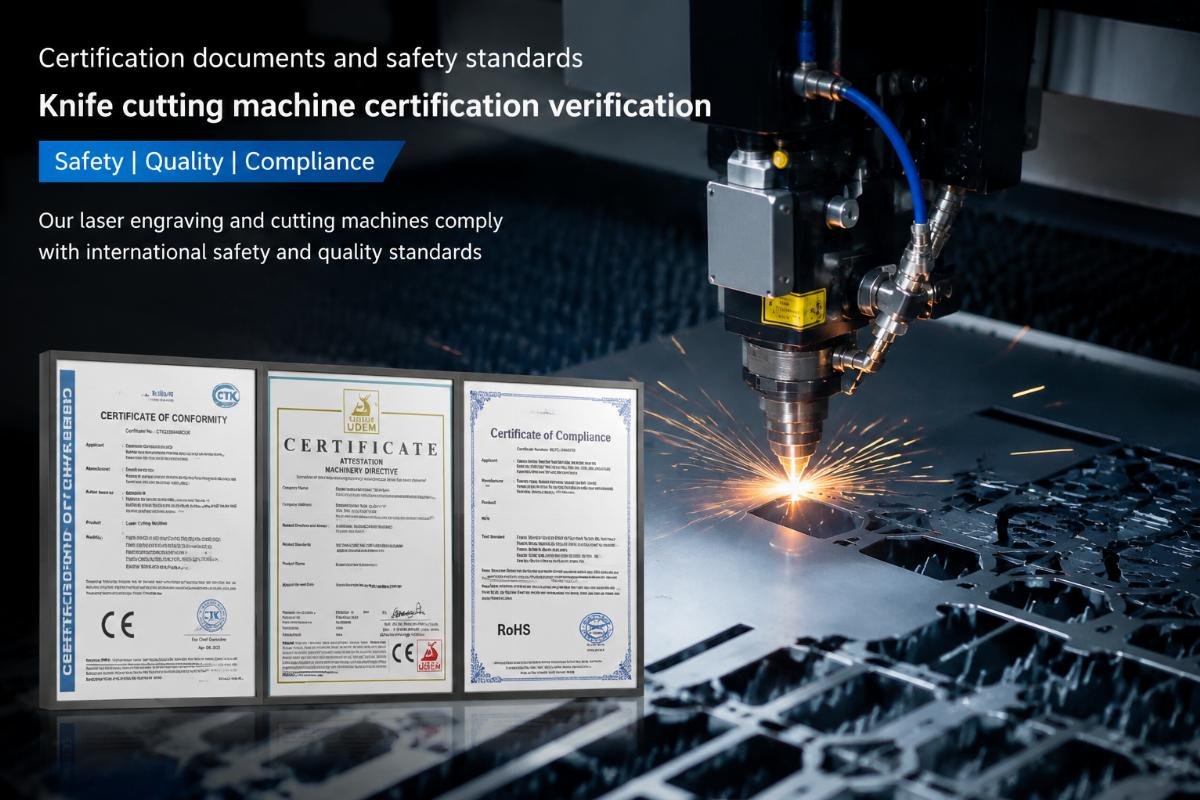
What supplier safety guard certification standards should I verify before buying knife cutting machines?
You've found a knife cutting machine supplier with an impressive certification list, but which marks actually protect your business from regulatory blocks, workplace liability, and customs delays? Most buyers collect certification documents without understanding what each standard covers or whether it matches their specific use case.
Supplier safety guard certification requirements split into three separate systems: market entry compliance (CE/UL marks for legal sale), customs clearance documentation (HS codes and origin certificates), and workplace safety obligations (OSHA/local labor codes). The certifications you need depend on your equipment's destination region, your role as end-user/distributor/integrator, and your operating environment — not on collecting the longest certification list.
I talk to buyers every week who send the same message: "Send me all your certifications." When I ask what they're actually using the machine for, where it's going, and who's responsible for workplace safety, most pause. They thought certification was a one-time supplier checkbox, not a decision tree with legal and financial consequences that depend on their answers.
Why does certification confusion cause so many procurement mistakes?
Buyers search for "certification standards" because they know certifications matter, but suppliers hand them a mixed list without explaining what each mark unlocks or what risks remain after purchase. This creates three expensive mistakes I see repeatedly.
Certification confusion stems from three systems being presented as one: regulatory market access (the right to sell equipment in a region), trade documentation (customs clearance requirements), and operational safety compliance (workplace hazard management). Each system serves different gatekeepers, covers different liability boundaries, and requires different post-purchase actions from buyers.
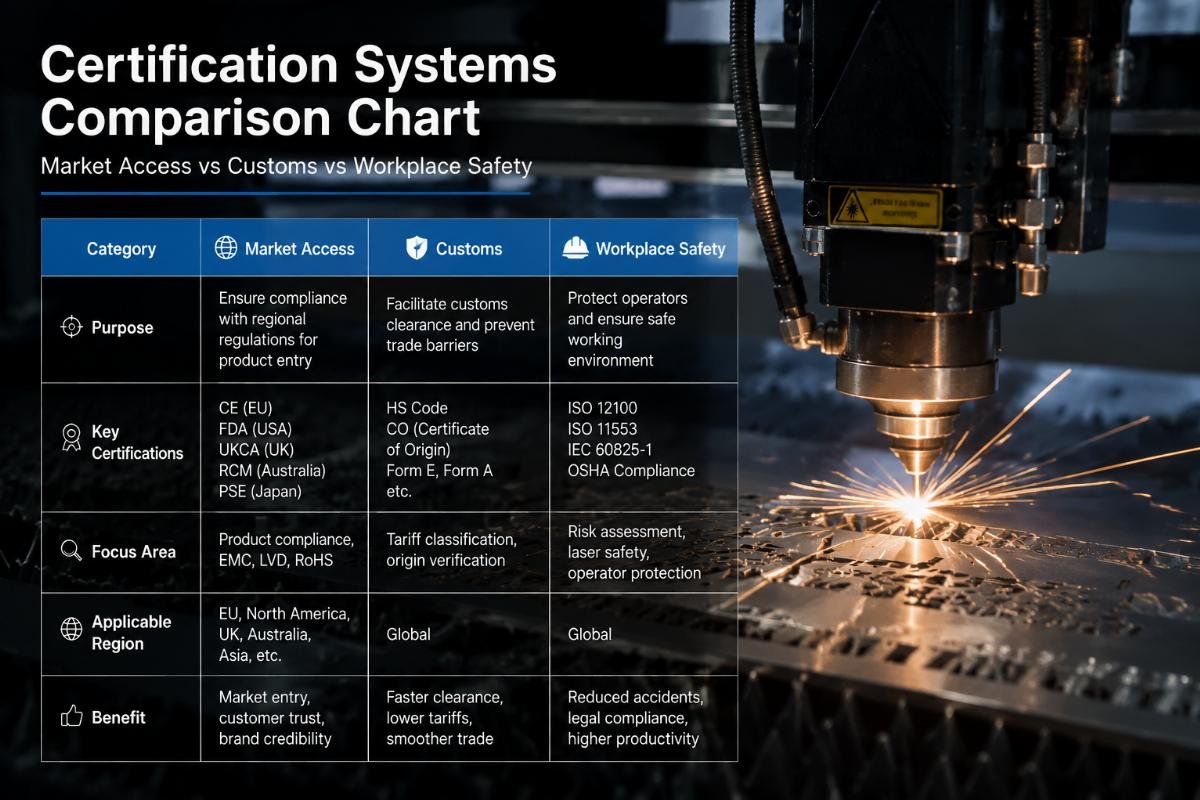
The first mistake happens when buyers treat CE marking as a safety inspection report. A factory manager in Germany once told me he assumed CE meant "tested safe for German factories." When his insurance auditor visited, she explained CE only confirms the manufacturer's claim that the machine meets EU directives — it doesn't cover his workplace risk assessment obligations under German occupational safety law. He needed separate documentation showing emergency stop response times, blade guard effectiveness testing, and operator training protocols. The CE mark gave him market access but didn't touch his liability as the employer operating the equipment.
The second mistake involves customs. A distributor in Brazil ordered machines with full CE certification, assuming that covered import requirements. Customs held the shipment for three weeks requesting product classification documents, voltage compliance certificates for Brazilian standards, and Portuguese-language technical manuals. CE marking applies to EU market entry, not Brazilian import regulations. He needed INMETRO certification and specific customs documentation that had nothing to do with the CE mark on the machine.
The third mistake comes from role confusion. An equipment integrator in Texas asked if our CE marking would cover his liability when installing our cutting machine into his client's automated production line. It wouldn't. As the integrator, he's responsible for system-level safety compliance under OSHA and potentially UL 508A standards for industrial control panels. Our machine certification covers the equipment we sold him, not the integrated system he's building. He needed to conduct his own hazard assessment and possibly seek additional certification for the complete installation.
Buyers focus on upfront certification costs and supplier credentials but miss ongoing compliance duties that shift to them after delivery. This disconnect between purchase-time documentation and operational-phase obligations creates liability gaps.
| Certification Stage | Supplier Responsibility | Buyer Responsibility | Common Gap |
|---|---|---|---|
| Pre-sale | Provide valid certification documents matching destination region | Verify certifications match intended use case and regulatory requirements | Buyers request generic certification without checking regional applicability |
| Customs clearance | Supply accurate HS codes, origin certificates, technical specifications | Ensure import documentation meets destination country customs requirements | CE marking treated as universal import approval |
| Installation | Provide installation manual meeting local language/unit requirements | Conduct workplace risk assessment and implement safety measures per local labor law | Buyers assume machine certification covers workplace compliance |
| Operation | Honor warranty terms and provide technical support | Train operators, maintain safety guards, document safety procedures, conduct periodic inspections | Buyers overlook ongoing documentation and inspection requirements |
| Incident investigation | Cooperate with investigations and provide technical data on machine design | Demonstrate workplace safety measures were implemented and maintained | Liability confusion when both machine design and workplace procedures are questioned |
A packaging factory in Poland learned this the hard way. They purchased machines with full CE marking and proper customs documentation. Two years later, a labor inspector visited and requested documentation showing they'd conducted initial and annual safety training for operators, maintained service records with safety-critical checks, and had written procedures for blade replacement and emergency response. The CE mark proved the supplier met EU machine directive requirements at manufacture, but didn't create the workplace safety documentation the factory was legally required to maintain. They faced fines not because the machine lacked certification, but because they failed their own compliance obligations as the equipment operator.
Which certifications actually matter for my specific buying scenario?
Generic certification lists waste time and budget. The marks you need depend on three variables that most suppliers don't ask about before sending their standard certification package.
Certification requirements map to three decision variables: destination region (determines market access marks), buyer role (determines liability boundaries), and operating environment (determines workplace safety standards). A machine sold to an EU end-user needs CE marking and potentially workplace risk assessment documentation; the same machine sold to a North American distributor for resale needs different marks and doesn't require end-use safety documentation from the supplier.
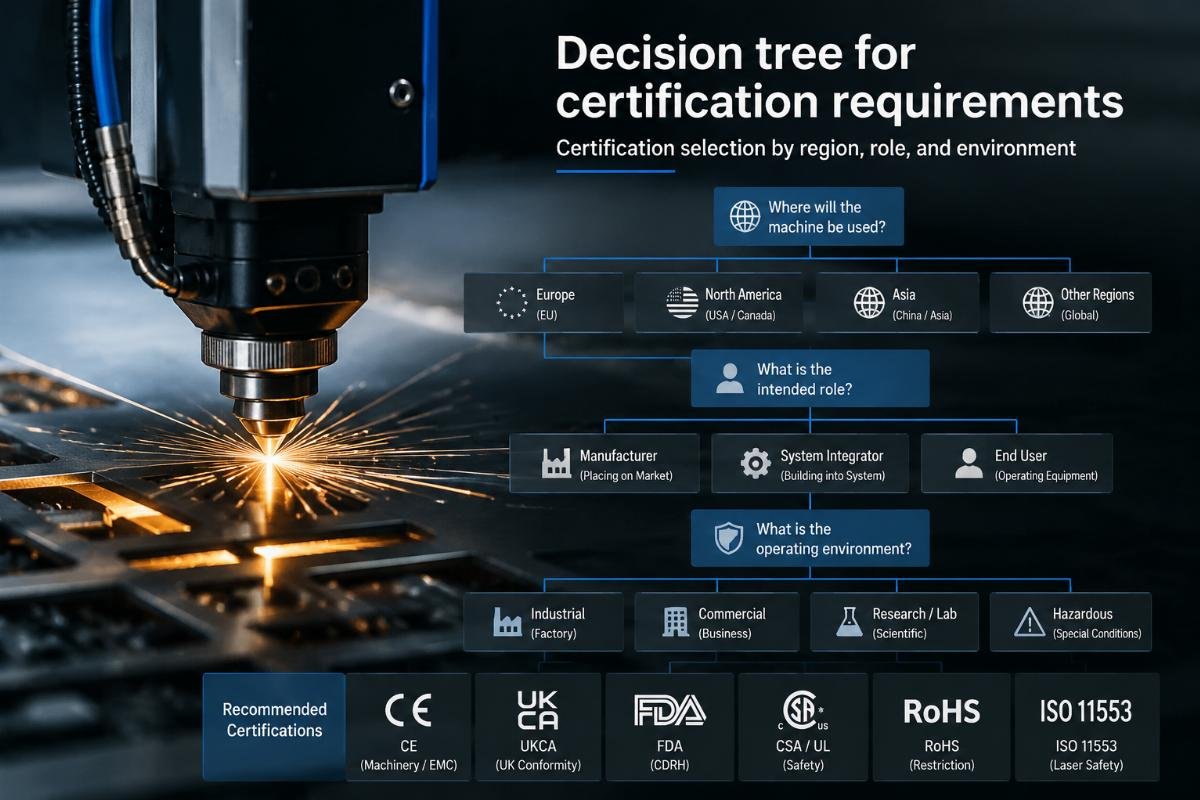
I ask buyers three questions before discussing our certification portfolio. First, where will the machine physically operate? This determines market access requirements. EU destinations require CE marking under the Machinery Directive. UK destinations now require UKCA marking post-Brexit. North American buyers may need UL or CSA certification depending on their customer requirements and local electrical codes. Asian markets have their own standards — CCC marking for China, PSE for Japan, KC for South Korea. A distributor in Australia ordering for local resale needs different marks than a distributor ordering for export to Southeast Asia.
Second, what's your role in the supply chain? End-users who operate equipment in their own facilities carry workplace safety obligations and need documentation supporting their risk assessments. Distributors who resell without installation need market access certification and commercial documentation but not operational safety protocols. Integrators who incorporate our machines into larger systems need machine-level certification plus technical data allowing them to conduct system-level safety analysis. I've seen integrators purchase machines with full certification but lack the technical specifications they needed to prove their integrated system met safety standards, forcing expensive re-engineering.
Third, what's your operating environment? Industrial production facilities face stricter workplace safety regulations than R&D labs or small workshops. A factory manager operating multiple shifts with minimally trained operators needs comprehensive safety documentation, operator training materials, and potentially third-party workplace risk assessment support. A university research lab with PhD-level users in controlled environments has different risk profiles and documentation needs. The certifications required to sell the machine are identical, but the supporting documentation that makes the certification useful varies dramatically.
How do regional regulations create different certification priorities?
The EU, North America, and Asia use fundamentally different regulatory approaches that change which certifications provide real value versus which ones are supplier marketing padding.
| Region | Core Requirement | What It Covers | What Buyers Still Need | Common Misunderstanding |
|---|---|---|---|---|
| European Union | CE marking (Machinery Directive 2006/42/EC) | Manufacturer's declaration that machine meets essential health and safety requirements | Workplace risk assessment per EU member state occupational safety law; operator training; periodic inspections | "CE means tested safe" — actually means manufacturer claims compliance |
| United Kingdom | UKCA marking (post-Brexit) | Similar to CE but UK-specific; declaration of conformity to UK regulations | Same workplace obligations as EU; separate mark required since 2023 | "CE still works in UK" — transition period ended |
| United States | UL certification (voluntary); OSHA workplace standards (mandatory) | UL covers electrical safety; OSHA requires employer hazard assessment and controls | Employer conducts hazard assessment; implements machine guarding per OSHA 1910.212; trains workers | "UL certification covers OSHA compliance" — separate systems |
| Canada | CSA certification (often required by provinces); CCOHS workplace standards | CSA covers electrical/mechanical safety; CCOHS requires employer hazard controls | Similar to US — employer-led workplace safety program | "Federal certification covers provincial requirements" — provinces vary |
| China | CCC marking (mandatory for market entry) | Certification that product meets Chinese safety and quality standards | Factory registration; customs documentation; ongoing surveillance audits | "CCC is one-time certification" — requires continuous compliance |
A distributor in the Netherlands asked why we provided CE marking but his customer in Switzerland requested additional documentation. Switzerland isn't an EU member, so while CE marking often facilitates market access, Swiss authorities can request additional conformity assessment. He needed to verify Swiss-specific requirements beyond EU standards. Similarly, a buyer in Norway (not EU but part of EEA) needed CE marking but faced different workplace safety enforcement than an EU member state.
The North American situation confuses many international sellers. A factory manager in Ohio told me he needed UL certification to satisfy his insurance company and local building inspector, even though OSHA doesn't mandate UL marks. UL certification is voluntary at the federal level but often becomes a practical requirement through insurance policies, local electrical codes, and customer purchasing requirements. Meanwhile, his OSHA obligations to conduct hazard assessments and implement machine guarding existed regardless of whether the machine had UL certification. The certification helped him demonstrate due diligence but didn't replace his own safety program.
What questions should I ask suppliers about their certification claims?
Suppliers list certifications in marketing materials without explaining validity periods, scope limitations, or what the certification doesn't cover. Ask specific questions that reveal whether their certifications match your needs and risk exposure.
I suggest buyers ask five questions that separate substantive certification from marketing noise. First, "What specific models and configurations does your certification cover?" Some suppliers show certification for one machine model but sell multiple variants. A CE certificate for our standard machine configuration doesn't automatically extend to customer-specific modifications with different blade types, material handling systems, or control interfaces. If you're ordering customized equipment, verify the certification covers your actual configuration or understand what additional conformity assessment you'll need.
Second, "What's the certification's validity period and renewal status?" Some certifications require periodic renewal or surveillance audits. CCC marking in China requires annual factory inspections and certificate renewals. If a supplier shows a CCC certificate from three years ago, ask if they've maintained compliance through required audits. Expired or non-renewed certifications create import and liability risks even if the physical machine hasn't changed.
Third, "What testing lab or notified body issued the certification?" Not all certification bodies have equal recognition across regions. For CE marking, ask which notified body (if required for their machine category) issued the certificate and verify that body's scope covers machinery safety. For UL certification, verify it's from UL itself, not a similar-sounding mark. I've seen suppliers present certificates from unknown testing labs that buyers' customers and regulators didn't recognize.
Fourth, "What technical documentation accompanies the certification?" CE marking requires a technical file including risk assessment, design calculations, test reports, and instructions. A supplier who provides the CE mark but can't supply the underlying technical file may not have conducted proper conformity assessment. This technical documentation becomes critical if you're an integrator needing to analyze how the machine fits into your system safety analysis, or if regulators question the certification's validity.
Fifth, "Where does your certification responsibility end and mine begin?" This question clarifies liability boundaries. Ask specifically: "Does your CE marking cover my workplace risk assessment obligations?" and "If I modify the machine or integrate it into a production line, what happens to the certification?" Suppliers should clearly explain that their certification covers the machine as delivered but your responsibilities for workplace safety, operator training, and system integration remain separate.
How do different buyer roles change certification requirements?
A certification that's mandatory for one buyer type may be irrelevant or insufficient for another. Understanding your role in the supply chain determines which certifications protect your specific risks.
End-users operating equipment in their own facilities need certifications that support workplace compliance, not just market access. Distributors reselling equipment need certifications that enable legal sale in target markets plus commercial documentation. Integrators need machine-level technical data allowing system-level safety analysis.
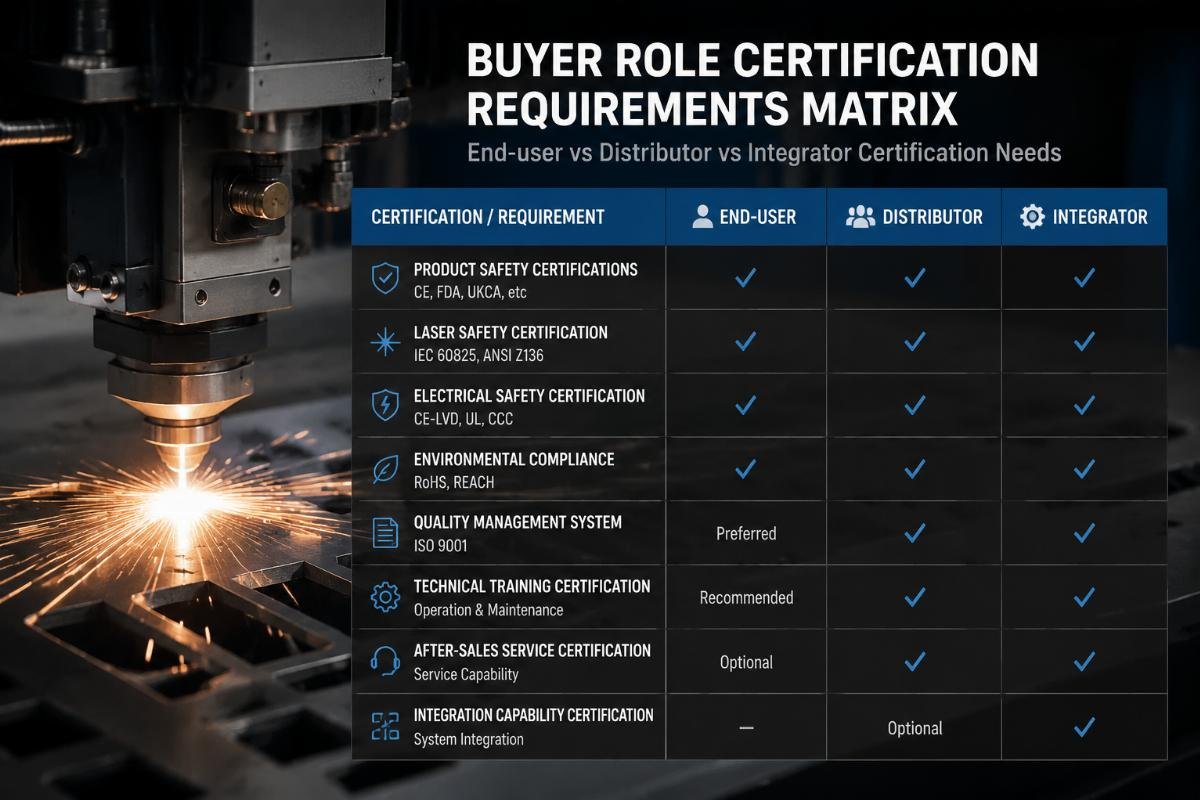
I work with a furniture manufacturer in Italy who operates our machines in their own production facility. They're end-users. Their procurement manager asked for CE marking and then requested our risk assessment documentation, safety test reports, and operator training materials. They needed these not because Italian law required them from us, but because Italian occupational safety law required them to conduct a workplace risk assessment. Our documentation helped them fulfill that obligation. They also asked about noise level test data and ergonomic specifications because their workplace health program required monitoring these factors. For end-users, certification is the starting point, not the endpoint.
Contrast this with a distributor in Denmark who resells cutting machines to multiple industries. They needed valid CE marking and declaration of conformity to legally place equipment on the EU market. They requested technical manuals in Danish and Swedish for their customers. But they didn't ask for the detailed risk assessment documentation the Italian manufacturer needed, because as a distributor not operating the equipment, they don't conduct workplace risk assessments. Their risk is commercial (selling non-compliant equipment) not operational (workplace injuries). They needed clear conformity statements and proper documentation chain to protect against regulatory penalties on their resale business.
An integrator in the US presented a third scenario. They build automated cutting systems for automotive suppliers, incorporating our knife cutting machines into multi-stage production lines with robots, conveyor systems, and centralized controls. They needed our machine certification and detailed technical specifications: response time data for emergency stops, electrical schematics, mechanical drawings, and information on safety-related control functions. This data allowed their engineers to conduct system-level hazard analysis under OSHA and potentially seek UL 508A certification for their complete control panel. Our machine certification covered the equipment we sold, but they couldn't use it to claim their integrated system was certified without conducting their own analysis and possibly seeking system-level certification.
How should I evaluate a supplier's certification portfolio for my needs?
Translate the supplier's certification list into a risk assessment for your specific use case. Map each certification to what it actually protects you from and what obligations it leaves with you.
Effective certification evaluation starts with your variables — region, role, environment — then asks whether each certification closes a specific risk gap. Skip certifications that don't apply to your scenario; demand documentation for certifications that matter; verify ongoing compliance requirements beyond purchase.
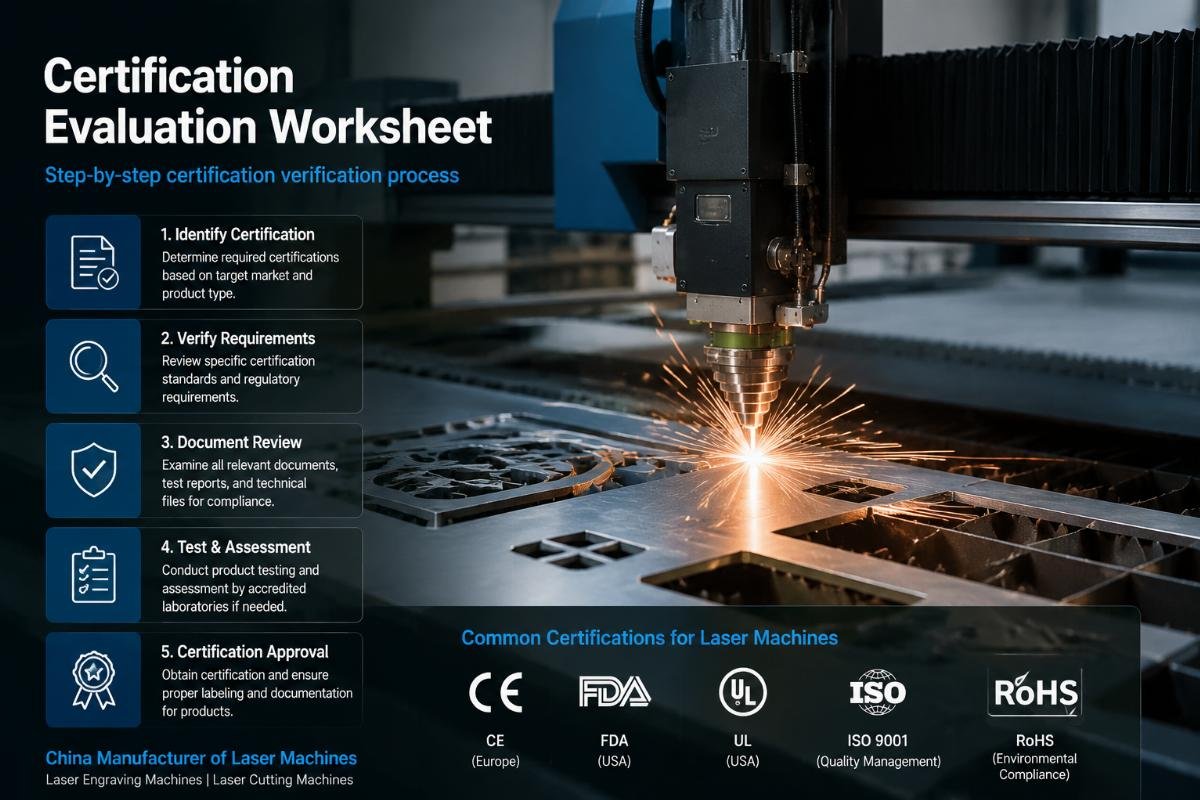
I create a simple evaluation framework with buyers. In the left column, list your requirements based on destination region regulations, your role obligations, and your operating environment standards. In the middle column, list the supplier's certifications. In the right column, note gaps where your requirements exceed supplier certifications and additional actions you must take.
A buyer in South Africa used this approach. In their left column: "Import to South Africa — need SABS compliance or equivalent; operate in food packaging facility — need sanitary design documentation; employ operators with basic education — need simplified training materials." In the middle column: our CE marking, ISO 9001 quality certification, test reports for electrical safety. In the right column they identified gaps: "CE doesn't cover South African import — need to verify SABS recognition or conduct separate certification; sanitary design not specifically certified — need to inspect design features and cleaning procedures; training materials in English but technical — need to develop simplified version for our workforce."
This gap analysis showed them what our certifications actually provided versus what remained their responsibility. They didn't reject our machines because we lacked SABS certification; they understood CE marking often receives recognition for South African imports and verified this with their customs broker. They didn't expect us to provide workforce-specific training; they developed their own materials using our technical manuals as source material. The framework prevented both over-reliance on our certifications and unnecessary rejection based on missing marks that weren't actually required.
What red flags indicate certification problems?
Certain supplier responses and documentation patterns suggest certification claims that won't protect you when tested by regulators, customs, or liability situations.
I watch for five warning signs. First, the supplier can't produce the actual certification document, only marketing claims of being "certified" or "compliant." Real certifications come with certificate numbers, issuing body names, validity dates, and scope statements. If a supplier lists "CE certified" but can't provide the Declaration of Conformity document with technical file references, their CE marking may not stand up to scrutiny.
Second, the supplier offers to "add any certification you need" to the order without explaining testing requirements or timeline. Legitimate certification involves testing, documentation, and time. A supplier who promises to provide UL certification as a two-week add-on likely doesn't understand what UL certification requires. They may be planning to apply a mark without proper authorization, creating legal and liability risks for you.
Third, all their certification documents show the same recent date. If a company suddenly acquired CE marking, UL listing, ISO 9001, and CCC certification in the same month, question whether they rushed through proper assessment or are presenting newly fabricated documents. Established certification programs happen over time as companies expand to new markets and mature their quality systems.
Fourth, they can't explain what each certification covers or its limitations. When I present our certifications, I explain that CE marking covers EU market access under the Machinery Directive but doesn't replace your workplace risk assessment; ISO 9001 covers our quality management system but isn't a product safety certification; our electrical safety testing meets IEC standards but you should verify compatibility with your local electrical codes.