

Blog
Does Wetting Cardboard Make It Easier to Cut?

Does Wetting Cardboard Make It Easier to Cut?
You might think water softens cardboard, making cuts smoother. I understand that instinct. But after watching customers attempt this during pre-sales tests, I can tell you the opposite happens. Wet cardboard creates problems that dry cutting tools could have solved cleanly.
Wetting cardboard does not make it easier to cut. Water causes edge distortion, layer separation, and dimensional instability, turning a solvable tool problem into material damage. The real fix lies in choosing sharper blades, adjusting cutting techniques, or upgrading to equipment designed for your volume and precision needs.
You are not alone if you considered this shortcut. Many small workshop owners and packaging processors ask me about pre-wetting during consultations. They notice household paper cuts easier when damp and assume the same logic applies to industrial cardboard. Let me show you why it doesn't work and what actually solves your cutting difficulty.
Why does wetting cardboard fail during cutting?
You expect water to soften fibers and reduce resistance. That works for single-layer tissue paper. But cardboard is not a single sheet. It consists of multiple layers bonded together with adhesive.
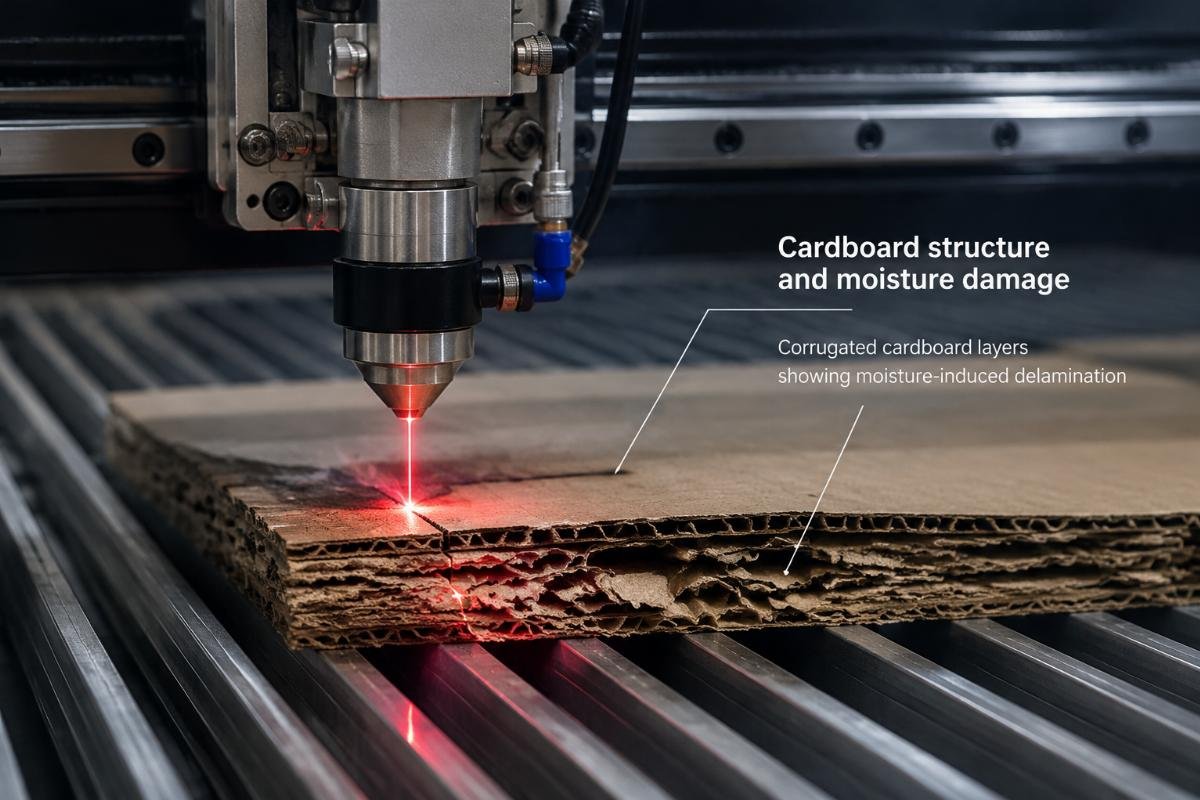
When moisture enters cardboard, the fluted inner layer absorbs water faster than the outer liners1. This uneven absorption causes swelling, warping, and delamination. The glue layer weakens, and cut edges fray instead of staying crisp.
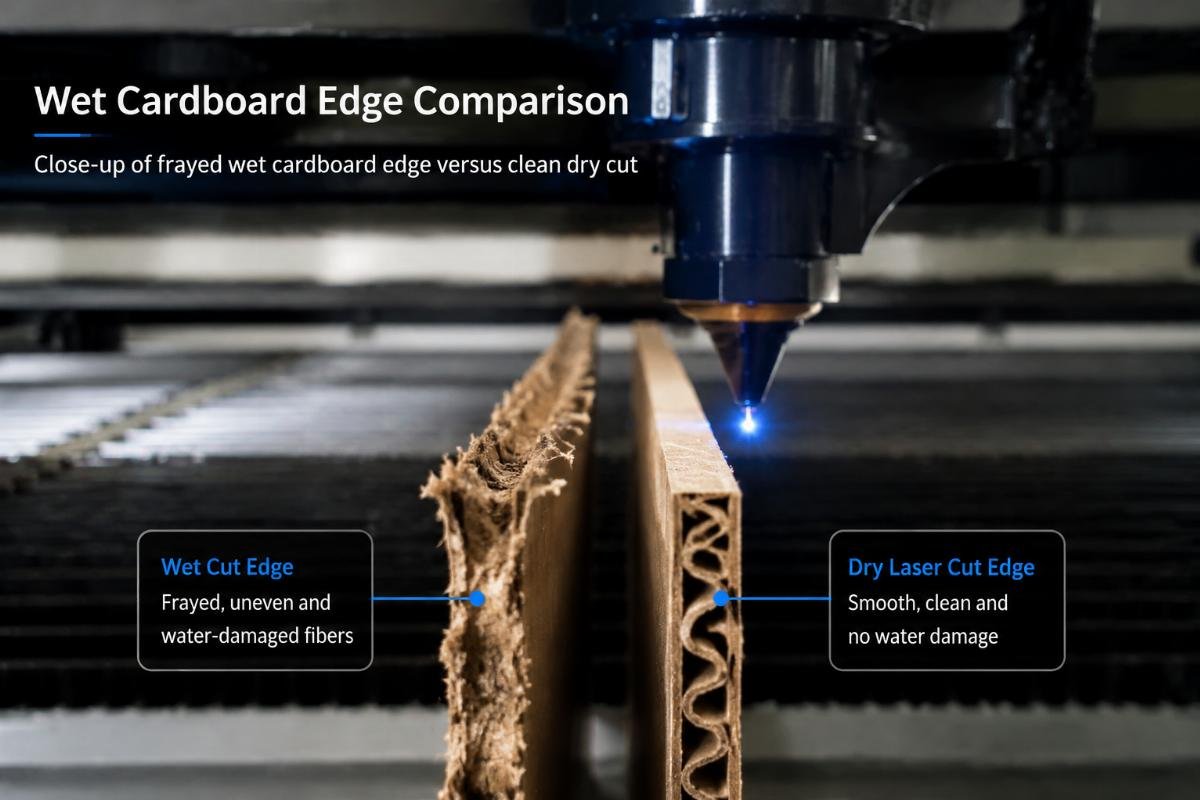
I have seen this happen during customer tests at our facility. A client brought corrugated sheets pre-dampened with a spray bottle, expecting smoother cuts on our sample press cutter. The blade pushed through the softened top layer, but the wet flutes compressed sideways instead of separating cleanly. The cut edge looked crushed, not sliced. Worse, the board curled within minutes as the moisture redistributed.
What problems does wetting cause during and after cutting?
The damage starts immediately and continues after you finish cutting. Wet cardboard creates issues at every stage.
During cutting:
| Problem | Cause | Observable result |
|---|---|---|
| Edge distortion | Uneven layer compression | Wavy cut lines, crushed flute edges |
| Blade adhesion | Wet fiber sticking to tool | Dragging sensation, fiber buildup on blade |
| Dimensional shift | Swelling perpendicular to flutes | Parts no longer match template dimensions |
One customer told me they tried wetting boards before die cutting. The adhesive on the blade accumulated wet pulp within 20 cuts. They had to stop and clean the tool repeatedly. The process took longer than cutting dry boards with a freshly sharpened blade.
After cutting:
You cannot use wet cardboard immediately. It must dry completely or your parts will warp during assembly or storage. Drying adds hours or days to your workflow depending on humidity levels. During drying, the glue layer may fail, causing delamination you won't notice until someone handles the parts. I have seen customers discard entire batches because post-cut warping made boxes impossible to fold correctly.
Does any scenario justify pre-wetting cardboard?
No scenario I have encountered benefits from pre-wetting. The problems always outweigh any perceived softening effect. Customers who tried this approach came back looking for equipment solutions after wasting materials and time.
If your cardboard feels difficult to cut, you have a tool or technique problem, not a material hardness problem. Solving tool issues is faster and cheaper than managing moisture damage.
What makes cardboard feel hard to cut in the first place?
You struggle with cuts for specific, fixable reasons. Identifying the real cause shows you which solution fits your situation.
Cutting difficulty comes from blade dullness, incorrect blade type for your cardboard thickness, or cutting perpendicular to the flute direction without proper support. Moisture content is rarely the limiting factor in dry, properly stored cardboard.
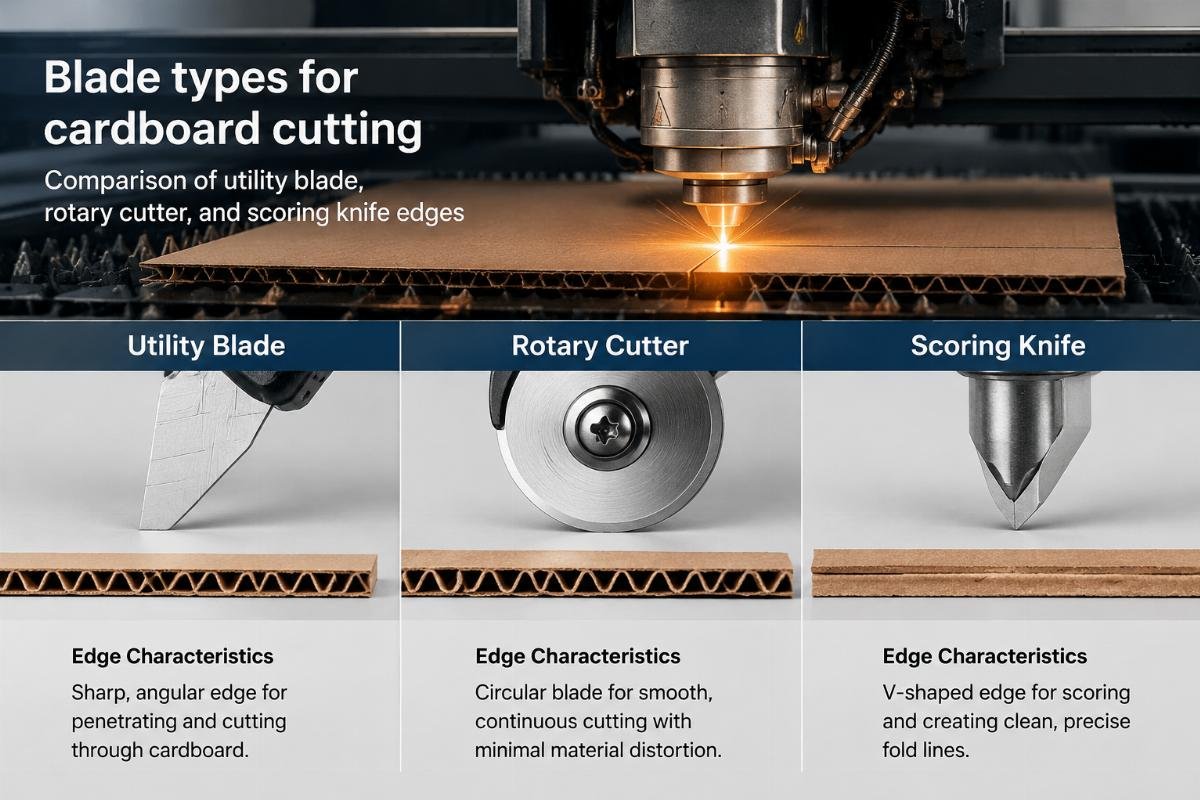
Most small-batch users I speak with use household utility blades designed for occasional light duty. These blades dull quickly when cutting corrugated board repeatedly. A dull edge crushes fibers instead of slicing them, creating resistance you misinterpret as material hardness.
How does flute direction affect cutting difficulty?
Cardboard cuts differently depending on which way you orient your blade relative to the internal flutes. This structural fact matters more than sharpness in some cases.
Cutting parallel to flutes (along the ridges):
The blade follows the natural separation between flute peaks. Resistance stays low. Even moderately sharp tools produce clean cuts.
Cutting perpendicular to flutes (across the ridges)2:
Your blade must sever each flute ridge individually. This creates multiple small resistance points along the cut line. Without proper support underneath, the flutes collapse sideways instead of separating. You feel this as dragging or tearing.
I watched a workshop owner struggle with cross-flute cuts on E-flute board using a standard utility knife. The blade kept snagging. When I handed them a rotary cutter and placed a self-healing mat underneath, the same board cut smoothly in one pass. The problem was never the cardboard.
What role does blade sharpness actually play?
A sharp blade concentrates force on a microscopic edge3. This slices fibers cleanly. A dull blade spreads force over a wider area, crushing fibers before separation occurs.
Replace blades more often than you think necessary. I recommend changing utility blades after every 50 linear feet of corrugated cuts, or sooner if you notice increased resistance. The cost of fresh blades is far lower than time wasted fighting dull tools or discarding damaged parts.
Which cutting methods work better than wetting cardboard?
The right solution depends on your production volume and precision requirements. I will start with low-tech options and explain when each approach reaches its limit.
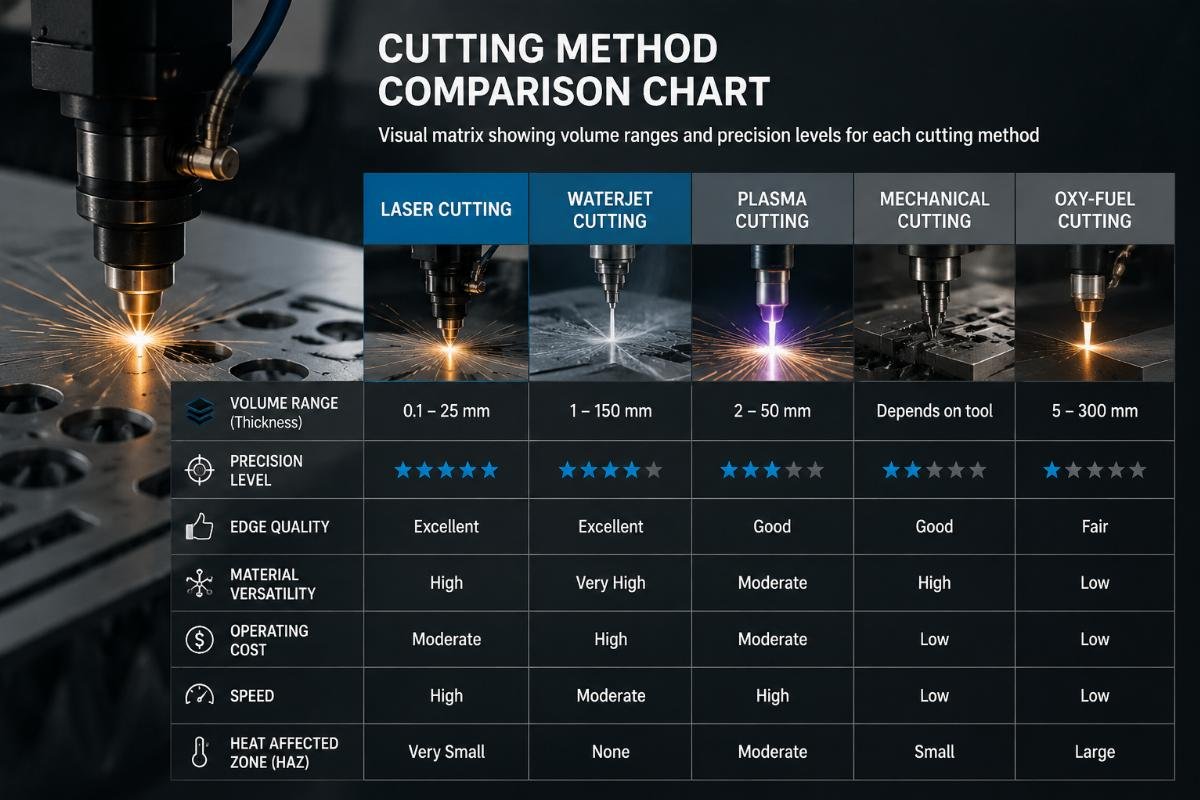
For small batches (under 50 pieces per run), use sharp rotary cutters with proper technique. For medium volumes (50-500 pieces), vertical press cutters with custom dies provide consistency. For high volumes or tight tolerances (500+ pieces or ±0.5mm precision), CNC vibrating or rotary knife systems4 eliminate manual error.
What improvements work for low-volume hand cutting?
You do not need expensive equipment if you cut fewer than 50 pieces per day. Better tools and technique adjustments solve most problems.
Tool upgrades:
| Tool type | Best use case | Key advantage |
|---|---|---|
| Rotary cutter (45mm) | Straight cuts up to 3/16" thick | Continuous slicing motion reduces snagging |
| Scoring knife | Fold lines, partial-depth cuts | Controlled depth prevents over-cutting |
| Fresh utility blades | Detail work, curved cuts | Replace every 50 ft of cutting |
Technique adjustments:
Use a metal straightedge clamped to the board for straight cuts. This prevents blade wander and gives you a guide for consistent pressure. Cut in multiple light passes instead of one heavy pass, especially on B or C flute boards. This lets you sever top layers first, then break through the flute structure with support intact.
Place a self-healing cutting mat5 or dense cardboard scrap underneath your workpiece. This prevents the bottom layer from tearing as your blade exits. I have seen customers get dramatically cleaner cuts just by adding this simple support.
When should you consider vertical press cutting?
Hand cutting becomes inefficient and inconsistent beyond a certain volume. If you produce the same shapes repeatedly, press cutting with custom dies gives you speed and uniformity.
You reach the hand-cutting limit when:
- Daily production exceeds 50 identical pieces
- Shape complexity requires more than 5 cuts per piece
- Assembly teams complain about dimensional variation between parts
A vertical press with a steel rule die6 cuts stacked layers in one motion. You position the stack, pull the lever, and remove finished parts. Cut quality stays consistent because the die geometry never changes.
I have customers running small packaging operations who cut 200-300 boxes per day this way. The upfront die cost (typically $100-300 for simple shapes) pays back within weeks compared to hand-cutting labor.
What problems does CNC cutting solve that manual methods cannot?
CNC systems make sense when precision matters more than tooling cost, or when shape variations occur frequently. These machines use computer-controlled blades (vibrating or rotating) that follow programmed paths.
Advantages I see customers value most:
-
Design flexibility: You change cut patterns by uploading new files, not ordering new dies. One customer switches between 15 different packaging designs daily without manual setup changes.
-
Precision: CNC systems hold tolerances within 0.5mm consistently7. This matters for parts that must fit together tightly or align with printed graphics.
-
Multi-layer cutting: The machine cuts stacked sheets while compensating for material compression. You get identical parts from all layers.
-
Complex geometry: Curves, notches, and intricate shapes that would take 15 minutes by hand take 2 minutes on CNC equipment.
Our company manufactures these systems, so I see the decision calculus clearly. CNC equipment makes financial sense when you cut more than 500 pieces per day, need frequent design changes, or require precision beyond what press dies deliver. Below that threshold, the capital cost rarely justifies the speed gain.
What should you do next to improve your cutting results?
Start with the simplest solution that matches your current volume. You can always scale up later.
Assess your blade condition first. Replace utility blades and test cuts again. If resistance drops significantly, you never had a cardboard problem. Order blades in bulk and set a replacement schedule.
If blade changes help but not enough, try a rotary cutter with a cutting mat underneath. This combination solves most cross-flute cutting struggles without equipment investment.
If you cut more than 50 identical pieces daily, get quotes for simple press dies. Calculate labor hours saved versus die cost. Most small operations see payback within 3-6 months.
If precision matters or designs change frequently, explore CNC options. Request sample cuts from manufacturers using your actual cardboard. Compare edge quality and dimensional accuracy to your current results.
Do not wet your cardboard. The problems it creates are harder to fix than the cutting difficulty you started with. You have better options that preserve material integrity and improve results at every production scale.
Conclusion
Wetting cardboard damages its structure and delays your workflow without making cuts easier. Sharp tools, proper technique, and volume-appropriate equipment solve cutting problems without compromising material quality. Start with blade upgrades, scale to press cutting if needed, and consider CNC only when precision or flexibility justify the investment.
"Figure 4 - from Moisture diffusion through a corrugated", https://www.academia.edu/figures/26682742/figure-4-moisture-diffusion-through-corrugated-fiberboard. Research on moisture dynamics in corrugated packaging shows that flute medium typically exhibits faster water uptake than linerboard due to lower density and greater exposed surface area per unit volume. Evidence role: mechanism; source type: paper. Supports: differential moisture absorption occurs between corrugated board components due to varying fiber densities and orientations. ↩
"[PDF] Machine direction strength theory of corrugated fiberboard", https://www.fpl.fs.usda.gov/documnts/pdf1996/urban96a.pdf. Studies on corrugated board mechanics confirm anisotropic behavior, with significantly different resistance to cutting parallel versus perpendicular to flute direction due to the oriented structure of the corrugated medium. Evidence role: mechanism; source type: paper. Supports: corrugated structures exhibit directional mechanical properties. ↩
"Comprehensive Analysis of Cutting-Force Components in Milling ...", https://pmc.ncbi.nlm.nih.gov/articles/PMC12388005/. Basic mechanics principles establish that pressure equals force divided by area, meaning sharper edges with smaller contact areas generate higher localized pressures that facilitate material separation. Evidence role: mechanism; source type: education. Supports: reducing contact area increases pressure for a given applied force. ↩
"CNC Oscillating Knife Cutting Machine", https://cncamor.com/product/cnc-knife-cutting-machine/. CNC cutting systems for flexible materials utilize either oscillating (vibrating) blades that reciprocate vertically while moving laterally, or rotary blades that spin continuously, each suited to different material properties and cutting requirements. Evidence role: definition; source type: other. Supports: CNC cutting systems employ different blade motion technologies. ↩
"Properties and Applications of Self-Healing Polymeric Materials - PMC", https://pmc.ncbi.nlm.nih.gov/articles/PMC10674826/. Self-healing cutting mats, typically made from PVC or similar polymers, provide a yielding but supportive surface that closes after blade passage, preventing material tear-out at cut exit points. Evidence role: mechanism; source type: other. Supports: resilient cutting surfaces provide consistent support during blade exit. ↩
"Die (manufacturing) - Wikipedia", https://en.wikipedia.org/wiki/Die_(manufacturing). A steel rule die consists of sharp steel blades formed to specific shapes and mounted in a substrate, used in press equipment to cut sheet materials through applied pressure. Evidence role: definition; source type: encyclopedia. Supports: steel rule dies are cutting tools used in press operations. ↩
"Understanding CNC Machining Tolerances - Protolabs", https://www.protolabs.com/resources/design-tips/fine-tuning-tolerances-for-cnc-machined-parts/. Industrial CNC cutting systems for flexible materials typically specify positioning accuracy in the range of 0.1-0.5mm, though actual cutting tolerance depends on material properties and blade condition. Evidence role: statistic; source type: other. Supports: modern CNC cutting systems achieve sub-millimeter precision. Scope note: Achievable tolerance varies with material thickness, blade type, and machine calibration ↩