

Blog
What is the realistic factory production capacity ramp-up time for knife cutting machines?

What is the realistic factory production capacity ramp-up time for knife cutting machines?
You just signed a purchase order for 50 knife cutting machines with delivery spread across three months. Your supplier confirmed the timeline. Three weeks before the first shipment date, they request an extension because "ramp-up took longer than expected." Your downstream production schedule collapses. This scenario repeats across industries because buyers and suppliers define "ramp-up time" differently.
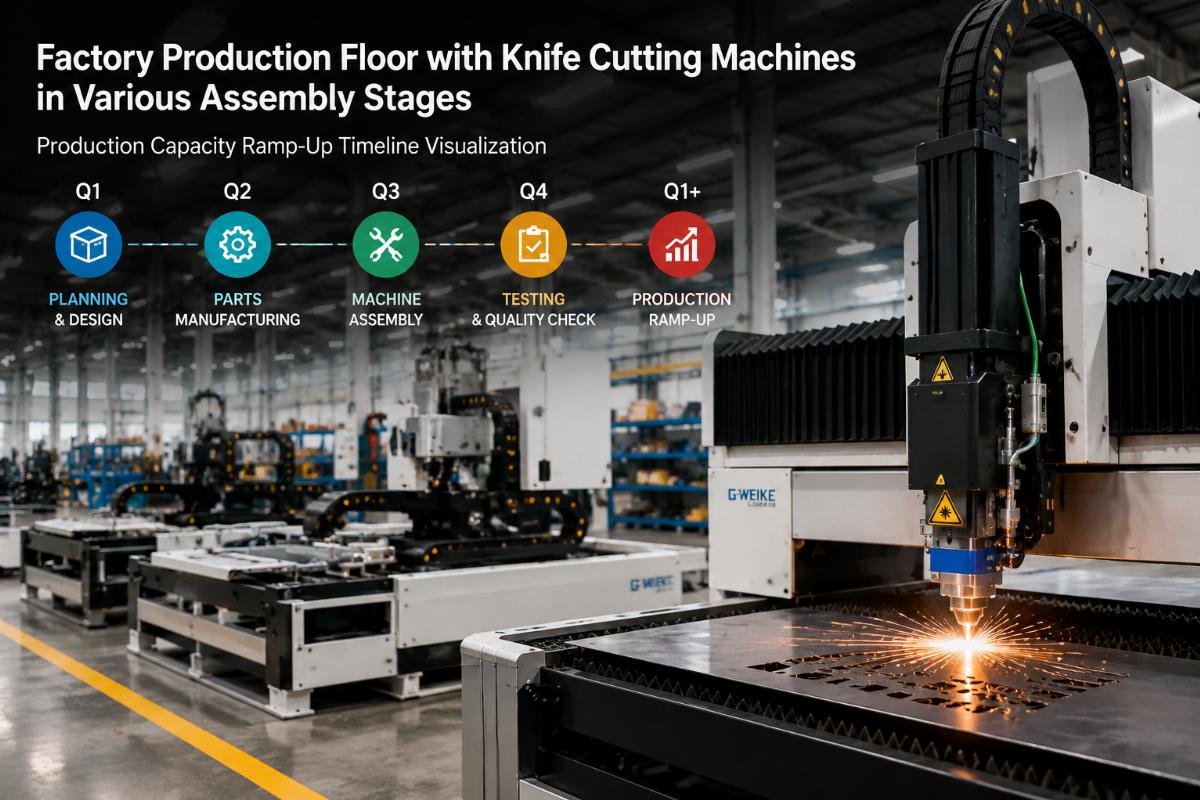
Factory production capacity ramp-up for knife cutting machines typically spans 4 to 12 weeks from order confirmation to stable full-volume output, but this timeline depends on equipment configuration complexity, component supply chain status, workforce training requirements, and process optimization cycles—not just the number of machines or their rated speed.
Most first-time buyers ask about ramp-up time during price negotiation, but they rarely ask the follow-up questions that reveal whether a supplier's timeline is realistic or aspirational. I have handled dozens of delivery timeline inquiries at Realtop, and the pattern is consistent: buyers focus on when the first machine ships, not when the last machine in their order reaches stable output. The gap between these two milestones is where commercial risk concentrates.
Why do buyers and suppliers define ramp-up time differently?
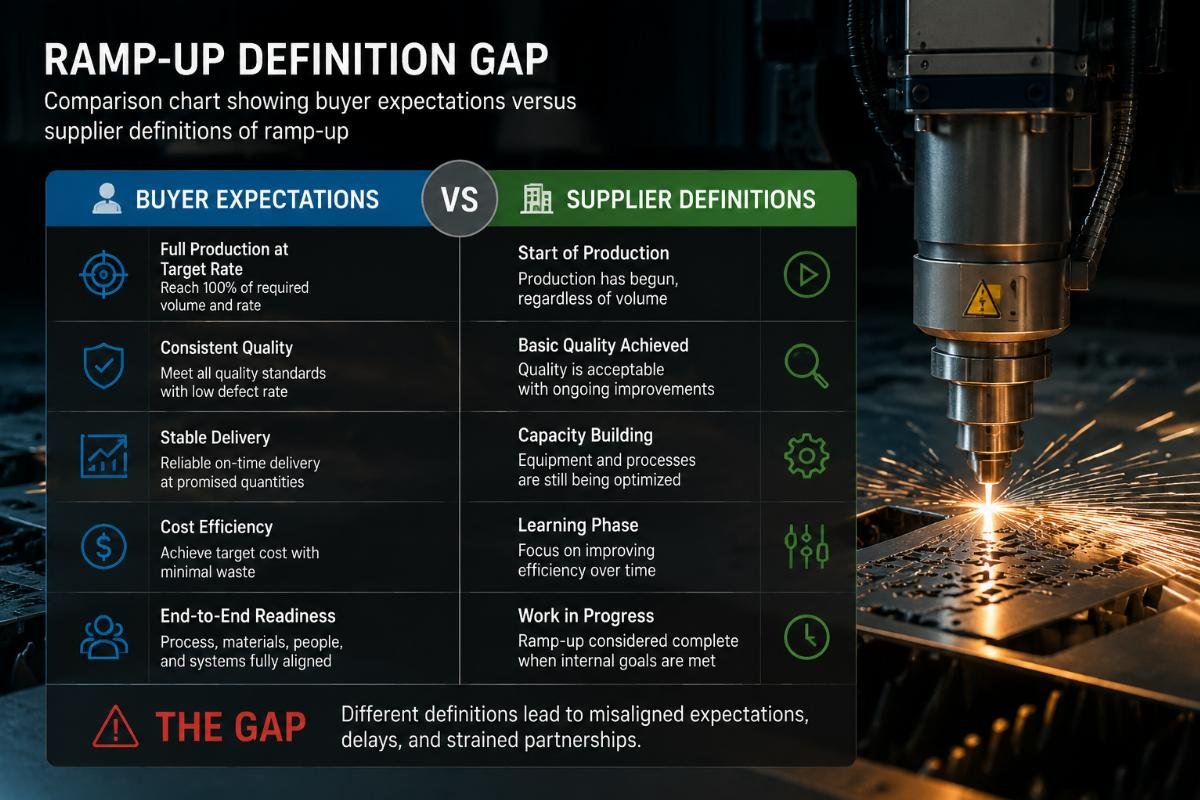
When you ask a supplier "how long does ramp-up take," you are trying to answer a scheduling question: when can I safely commit to my own customers that I will have full production capacity? When the supplier answers that same question, they are often describing equipment commissioning time: how long it takes to get one machine from unpacked to operational.
The mismatch happens because ramp-up has three distinct phases—machine assembly, operator proficiency development, and process stabilization—but most delivery commitments only account for the first phase.
What are the three phases of actual ramp-up?
I will break down what actually happens during ramp-up so you can identify which phase a supplier is referring to when they quote a timeline.
| Ramp-up Phase | What Happens | Typical Duration | What Buyers Should Verify |
|---|---|---|---|
| Machine Assembly | Physical equipment production, component sourcing, quality testing, packaging | 2-6 weeks depending on order size | Lead time for critical components (servo motors, control systems, cutting heads), current order backlog, factory capacity allocation |
| Operator Proficiency | Workforce training, speed curve improvement, error rate reduction, workflow optimization | 3-5 weeks for standard models, 6-8 weeks for custom configurations | Training program structure, whether operators will be working on your specific configuration during training, baseline productivity expectations |
| Process Stabilization | Parameter tuning, quality consistency achievement, throughput optimization, defect rate control | 2-4 weeks for proven designs, 4-8 weeks for new applications | Number of trial runs planned, QC standards definition, process documentation availability, troubleshooting protocol |
The problem emerges when suppliers quote only the machine assembly timeline but buyers assume that number represents full operational capacity. A supplier might say "we can deliver in 4 weeks" and mean "we can ship assembled machines in 4 weeks." You hear "we can provide stable production capacity in 4 weeks." This gap causes most delivery disputes I have witnessed.
How does order complexity change the timeline?
Standard configurations follow predictable ramp-up patterns because the factory has produced identical machines before. Custom configurations introduce variables that extend every phase.
When a customer requests non-standard cutting widths, specialized material handling systems, or integrated vision recognition modules, we cannot simply pull those machines from existing production lines. Custom orders require parameter validation, sometimes new fixture designs, and always additional testing cycles. A standard 1625 model might ramp to full capacity in 6 weeks, but a custom 2516 model with automatic feeding and specialized blade configurations might need 10 weeks even though the core machine is similar.
The extension happens because custom configurations require iterative tuning. You cannot finalize parameters until the machine processes actual materials under real production conditions. This means the process stabilization phase starts later and lasts longer compared to standard models.
Suppliers quote ramp-up timelines based on ideal conditions, but real production environments contain friction points that slow everything down. I will identify the bottlenecks that most commonly cause timeline extensions so you can verify whether your supplier has accounted for them.
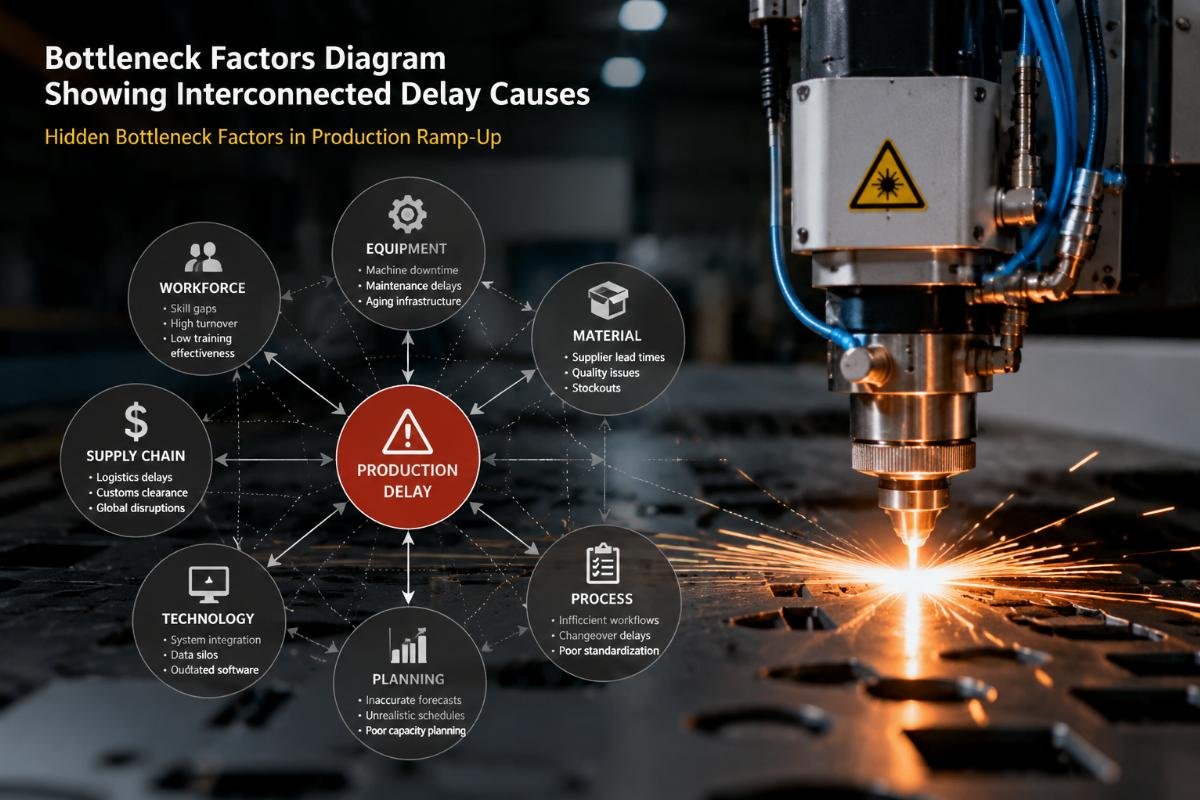
The bottlenecks that extend ramp-up are component supply chain delays, workforce availability and skill gaps, and process optimization cycles for unfamiliar materials—these factors compound rather than add linearly.
Which components create supply chain delays?
Not all components have equal impact on ramp-up speed. The critical path components for knife cutting machines are servo motors, control systems, precision linear guides, and specialized cutting heads. These parts typically have 3 to 6 week lead times from external suppliers, and they cannot be substituted without affecting machine performance.
When we receive a large order, we immediately place component orders, but if our supplier faces a backlog or manufacturing issue, that delay propagates directly into our assembly timeline. A 2-week delay in servo motor delivery means a 2-week delay in machine completion, which means a 2-week delay in when you can start operator training.
The risk increases with order size. If you order 10 machines, we can often fulfill from existing component inventory or standard reorder quantities. If you order 50 machines, we need to place bulk component orders, which may exceed our suppliers' normal production capacity and trigger their own ramp-up requirements.
How does operator proficiency affect stable output?
A newly assembled knife cutting machine can theoretically run at rated speed immediately after power-on, but actual throughput depends on operator skill. New operators make mistakes in material loading, tool path selection, and quality inspection that reduce effective output by 30 to 50 percent during the first two weeks.
The proficiency curve improves predictably with repetition, but the timeline varies by configuration complexity. Operating a standard flatbed cutting machine for fabric requires about 40 hours of practice to reach 80 percent of experienced operator speed. Operating a multi-head system with automatic feeding and vision alignment might require 80 to 120 hours because the decision tree is more complex.
This matters for your delivery timeline because you cannot schedule full production capacity until operators reach stable performance. If a supplier quotes 8 weeks to deliver 20 machines but does not account for operator training time, you will have 20 operational machines but only 60 to 70 percent of theoretical capacity for the first month after delivery.
Why does process optimization extend the timeline?
Even experienced operators need time to optimize parameters for new materials or production requirements. Cutting leather requires different blade angles, feed speeds, and vacuum pressure compared to cutting corrugated cardboard, even on the same machine. Finding the optimal parameter set requires trial runs, quality inspection, and iterative adjustment.
The optimization cycle extends when you introduce new materials that neither you nor your supplier has processed before. We maintain parameter libraries for common materials like PU leather, polyester fabric, and EPE foam, so customers can start production quickly with proven settings. When a customer wants to cut a composite material we have never tested, we need additional time to develop and validate parameters.
This bottleneck catches buyers by surprise because they assume machine capability equals immediate production readiness. A machine that can physically cut your material might still need 2 to 3 weeks of parameter tuning before it consistently meets your quality standards at target speed.
How can buyers verify whether a supplier's ramp-up timeline is realistic?
You cannot eliminate ramp-up uncertainty completely, but you can verify whether a supplier has thought through the variables or is simply quoting aspirational timelines. I will share the questions we expect informed buyers to ask during negotiation, which signal whether they understand ramp-up complexity.
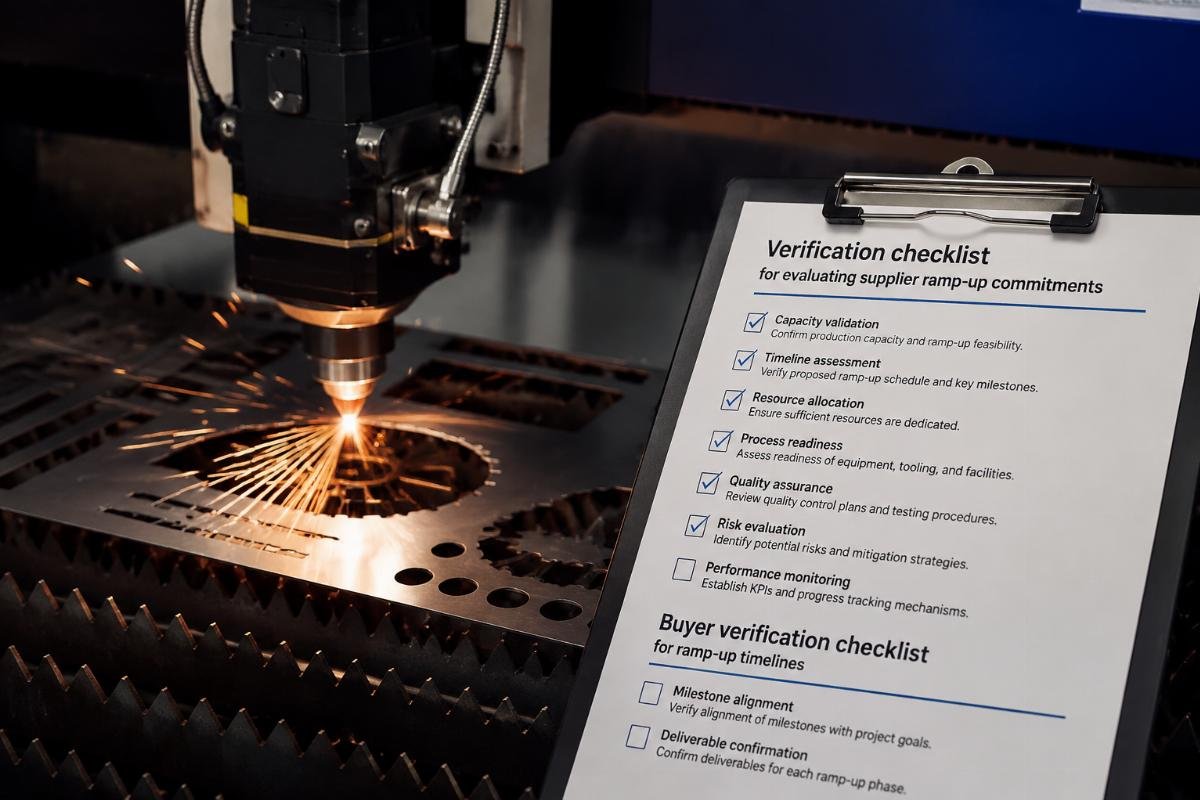
Buyers can verify ramp-up timeline credibility by requesting component lead time documentation, asking about current order backlog and capacity allocation, requiring written training and stabilization schedules, and defining milestone-based delivery terms instead of single target dates.
What documentation should you request upfront?
Serious suppliers can provide component sourcing timelines, current production schedules, and capacity allocation plans. When you ask "how long will ramp-up take," follow up with "show me your component lead times and current order backlog." If a supplier cannot produce this documentation, their timeline is probably based on best-case assumptions rather than confirmed capacity.
We maintain real-time component inventory data and supplier lead time updates specifically so we can provide realistic delivery commitments. When a customer requests 30 machines with delivery in 8 weeks, I can verify within one business day whether we have adequate component inventory or whether we need to place orders that might extend the timeline.
You should also request the training schedule and process optimization plan. A supplier who has thought through ramp-up will describe how many training hours they allocate per operator, what trial run protocol they follow for new configurations, and how they define "stable production" for milestone acceptance.
How should you structure delivery terms to manage ramp-up risk?
Single-date delivery terms concentrate all timeline risk on one milestone. If the supplier misses that date for any reason, you have limited recourse because contract enforcement requires proving fault, which is difficult when delays stem from component supply chains or optimization cycles beyond direct supplier control.
Milestone-based delivery terms distribute risk more fairly. Instead of "deliver 50 machines by June 30," structure the agreement as "deliver first 10 machines by June 15, next 20 machines by June 30, final 20 machines by July 15, with stable production demonstrated through [specific output and quality metrics] within 2 weeks of final delivery."
This structure accomplishes several goals. First, it acknowledges that ramp-up is gradual rather than instantaneous. Second, it gives you early warning if the supplier encounters delays, allowing you to adjust your own production schedule. Third, it defines "stable production" explicitly rather than leaving it ambiguous.
What questions reveal whether the supplier understands your application?
Generic knife cutting machines can handle dozens of materials, but optimal performance requires application-specific configuration. When you describe your requirements, pay attention to whether the supplier asks detailed questions about your materials, quality standards, and production environment.
Suppliers who understand ramp-up complexity will ask about material thickness variation, ambient humidity and temperature in your facility, operator experience level, and quality tolerance requirements. These questions indicate they are thinking about process optimization rather than just equipment delivery.
If a supplier quotes a timeline without asking these questions, they are probably assuming ideal conditions that may not match your actual production environment. This assumption gap is where optimization cycles extend beyond initial estimates.
What factors increase ramp-up time beyond standard timelines?
Standard timelines assume standard configurations, experienced operators, and familiar materials. When any of these conditions change, the timeline extends. I will identify the specific factors that add time so you can adjust supplier estimates based on your actual requirements.
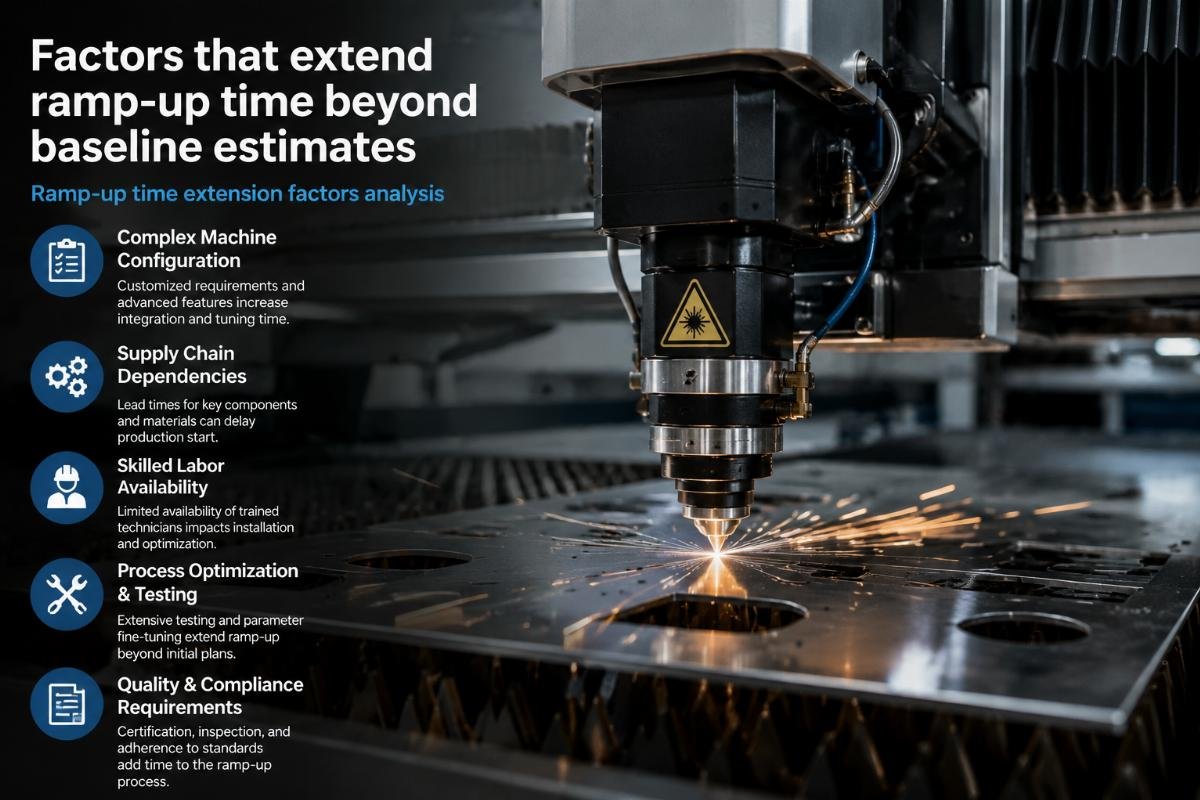
Ramp-up time increases when orders include custom configurations, when operators lack prior CNC cutting experience, when materials have not been previously tested, when production volume targets exceed supplier's typical order size, and when quality requirements are tighter than industry standard.
How much time do custom configurations add?
Custom configurations add 2 to 6 weeks depending on the degree of customization. Modifying cutting area dimensions or adding automatic feeding systems typically adds 2 to 3 weeks because these changes affect mechanical assembly but not core control logic. Integrating vision recognition systems or developing specialized tool paths for complex geometries might add 4 to 6 weeks because they require software development and extensive testing.
The time extension compounds when multiple customizations interact. A machine with both custom cutting area and vision recognition takes longer to optimize than the sum of individual customization times because we need to validate how the systems work together under production conditions.
When you request custom configurations, ask the supplier to break down which aspects add time and why. A supplier who provides detailed explanations is more likely to have accurately estimated the timeline compared to one who simply adds a fixed percentage to the standard timeline.
How does operator experience affect the timeline?
Operators with prior CNC cutting experience reach stable productivity 40 to 50 percent faster than operators learning CNC systems for the first time. This difference matters significantly for large orders where you need to train multiple operators simultaneously.
If you plan to staff 10 machines with 10 operators, and all 10 are new to CNC cutting, your workforce proficiency curve will be steeper and longer compared to a scenario where 3 experienced operators train 7 new operators. The mixed-experience approach allows faster knowledge transfer and reduces the trial-and-error period.
You can accelerate this phase by sending operators to the supplier's facility for advance training while the machines are still in production. We offer this option to customers who want to minimize post-delivery ramp-up time. Operators who train on similar equipment before their own machines arrive can achieve stable productivity within 1 to 2 weeks instead of 3 to 4 weeks.
What happens when materials have not been tested before?
Parameter optimization cycles extend significantly when neither you nor your supplier has production experience with your specific material. Standard materials like cotton fabric, PU leather, and corrugated cardboard have well-documented optimal parameters. Specialized materials like reinforced composites, multi-layer laminates, or heat-sensitive films require experimental parameter development.
The experimental cycle involves test cuts, quality inspection, parameter adjustment, and validation runs. This process might require 5 to 10 iterations before achieving consistent results, which translates to 2 to 4 additional weeks beyond standard ramp-up timelines.
You can reduce this uncertainty by providing material samples during the quotation phase so the supplier can conduct preliminary testing before order confirmation. We encourage customers to send samples early specifically because it allows us to identify potential parameter challenges and provide more accurate timeline estimates.
How do large orders affect ramp-up differently than small orders?
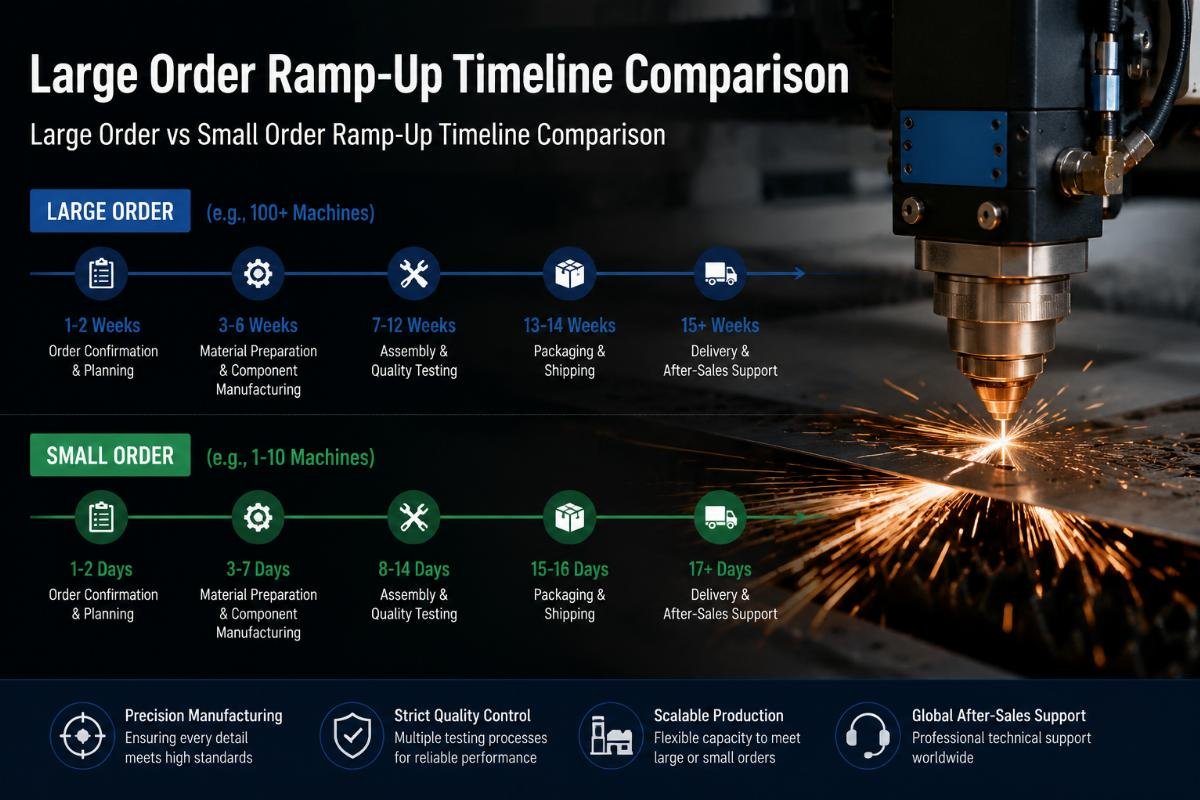
Order size affects ramp-up complexity in non-linear ways. Doubling the order quantity does not simply double the ramp-up time, but it does introduce coordination challenges and resource constraints that small orders avoid. I will explain why large orders require different timeline expectations.
Large orders extend ramp-up time because they strain component supply chains, require workforce scaling and training, exceed single production line capacity, and introduce quality consistency challenges across batches—factors that small orders do not encounter.
When do component supply chains become the bottleneck?
Component suppliers maintain production capacity based on typical order patterns. When your order significantly exceeds those patterns, your supplier needs to either draw down inventory (which creates risk for their other customers) or place bulk orders with their own suppliers (which introduces lead time delays).
We stock components for approximately 15 to 20 standard machines at any given time, which allows us to fulfill small orders quickly from existing inventory. When a customer orders 40 machines, we need to place component orders that might exceed our suppliers' normal weekly production, triggering their own capacity ramp-up requirements.
This cascading effect means large orders face longer lead times even if your direct supplier has adequate assembly capacity. The bottleneck shifts upstream to component manufacturers who need time to increase their own output.
How does workforce scaling affect the timeline?
Small orders can be fulfilled with existing trained workforce. Large orders often require hiring and training additional operators, which extends the ramp-up timeline because new workers need time to reach experienced productivity levels.
We maintain a core production team of approximately 25 workers who handle standard production volume. When we receive an order that requires 40 workers to meet the delivery timeline, we need to recruit and train 15 additional workers. The training period for new production workers typically spans 3 to 4 weeks before they can work at acceptable speed and quality levels.
This workforce ramp-up happens in parallel with equipment production, but it introduces variability into the timeline. Recruitment might take longer than expected, or new workers might need additional training time beyond standard estimates.
Why do quality consistency challenges emerge with large orders?
Producing 5 identical machines allows intensive quality oversight. Producing 50 machines requires process standardization and quality control systems that prevent variation across batches. This transition from craft production to scaled manufacturing introduces challenges that extend ramp-up time.
The primary challenge is parameter drift across production batches. Early machines might receive more intensive tuning and adjustment compared to later machines as production pressure increases. We mitigate this through documented quality control procedures and batch testing protocols, but these systems add time to the overall ramp-up process.
Large orders also reveal design or process weaknesses that small orders might not expose. A minor tolerance issue that affects 1 in 20 machines becomes a significant problem when you are producing 50 machines. Identifying and correcting these issues mid-production adds time but prevents delivering equipment that fails in your facility.
What contingency should buyers include in their production planning?
Even with thorough verification and realistic supplier estimates, unexpected delays occur. I will recommend contingency planning approaches based on the delay patterns I have observed across dozens of orders.
Buyers should include 15 to 25 percent timeline contingency for standard orders and 25 to 40 percent contingency for custom configurations or first-time supplier relationships, with contingency allocated to component delays, process optimization, and workforce training rather than distributed evenly across the timeline.
![Contingency allocation framework