




-
 Courier delivery
-
 DHL Courier delivery
-
 Warranty 1 year
-
 Free 30-Day returns

Precision Tool Head Matching — In-house engineering aligns oscillating knife frequency and table vacuum zoning to the specific leather density and composite layering of your production run.
Technical Specifications
| Parameter | Value |
|---|---|
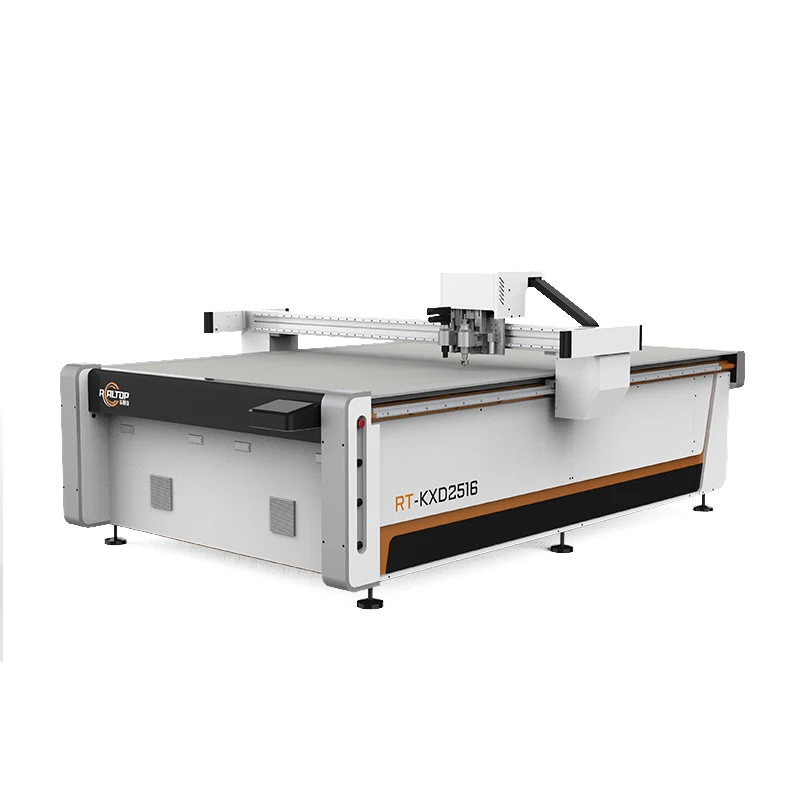
| Model | RT-D2516/RT-S2516 |
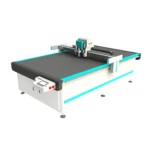
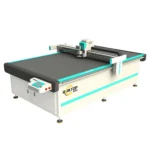
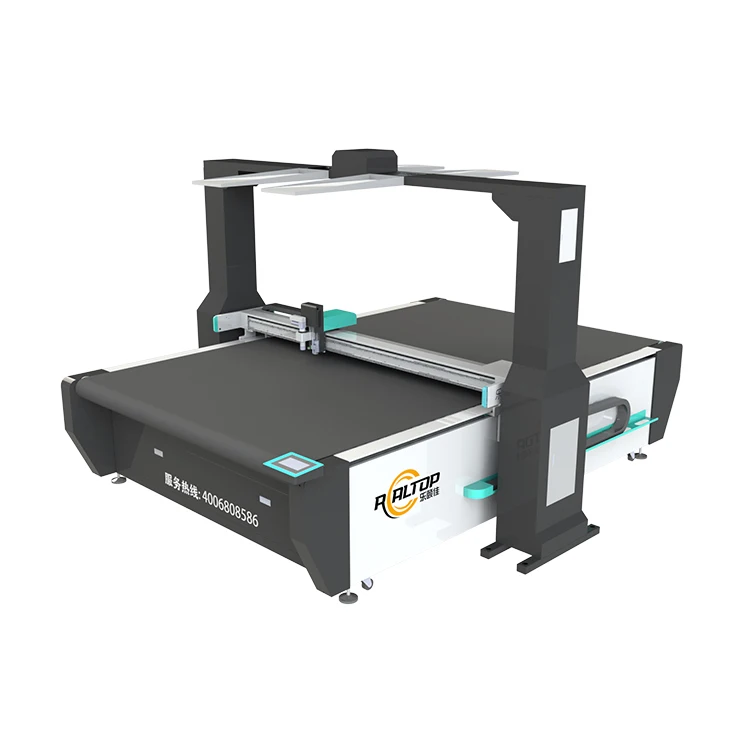
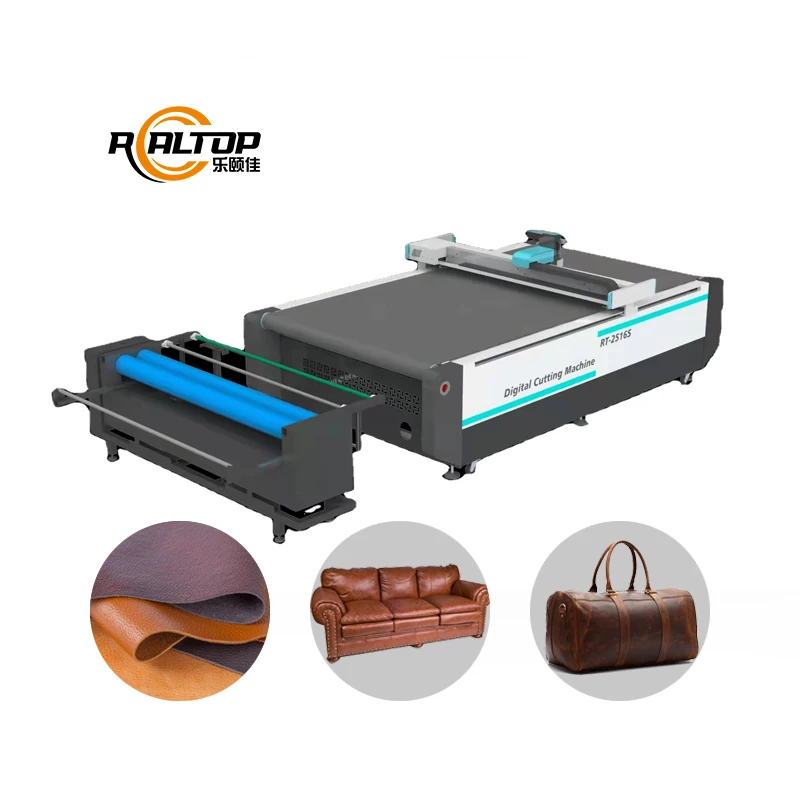
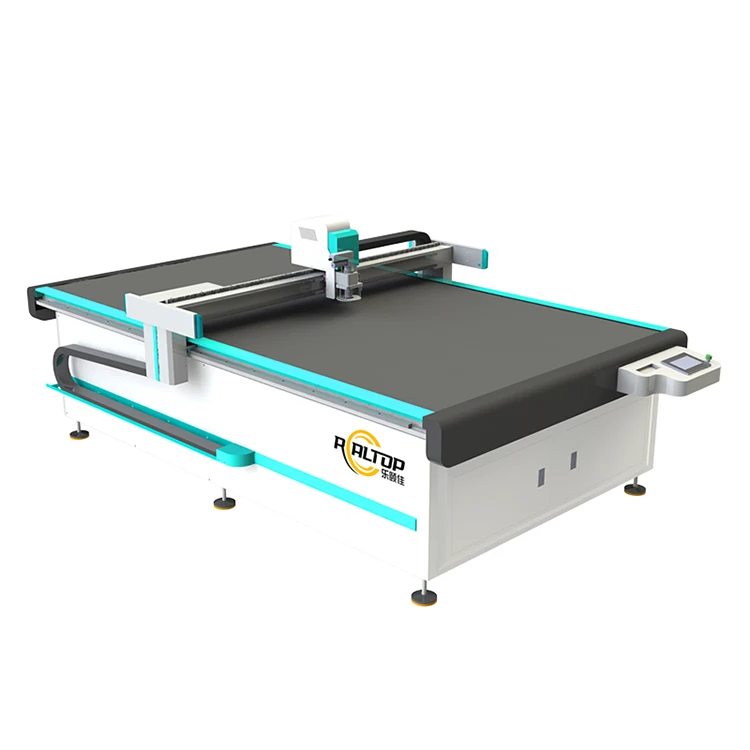
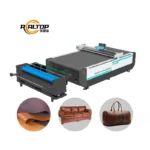
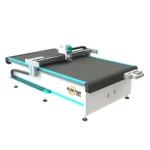
| Product Type | CNC Oscillating Knife Leather Cutting Machine |
| Working Area | 1600 × 2500 mm |
| Machine Dimensions | 3450 × 2300 × 1250 mm |
| Rated Power | 9 kW |
| Table Type | Flat working table with auto feeding and vacuum hold-down |
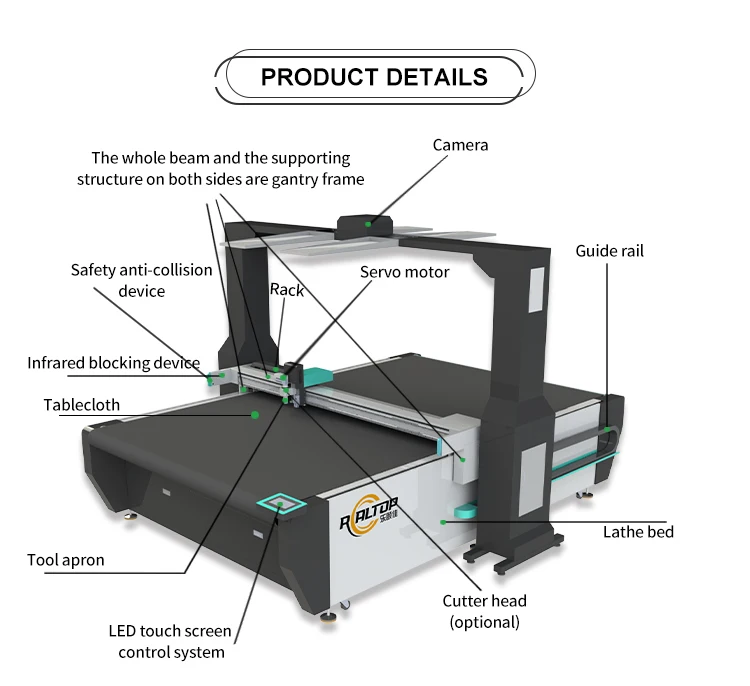
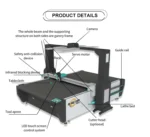
| Tool Head | Swiss imported knife with vibration full cutting, half cutting, and cursor location |
| Safety Device | Infrared sensors |
| Translational Velocity | 800–1200 mm/s |
| Cutting Speed | 200–800 mm/s (basis to be confirmed) |
| Repeated Accuracy | ≤0.1 mm |
| Transmission System | Digital servo motor, linear guide, synchronous belt, imported ball screw |
| Servo Motor | Japanese Yaskawa |
| Guide Rail | Taiwan Hiwin |
| Conveyor Belt | Germany imported |
| Instruction System | HP-GL compatible format |
| Voltage | 380V ±10% (customization available) |
| Vacuum Pump | 7.5 kW |
| Key Features | Auto feeding, vacuum table, infrared safety sensors, HP-GL file compatibility |
Application Suitability
| Application | Material or Output |
|---|---|
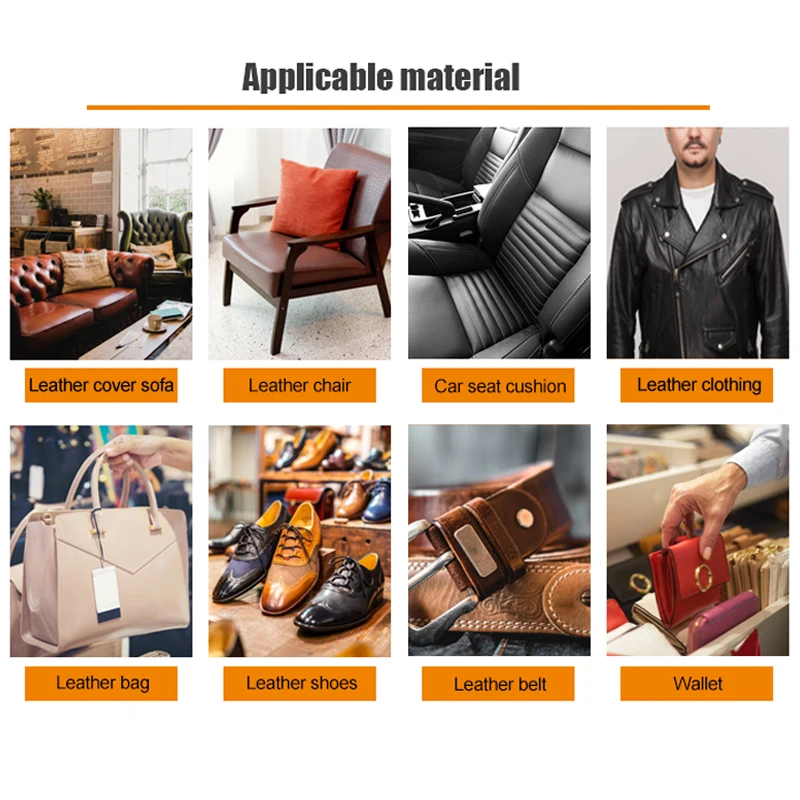
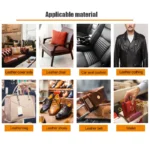
| Leather goods manufacturing | Natural leather, synthetic PU and PVC leather for bags, belts and wallets |
| Footwear production | Upper leather, lining material, sponge composite leather for shoe components |
| Garment and accessories processing | Clothing flexible material, textile-backed leather, soft composite sheets |
| Automotive interior fabrication | PVC, soft glass, silicon, rubber for gaskets and interior trim panels |
| Flexible composite cutting | Sponge composite leather, multi-layer bonded flexible materials |
Why Cutting Speed Claims Fail on Dense Composite Leather
A Leather CNC Cutting Machine manufacturer quoting 800 mm/s cutting speed without naming the material and thickness is handing you a number that may not survive first contact with your production floor. The RT-D2516/RT-S2516 lists a cutting speed range of 200–800 mm/s, but dense composite leather, multi-layer bonded hides, and stiff PVC all demand different knife frequencies and feed rates to hold edge quality.
When a buyer takes a headline speed at face value and runs thick sponge composite leather at the upper limit, the oscillating knife cannot complete its stroke before the next cut begins. The result is ragged edges, incomplete through-cuts, and material waste that only shows up after the first full sheet is processed. [NEED_CITE: oscillating knife stroke frequency and material density relationship in flatbed cutting]
Matching the Knife Stroke to Leather Density
The Swiss imported oscillating knife on this machine provides both full cutting and half cutting modes. Full cutting drives the blade through the entire material thickness for clean part separation, while half cutting scores the surface for folding or creasing operations common in leather goods assembly. The cursor location function registers reference points on printed or marked leather hides so that nested patterns align with natural grain direction and defect zones. This matters because a Leather CNC Cutting Machine that forces every cut through the same stroke profile will either overwork thin garment leather or underperform on dense automotive upholstery hides.
Vacuum Hold-Down and Small Part Stability
The 7.5 kW vacuum pump paired with the flat working table provides suction across the cutting surface. For large leather hides this prevents shifting during high-speed translational moves up to 1200 mm/s. But when the nest layout includes small components such as strap loops, buckle tabs, or gasket washers, the vacuum zoning must be sufficient to hold parts that are smaller than a single suction zone. If your production mix includes both full-hide cutting and small-part nesting, the table zoning configuration should be confirmed before the machine ships. [NEED_CITE: vacuum table zoning requirements for small nested parts on flatbed cutters]
How the Drive Train Holds Tolerance Across the Bed
The ≤0.1 mm repeated accuracy specification depends on the interaction between the Yaskawa digital servo motors, Taiwan Hiwin linear guides, and the imported ball screw transmission. On a 1600 × 2500 mm working area, thermal expansion and belt stretch can introduce positional drift over a long production run. The synchronous belt handles rapid traversing while the ball screw manages the precision cutting passes. This dual-path transmission means the machine does not sacrifice travel speed to maintain positional repeatability at the far corners of the bed, which is where most tolerance failures appear on large-format leather cutting tables.
The Real Cost of Skipping a Material Trial
Buyers who specify a Leather CNC Cutting Machine based on working area alone and skip the sample cutting step often discover problems only after the machine is installed. The wrong knife angle on natural full-grain leather produces edge burnishing instead of a clean slice. On sponge composite leather, insufficient oscillation frequency causes the foam layer to compress rather than cut, leaving a crushed edge that fails quality inspection. These are not machine defects — they are configuration mismatches that a pre-shipment sample cut on your actual material would have caught. [NEED_CITE: material-specific tool head configuration in CNC knife cutting]
Why Buyers Source This Equipment Here
The design team covers both knife and laser cutting technologies in-house, so the cutting method is selected based on your leather type and edge requirement rather than limited to a single process. Tool head selection and vacuum table configuration are specified per material thickness and production volume before the order is finalized. Every RT-D2516/RT-S2516 ships with a factory test record documenting performance on the buyer’s own material sample. Voltage, control language, and plug type are confirmed for the destination market before production begins. Software compatibility with the buyer’s existing nesting workflow and HP-GL file output is verified during the specification stage.
Documentation & Verification
- Machine specification sheet confirming tool head type and vacuum table zoning per leather material
- Electrical schematic with voltage confirmation matching destination market requirements
- Sample cutting report produced on buyer’s own leather stock before order confirmation
- HP-GL file format compatibility note documenting nesting software integration
- Factory test record showing repeated accuracy and cutting edge quality on specified material
- Spare parts list covering oscillating knife blades, vacuum cups, and drive belt consumables
Installation, Commissioning & Support
- 3450 × 2300 mm machine footprint requires level concrete floor with clearance for auto feeding conveyor
- 9 kW rated power plus 7.5 kW vacuum pump require dedicated three-phase 380V circuit with confirmed frequency
- Machine ships partially assembled with gantry and table requiring on-site alignment and leveling
- First-run commissioning includes vacuum zone mapping and servo calibration across the full 1600 × 2500 mm bed
- Operator training covers HP-GL file import, tool head changeover, and oscillation frequency adjustment per material
- Infrared safety sensor testing and emergency stop validation completed before production handover
What to Share Before Requesting a Quote
Send the specific leather type, thickness range, and maximum hide dimensions you process daily. Confirm your local voltage and frequency standard so the electrical system is configured before build. If you run existing nesting software, share a sample output file so HP-GL compatibility is verified. Providing a few sheets of your actual material for sample cutting eliminates configuration guesswork and gives you a cutting quality baseline before commitment.
Frequently Asked Questions
Q: How do I verify the cutting speed rating for my specific leather material?
A: The 200–800 mm/s range is a machine capability envelope, not a guaranteed production rate for every material. We run your actual leather sample on the RT-D2516/RT-S2516 and document the achievable speed while maintaining edge quality. The sample cutting report becomes part of your order file so there is no ambiguity about real-world throughput on your material.
Q: Can the voltage and control interface be customized for my country?
A: The standard configuration is 380V ±10%, but voltage and frequency can be adjusted for destination markets requiring different industrial power standards. Control language is confirmed during the specification stage so operators receive the interface in their working language. Plug type and electrical documentation match local requirements before shipment.
Q: How is the correct tool head selected for leather versus composite materials?
A: Natural leather, PU synthetic, and sponge composite leather each require different knife angles, oscillation frequencies, and cutting depths. We specify the Swiss imported knife configuration based on your material samples and production mix. The half-cutting function is configured separately for scoring and creasing operations if your leather goods assembly requires them.
Q: Will this machine work with my existing nesting software and file formats?
A: The instruction system accepts HP-GL compatible format, which covers most standard nesting and CAD output used in leather goods and footwear production. We verify compatibility with your specific software during the pre-order stage by processing a sample file. Any required format conversion or workflow adjustment is documented before the machine enters production.
Q: Is sample cutting available before I commit to an order?
A: Yes. Send your leather or composite material to the factory and we run it on the RT-D2516/RT-S2516 under production-representative conditions. The resulting sample cutting report documents edge quality, achievable speed, and tool head configuration. This report accompanies your quotation so the machine specification is grounded in your actual material behavior rather than generic assumptions.
You may also like

商品评价
Clear filtersThere are no reviews yet.