






-
 Courier delivery
-
 DHL Courier delivery
-
 Warranty 1 year
-
 Free 30-Day returns

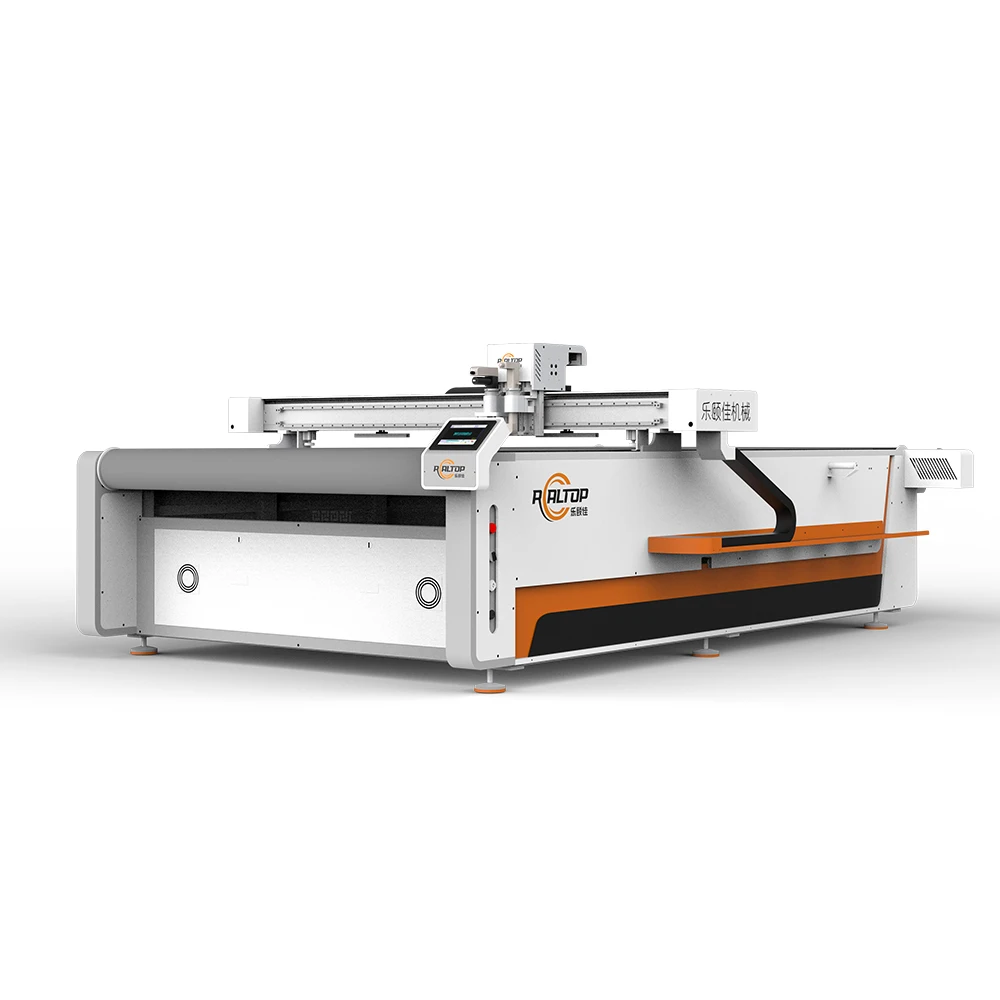
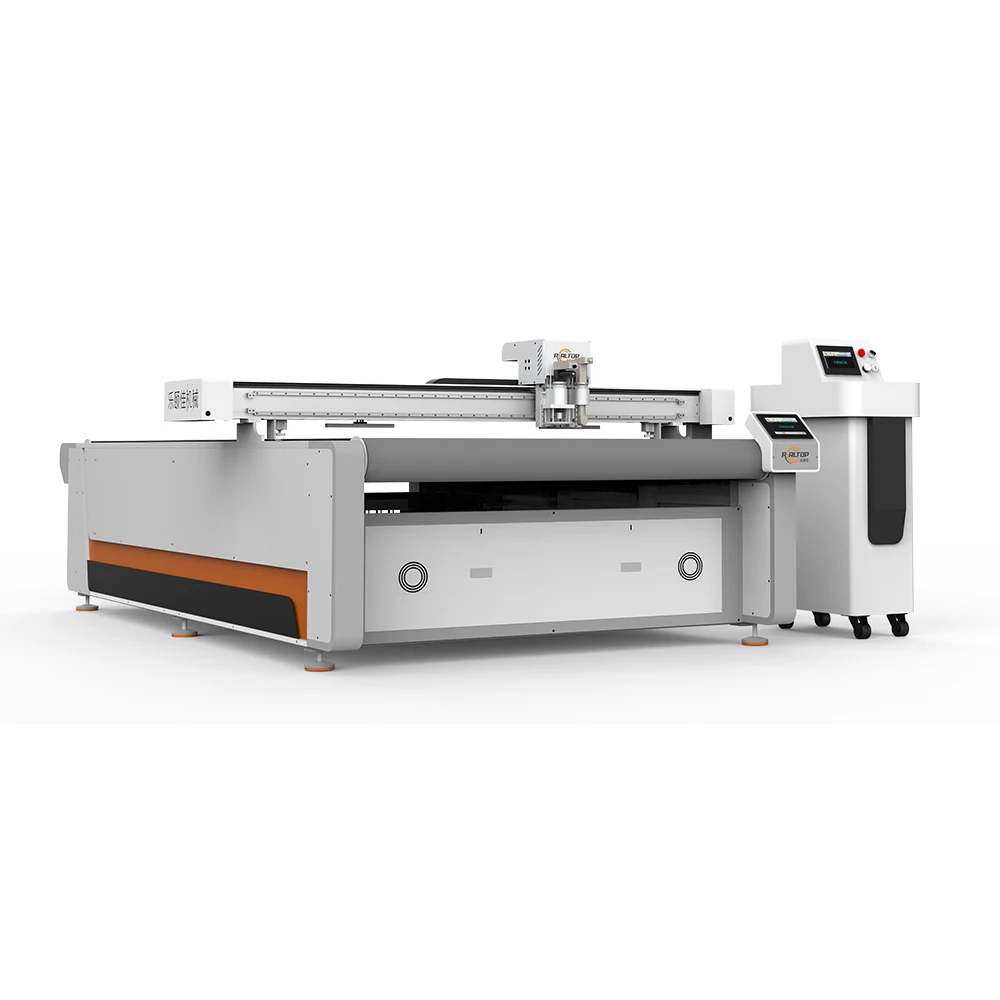
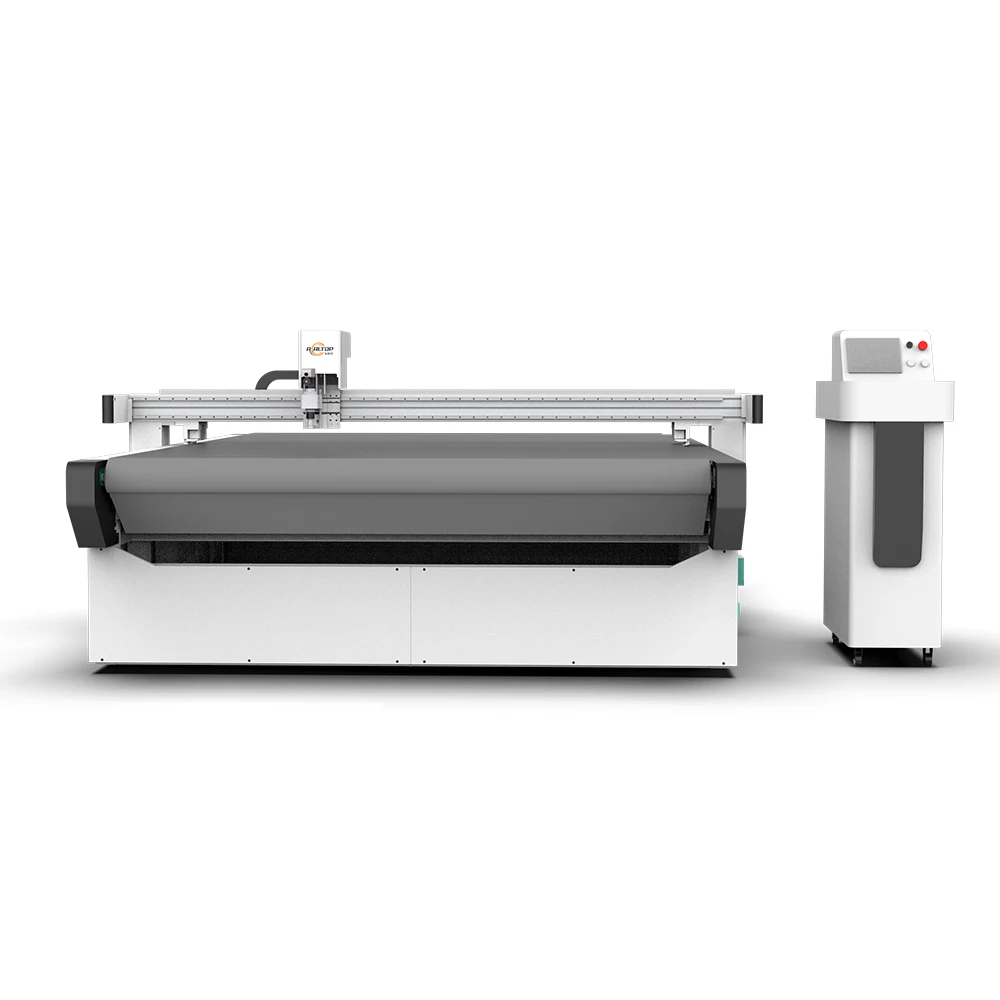
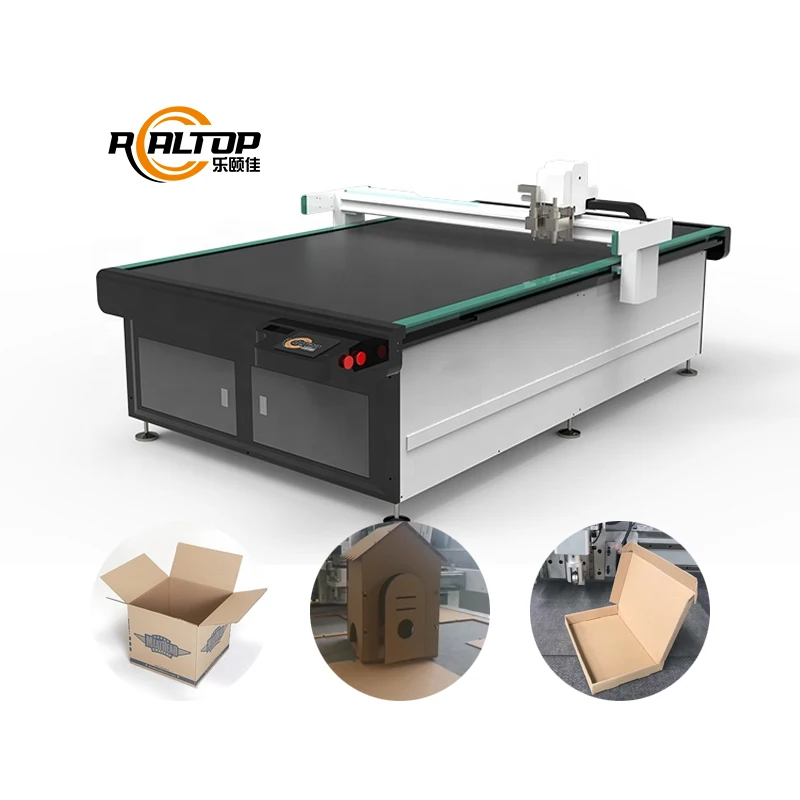
Factory-Built Frame Precision — Every RT-D2516/RT-S2516 frame is welded from thick-walled seamless steel, stress-relieved through high-temperature tempering, and finished on a CNC machining center at our Jinan core factory.
Technical Specifications
| Parameter | Value |
|---|---|
| Product Type | CNC Oscillating Knife Cutting Machine |
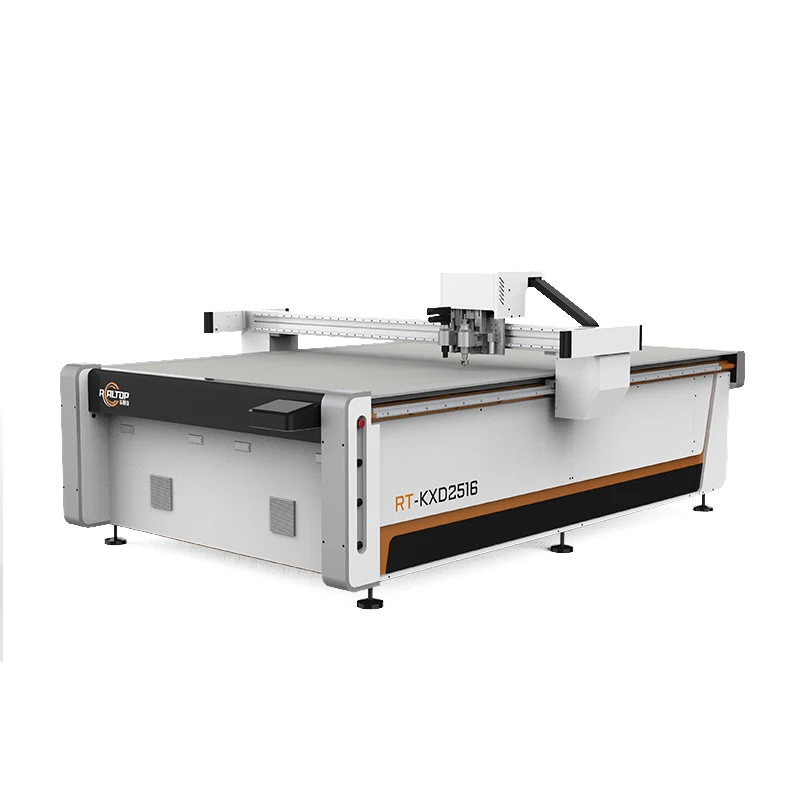
| Model | RT-D2516/RT-S2516 |
| Working Area | 1600×2500 mm |
| Overall Dimensions | 3450×2300×1250 mm |
| Rated Power | 9 kW |
| Voltage | 380V±10% (50/60 Hz to be confirmed per market) |
| Servo Motor | Delta (Panasonic available on request) |
| Transmission | Linear guide with synchronous belt and ball screw; Taiwan Hiwin rail |
| Translational Velocity | 800–2000 mm/s |
| Cutting Speed | 200–800 mm/s (varies with material) |
| Cutting Thickness | ≤100 mm (depends on material density and tool head) |
| Repeated Accuracy | ≤0.1 mm |
| Vacuum Table | Magnesium-aluminum alloy with PVDF fluorocarbon coating, anodic and hard oxidation treatment |
| Vacuum Pump | 7.5 kW, aviation aluminum shell with integrated silencer |
| Table Options | Flat working table or auto-feeding conveyor table |
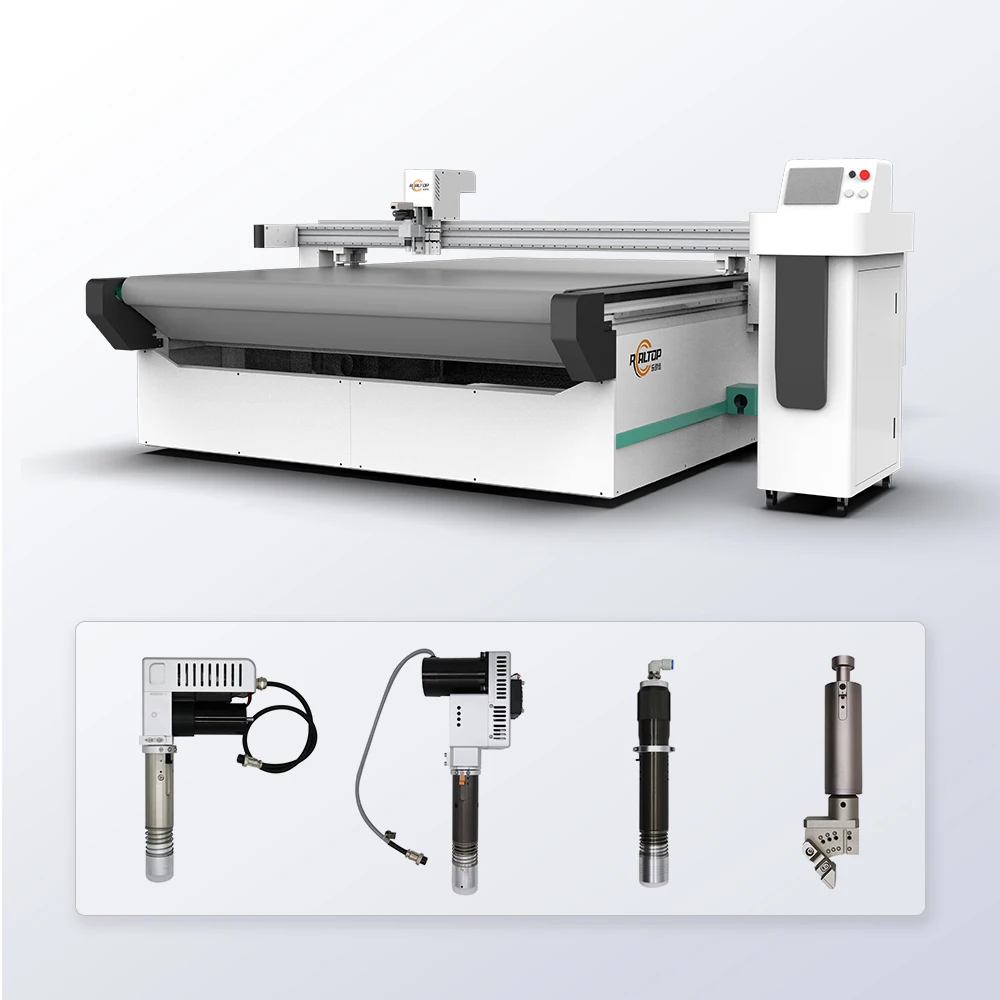
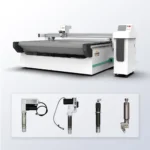
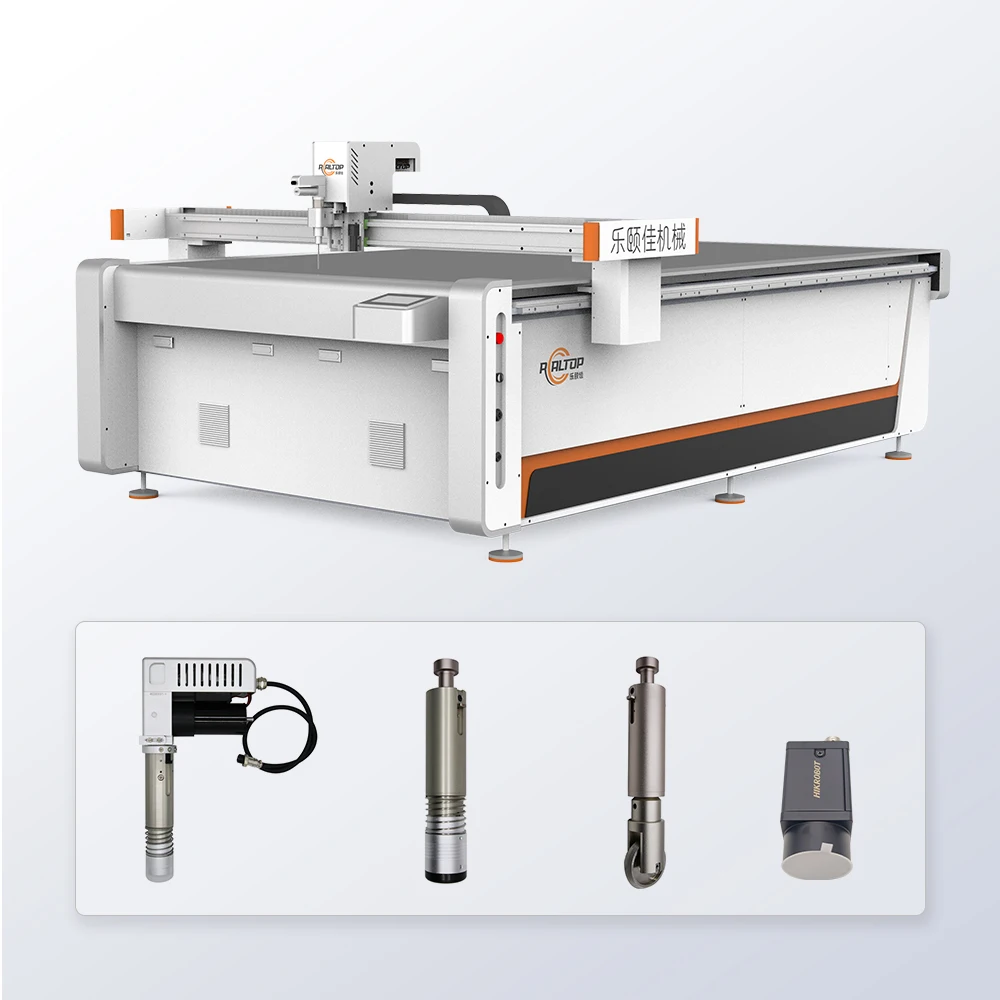
| Tool Heads | Oscillating knife, pneumatic knife, high-power vibrating knife, circular knife, V-cutting knife, drag knife, creasing wheel, dotted line knife, punching, brush |
| Visual Positioning | Small CCD mark point positioning, panoramic camera recognition, or projection positioning |
| Safety Devices | Infrared induction blocking, anti-collision system, emergency stop |
| File Formats | PLT, DXF, AI with auto-nesting software |
| Control Language | English, Russian, Italian, Chinese (additional languages customizable) |
| Standards | CE (verify current certificate status with factory) |
Application Suitability
| Application | Material or Output |
|---|---|
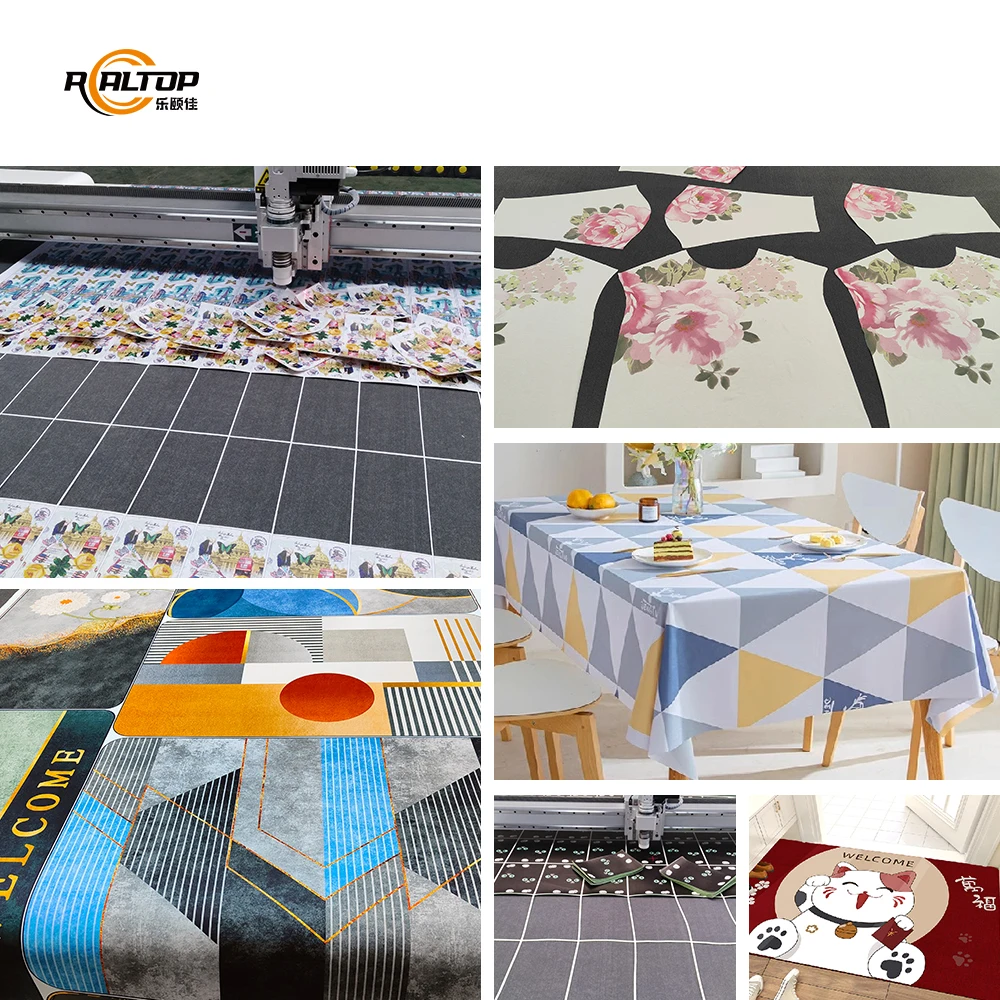
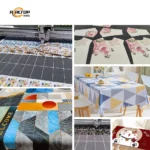
| Soft home furnishings cutting | Sofa fabrics, carpets, floor mats, woven and non-woven textiles |
| Automotive interior trimming | Gaskets, interior panels, sound insulation composites |
| Garment and footwear production | Clothing cloth, shoe uppers, luggage material, PU leather |
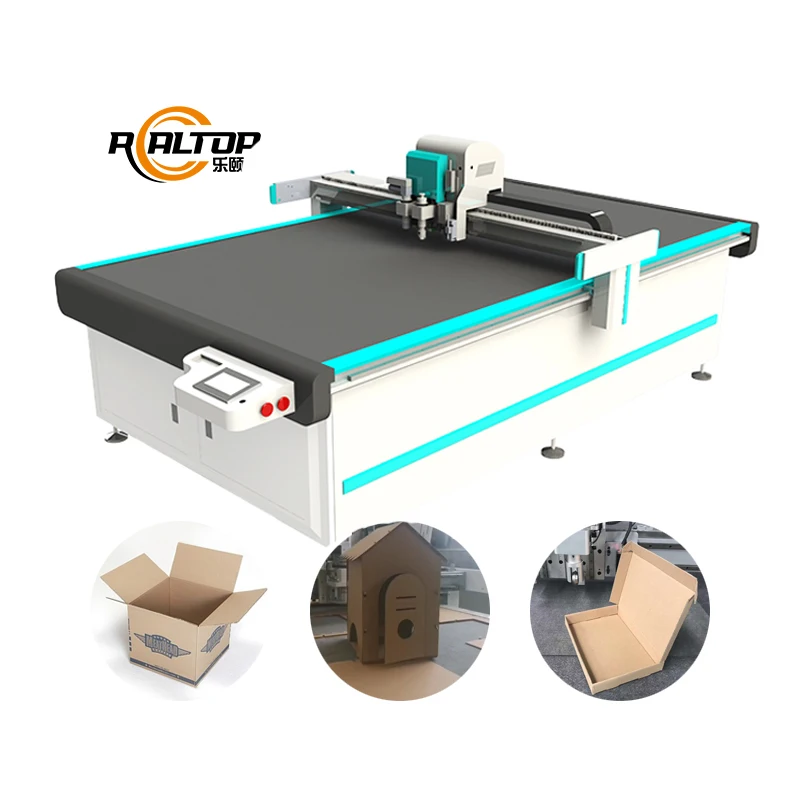
| Packaging sample making | Cardboard, corrugated board, plastic sheet samples |
| Advertising and signage | Self-adhesive vinyl, sticker film, flexible banner |
| Composite processing | Sponge-backed leather, fiberglass cloth, carbon fiber sheets |
| Sealing and gasket production | Rubber, PTFE, ETFE, silicone, compressed fiber |
Why Material Testing Must Precede Any Machine Order
A CNC oscillating knife cutting machine manufacturer can quote working area and speed all day, but those numbers mean little if the tool head cannot handle your specific material thickness and composition. The only way to lock the right configuration is to cut your actual material before the order goes to production.
I remember a Middle East buyer who sent a standard polyester sample for testing. The machine ran clean. When production started with their real fabric — a high-spandex blend — the oscillating knife tore the fibers and left ragged edges across every panel. We had to swap the tool head, recalibrate the vacuum zoning, and rewrite the cutting parameters from scratch. That single mismatch cost weeks of delay [NEED_CITE: material composition impact on knife cutting edge quality].
Specifying a machine on bed size alone is a common trap. A 1600×2500 mm table can cut thin garment cloth at full speed, but the same bed trying to push through dense rubber gaskets at the same rate will stall, overheat the motor, and produce crushed edges. The buyer discovers this only after the machine arrives.
Frame Construction and Long-Term Accuracy
The RT-D2516/RT-S2516 frame starts as thick-walled seamless steel tubing, welded into a single rigid structure. After welding, the entire frame goes through high-temperature tempering to release residual stress — a step that cheaper assemblers often skip. The frame then moves to a CNC machining center where all mounting surfaces for the linear guides and gantry are milled flat in one setup. This ensures the Hiwin rails sit on a true plane, which directly governs the ≤0.1 mm repeated accuracy across the full 2500 mm travel.
Why the Vacuum Table Matters More Than the Motor
Holding flexible material flat during cutting is where most failures happen. The magnesium-aluminum alloy table on this CNC oscillating knife cutting machine receives PVDF fluorocarbon powder spraying followed by anodic and hard oxidation. The result is a surface with high flatness and uniform suction that resists scratching from repeated loading. When cutting small gasket parts or narrow garment panels, zoned vacuum sections keep individual pieces from lifting mid-cut — a problem that causes both waste and knife damage [NEED_CITE: vacuum hold-down requirements for flexible sheet materials].
Matching Tool Heads to Your Material Stack
The available tool heads — oscillating knife, circular knife, drag knife, pneumatic knife, V-cutting knife, creasing wheel, and punching — are not interchangeable options to pick at random. Each one serves a distinct material range. An oscillating knife at high frequency handles thick sponge and layered textile without crushing the fibers. A drag knife works for thin vinyl and sticker film where a vibrating blade would drag and tear. A creasing wheel scores cardboard for folding without penetrating. The correct head depends on your material type, thickness, and the edge finish your downstream process requires.
Parameters That Actually Govern Output
Cutting speed on this machine ranges from 200 to 800 mm/s depending on material. That range exists because a 5 mm foam sheet can be cut at the upper limit, while a 20 mm rubber gasket demands the lower end to keep the blade from deflecting. The 7.5 kW vacuum pump runs continuously to maintain hold-down, and its integrated silencer sponge keeps workshop noise within reasonable bounds. Translational velocity of up to 2000 mm/s governs non-cutting moves — the travel between cut paths — so nesting software plays a direct role in total job time. File format compatibility with PLT, DXF, and AI means most buyers can feed their existing design workflow without conversion steps [NEED_CITE: nesting software impact on material yield in fabric cutting].
The Hidden Cost of a Configuration Mismatch
Choosing the wrong vacuum table type — flat versus conveyor — for your production volume causes constant material reloading that drags on throughput. Selecting an incorrect tool head for your material thickness produces ragged edges that fail quality inspection or crush foam layers that must then be scrapped. Skipping CCD camera positioning when your job involves printed contour cutting forces operators to align every sheet by eye, introducing registration errors that compound over a full shift [NEED_CITE: CCD contour recognition accuracy requirements in print-and-cut workflows].
Why Buyers Source This Machine From Our Factory
In-house design and production means the same team that engineers the frame also specifies the tool head configuration — there is no third-party integrator passing along markup. Every machine is fully assembled and tested at the Jinan core factory before crating, so buyers receive a unit that has already run under power rather than a flat-pack of parts. Sample cutting on the buyer’s own material is mandatory in our process, ensuring the configuration matches the actual production requirement. Voltage, control language, and software compatibility are confirmed in writing before production begins. The documentation package — from electrical schematics to the spare parts list — travels with the machine so importers and distributors have what they need for local compliance and after-sales service.
Documentation & Verification
- Machine specification sheet covering RT-D2516/RT-S2516 working area, power, and tool head list
- Electrical schematic with confirmed voltage and frequency for your local supply
- Factory test record documenting cuts on your submitted material samples
- Tool head and table configuration list matched to your material and volume
- Software license with confirmed PLT, DXF, and AI file format compatibility
- Spare parts list with part numbers for knives, blades, and wear components
Installation, Commissioning & Support
- Requires level concrete floor capable of supporting 9 kW total power draw plus the 7.5 kW vacuum pump circuit
- 380V±10% three-phase supply with dedicated breaker; frequency confirmed to 50 or 60 Hz before wiring
- Arrives fully assembled; only conveyor belt tensioning and vacuum hose connection needed on site
- First-run parameter tuning based on your material test report included in the commissioning session
- Operator training covers tool head changeover, CCD camera calibration, and nesting software workflow
- Recommended spare knife blades and oscillating knife consumables ship in the initial package
What We Need Before Quoting Your Configuration
To recommend the correct tool head, table type, and camera option for your line, we need your material type, typical thickness range, and maximum sheet size. Share your daily cutting volume and whether your workflow involves printed contour work or plain-shape nesting. If your workshop runs on a voltage standard outside 380V/50Hz, let us know the exact supply so we can confirm motor and pump compatibility before the order enters production.
Frequently Asked Questions
Q: How does the factory ensure frame precision and long-term structural integrity?
A: Every RT-D2516/RT-S2516 frame is welded from thick-walled seamless steel, stress-relieved through high-temperature tempering, and finish-machined on a CNC machining center in a single setup. This process ensures linear guide mounting surfaces remain true, maintaining repeated accuracy throughout the machine’s service life.
Q: What OEM and customization options are available for distributors?
A: We offer voltage and frequency adjustment to match local power standards, control panel language customization beyond the default English, Russian, Italian, and Chinese options, and branding on machine panels. All customizations are confirmed in the specification document before production begins.
Q: Can buyers visit the core factory to inspect build quality before shipment?
A: Factory visits are welcome. Buyers can inspect frame welding, CNC-machined mounting surfaces, and full assembly on the production floor. Witnessing the factory test on their own material provides direct verification before the machine is crated for export.
Q: How is the tool head selected and validated against my material?
A: We require physical material samples before configuration is finalized. The sample is cut using candidate tool heads, and the results — edge quality, cutting speed, and vacuum hold-down performance — are documented in a sample cutting report shared with the buyer for approval.
Q: What documentation is provided for import compliance and after-sales support?
A: Each machine ships with a specification sheet, electrical schematic, CE declaration, factory test record, operation and maintenance manual, software license, file format compatibility note, and a spare parts list with part numbers for local sourcing.
You may also like

商品评价
Clear filtersThere are no reviews yet.