




-
 Courier delivery
-
 DHL Courier delivery
-
 Warranty 1 year
-
 Free 30-Day returns

Material-matched tooling — every RT-D2516/RT-S2516 head, blade and vacuum zone is specified after sample cutting on the buyer’s actual fabric stack, not pulled from a standard catalogue page.
Technical Specifications
| Parameter | Value |
|---|---|
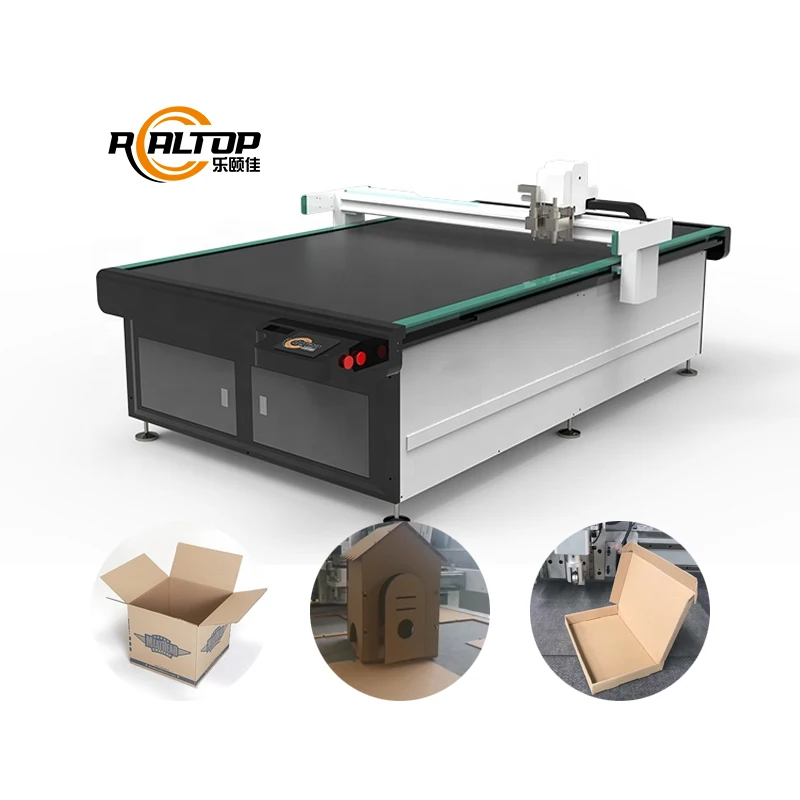
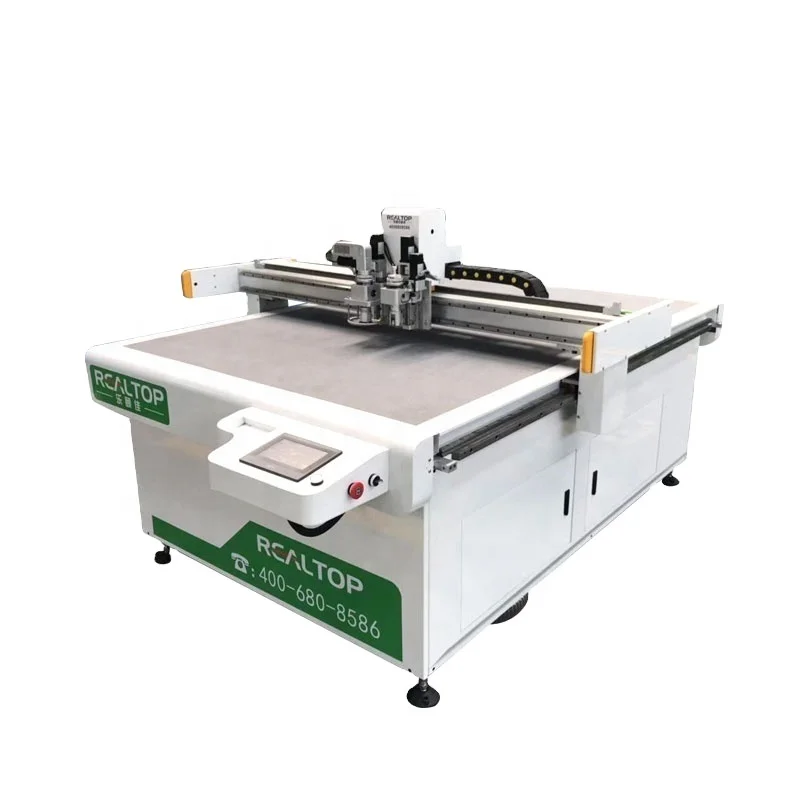
| Product Type | CNC Oscillating Knife Cutting Machine |
| Model | RT-D2516 / RT-S2516 |
| Working Area | 1600 × 2500 mm |
| Overall Dimensions (L×W×H) | 3450 × 2300 × 1250 mm |
| Rated Power | 9 kW |
| Voltage | 380V ±10% |
| Table Type | Flat working table with vacuum and auto feeding |
| Vacuum Pump | 7.5 kW |
| Tool Head | Multifunctional head with Swiss imported knife (vibration full cutting, vibration half cutting, cursor location) |
| Translational Velocity | 800 – 1200 mm/s |
| Cutting Speed | 200 – 800 mm/s (basis to be confirmed) |
| Repeated Accuracy | ≤ 0.1 mm |
| Transmission System | Digital servo motor, linear guide, synchronous belt, ball screw (imported) |
| Servo Motor | Japanese Yaskawa |
| Linear Guide | Taiwan Hiwin rail |
| Conveyor Belt | Germany imported |
| Safety Device | Infrared sensors |
| Instruction System | HP-GL compatible format |
| Warranty | 12 months for whole machine, 3 months for consumables |
Application Suitability
| Application | Material or Output |
|---|---|
| Sofa and upholstery panel cutting | Woven fabric, chenille, velvet, ice silk textile stacks |
| Mattress cover and quilting layer processing | Ice silk, knitted spacer fabric, thin sponge composite |
| Footwear and leather goods nesting | Genuine leather, PU, sponge composite leather |
| Gasket and soft seal fabrication | Rubber, silicon, soft glass, PVC sheets |
| Automotive interior trim blanks | Flexible composite materials, synthetic leather |
Why the Tool Head Matters More Than the Working Area
Most cutting tables are sold on bed size alone, yet the real failure point on a fabric sofa CNC cutting machine is the tool head meeting a material it was never configured for. The oscillating knife frequency, blade profile and hold-down pressure must match the exact fabric stack before the order is confirmed.
A buyer cutting ice silk mattress layers on a round-knife machine meant for standard foam often finds the blade crush*posite. The result is frayed edges, delaminated plies and a pile of rejected panels. The same problem appears in reverse when a drag knife is asked to slice through multi-layer sponge composite leather — the blade deflects, accuracy drifts and the nesting yield drops noticeably [NEED_CITE: common causes of edge delamination in multi-layer textile cutting]. Matching the vibration full cutting or half cutting mode on the Swiss imported knife to the buyer’s material stack removes this failure mode before production begins.
Matching Knife Mode to the Fabric Stack
The multifunctional head on this CNC oscillating knife cutting machine manufacturer platform supports vibration full cutting, vibration half cutting and cursor location in one unit. Full cutting mode drives the blade through the entire fabric stack in a single pass, which suits tightly woven upholstery textiles and single-ply leather where edge sealing is not required. Half cutting mode scores only the top layer of a laminate, allowing the operator to peel the face fabric without disturbing the foam or adhesive backing beneath — a routine requirement when processing sponge composite leather for footwear uppers or automotive seat inserts. Cursor location uses the same head to register printed marks or woven labels, positioning the cut path relative to existing pattern features rather than the sheet edge.
Vacuum Zoning and Continuous Feeding
A 7.5 kW vacuum pump holds thin, flexible materials flat across the 1600 × 2500 mm working area, but holding force is only effective if the table is zoned correctly. Small gasket blanks and narrow sofa welt strips tend to lift at the trailing edge when the entire table is under uniform suction, because the off-cut areas bleed air back into the zone. The auto-feeding conveyor, fitted with a Germany imported belt, advances the next roll segment while the head finishes the previous nest, keeping the cutting cycle continuous without manual sheet reloading. This workflow suits high-roll-count environments such as mattress ticking and sofa panel batching, where each roll differs in width or pattern repeat. [NEED_CITE: vacuum table zoning practices for flexible sheet materials]
Reading the Specification Sheet Against the Material List
Repeated accuracy of ≤ 0.1 mm is delivered by the combination of a Japanese Yaskawa digital servo motor and Taiwan Hiwin linear guide, but the practical meaning of that figure depends on what the blade is actually doing inside the material. When cutting 3 mm sponge composite leather, the lateral force on the blade is low and the servo can hold tolerance without difficulty. When the same machine processes 15 mm dense foam, blade deflection adds a variable that the motion system alone cannot correct — the operator must reduce cutting speed from the upper range toward 200 mm/s to maintain edge squareness. Translational velocity of 800 – 1200 mm/s governs how fast the head repositions between cuts, which directly affects the non-cutting portion of the cycle. The HP-GL compatible instruction system accepts nesting files from most mainstream pattern software, so the buyer’s existing file workflow transfers without re-purchasing a licence or retraining the design room.
The Hidden Cost of a Default Configuration
Choosing a round knife for ice silk because the price was lower leaves the buyer with crushed fibers on every panel, forcing a secondary trimming step that consumes the time the CNC was supposed to save. A drag knife run at full speed on abrasive rubber gasket material wears through blades in a single shift, turning consumable cost into a daily variable rather than a monthly constant. [NEED_CITE: premature blade wear in abrasive non-metal cutting] Vacuum tables without zoning cause small parts to migrate during the final cuts of a nest, producing scrap where the tolerance was already held on the first piece. These failures share a single root — the configuration was decided before the material was tested.
Why Source This CNC Oscillating Knife Cutting Machine Manufacturer Configuration Here
The design team engineers both knife and laser platforms in-house, so a buyer evaluating an oscillating knife table can also request a laser-cut sample on the same material to compare edge finish before committing to one method. Every tool head and vacuum zone combination is written into the specification sheet against the buyer’s own material type and thickness, not selected from a default menu. Sample cutting on the buyer’s supplied roll stock produces a written report showing edge quality, cutting depth and cycle time, so the decision rests on physical evidence rather than a brochure claim. Voltage, plug type and control panel language are confirmed in writing before production starts, preventing the mismatch that leaves machines idle on the dock. Software licence terms and file format compatibility notes are included in the documentation package, ensuring the nesting workflow in the design office communicates directly with the machine controller.
Documentation & Verification
- Machine specification sheet listing tool head, blade type and vacuum zone map matched to buyer’s fabric stack
- Electrical schematic and voltage confirmation document aligned with buyer’s local 380V ±10% supply
- Sample cutting report on buyer’s own ice silk or composite material showing edge quality and depth
- Factory test record covering repeated accuracy check on the 1600 × 2500 mm working area
- Software licence and HP-GL file format compatibility note for buyer’s nesting workflow
- Spare parts list identifying consumable blades and belt segments with part numbers
Installation, Commissioning & Support
- Foundation must be level within 2 mm across the 3450 × 2300 mm footprint to maintain ≤ 0.1 mm repeated accuracy
- Dedicated 380V ±10% circuit with capacity for 9 kW rated plus 7.5 kW vacuum pump inrush current
- Machine arrives with conveyor belt pre-tensioned; final alignment verified on first powered run
- First-day commissioning includes vacuum zone mapping on buyer’s actual roll stock width
- Operator training covers blade change on the Swiss imported multifunctional head and HP-GL file import
- Infrared sensor safety devices tested weekly; consumable blades and belt segments listed in spares package
What to Prepare Before Requesting a Quotation
Send the material data sheet or a physical roll sample so the tool head, blade profile and vacuum zoning can be specified before pricing. State the local voltage, frequency and plug type along with the preferred control panel language. Confirm whether the existing design office runs DXF, PLT or HP-GL files so the software compatibility note can be drafted in advance.
Frequently Asked Questions
Q: How is cutting capacity verified before the order is placed?
A: A sample cutting report is produced on the buyer’s own material, documenting edge quality, achieved cutting depth and cycle parameters. The report is shared before commercial commitment so the buyer can compare physical results rather than rely on published speed figures that omit material variables.
Q: Which tool head configuration suits ice silk mattress layers?
A: Vibration full cutting with the Swiss imported oscillating knife is typically recommended for clean through-cuts on woven and knitted ice silk stacks. Half cutting mode may be selected if the textile is laminated to a foam backing that must remain unscored for a subsequent peeling step.
Q: Is voltage and control language confirmed before shipment?
A: Yes. Electrical schematic, voltage confirmation document and control panel language are all agreed in writing during the specification stage. The 380V ±100% supply requirement and frequency are matched to the buyer’s local grid before the electrical cabinet is wired.
Q: What nesting file formats does the system accept?
A: The HP-GL compatible instruction system imports standard plotter files. DXF and PLT exports from common nesting software are routinely accepted. A file format compatibility note is included in the documentation package to confirm the buyer’s specific software version.
Q: What does the warranty cover and how are spare parts supplied?
A: The whole machine carries a 12-month warranty; consumables such as blades and belt segments carry 3 months. A spare parts list with part numbers is provided at delivery, and replacement blades for the multifunctional head are shipped as standard export parcels.
You may also like

商品评价
Clear filtersThere are no reviews yet.