

Blog
How Does Manufacturer Customization Solve Low-Tension Cutting for Lace?

How Does Manufacturer Customization Solve Low-Tension Cutting for Lace?
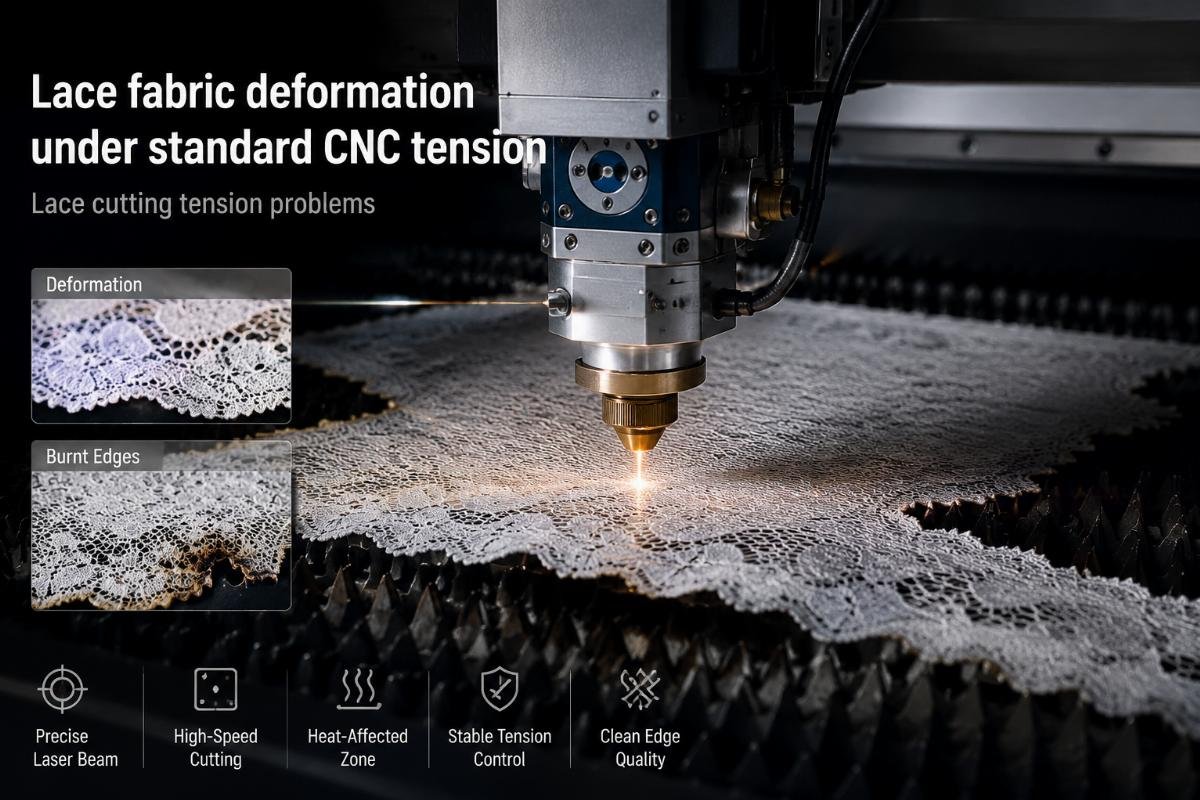
When I receive lace samples from garment manufacturers, the damage has already happened before they even contact us. They send me pieces of French lace with collapsed eyelets, elastic lace with wavy edges, and bridal fabric with stretched-out scallops—all cut on standard CNC machines. The question they ask is always about blade sharpness or cutting speed, but the real problem started the moment the fabric touched the conveyor belt.
Standard CNC cutting machines apply uniform tension designed for stable materials like leather or cardboard.1 Lace, with its open-work structure and elastic fibers, deforms under this tension before the blade makes contact.2 Low-tension customization prevents pattern collapse, edge waviness, and fabric stretch by reducing brush bar pressure and slowing feed rates based on the specific lace type—not by changing blade specifications.
Most manufacturers discover the tension problem only after they've already invested in cutting equipment. They run a test batch, see defects they can't explain, and wonder if they need better blades or faster machines. What they actually need is equipment that treats lace differently from the first moment of material contact—not just during the cutting stroke.
Why Does Standard CNC Tension Deform Lace Before Cutting?
When you load lace onto a standard CNC cutter, the machine assumes you're working with dimensionally stable material. The conveyor belt pulls the fabric forward, the brush bar presses down to prevent lifting, and the vacuum table holds everything flat. For leather or vinyl, this works perfectly. For lace, each of these steps introduces deformation.
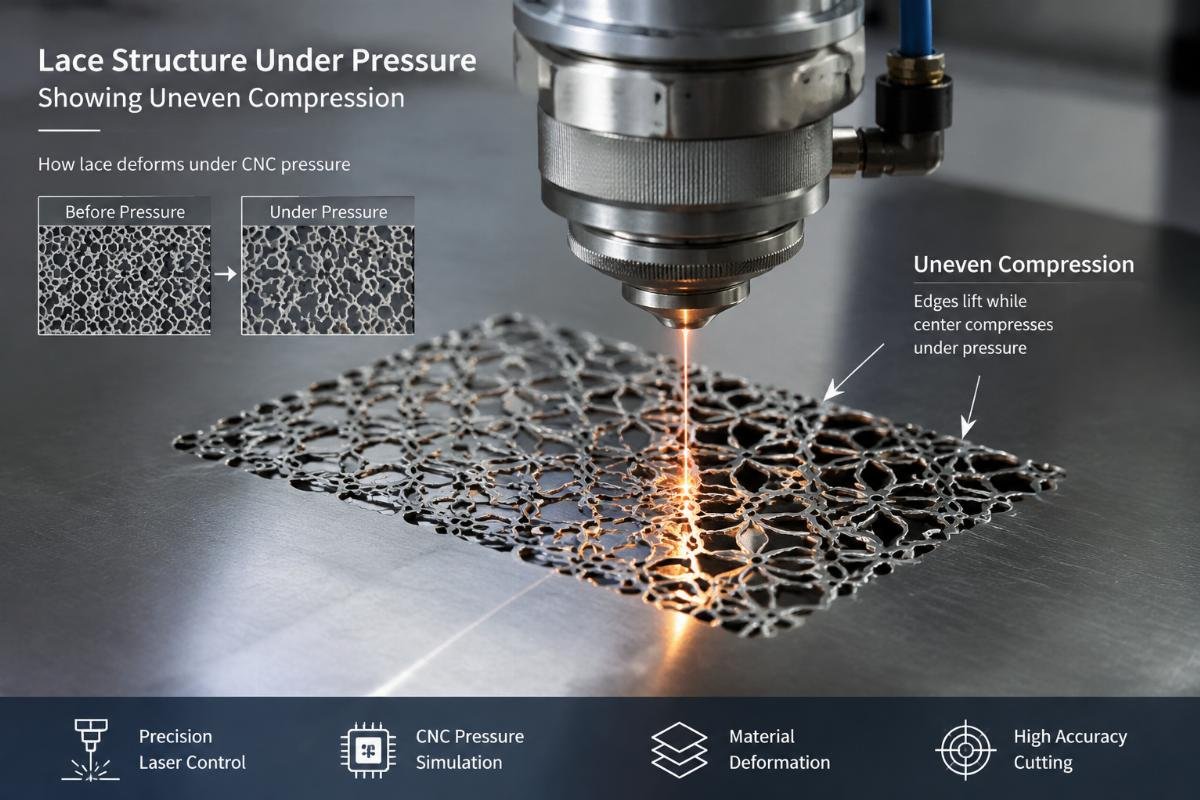
Lace deforms under standard CNC tension because its open structure can't distribute pressure evenly. When the brush bar presses down with standard force, it compresses the solid parts of the pattern while the hollow areas collapse inward.3 When the vacuum pulls, the elastic fibers in stretchy lace elongate before the blade arrives.4 The fabric is already distorted when cutting begins.5
Where Does Deformation Start in the Cutting Process?
I've debugged hundreds of lace cutting issues, and the deformation always starts at one of three contact points: the material feed system, the hold-down mechanism, or the vacuum table. Understanding which point causes your specific problem determines whether you need parameter adjustment or equipment redesign.
| Contact Point | How It Deforms Lace | When You See This Problem | Solution Type |
|---|---|---|---|
| Material feed | Uneven pulling stretches elastic fibers longitudinally | Wavy edges parallel to cutting direction, especially with spandex-blend lace | Parameter adjustment (slower feed) or equipment upgrade (compliant roller system) |
| Brush bar hold-down | Excessive pressure collapses hollow patterns | Crushed eyelets, flattened scallops in areas where brush bar contacted fabric | Parameter adjustment (reduced pressure) or hardware modification (soft-contact brush) |
| Vacuum table | Strong suction pulls stretchy lace taut before cutting | Fabric shrinks back after cutting, creating undersized pieces | Parameter adjustment (reduced suction zones) or equipment limitation requiring upgrade |
The first question I ask customers who bring failed samples is: "Where do you see the defect relative to the cut line?" If the deformation is in the cut edges themselves, it's usually a blade problem. If the deformation is in the pattern around the cut—collapsed eyelets two centimeters away from the edge, or waviness in areas the blade never touched—it's a tension problem that started before cutting.
When a bridal atelier sends me French lace with intricate hollow patterns, I don't test blade sharpness first. I run the fabric through the machine with the blade lifted, just to see how the material behaves under the hold-down and vacuum systems. If the eyelets collapse during this test, no amount of blade optimization will fix the final cut quality. The equipment is applying standard tension to a material that can't handle it.
The core issue is that standard CNC cutters are tuned for materials where "holding the fabric flat" and "preventing deformation" are the same goal. With lace, these two goals conflict. Holding it flat with standard pressure guarantees deformation. The manufacturer's customization work is finding the minimum tension that prevents lifting without collapsing the pattern—and for many lace types, standard equipment can't operate in that narrow range.
What Does Low-Tension Customization Actually Change?
When customers ask about low-tension customization, they often expect a simple parameter adjustment—just turn down the vacuum power or reduce the brush bar pressure. Sometimes that works. But for lace with complex structures or high elasticity, you're asking the equipment to operate outside its design limits. Low-tension customization can happen at two levels: parameter tuning or hardware redesign.
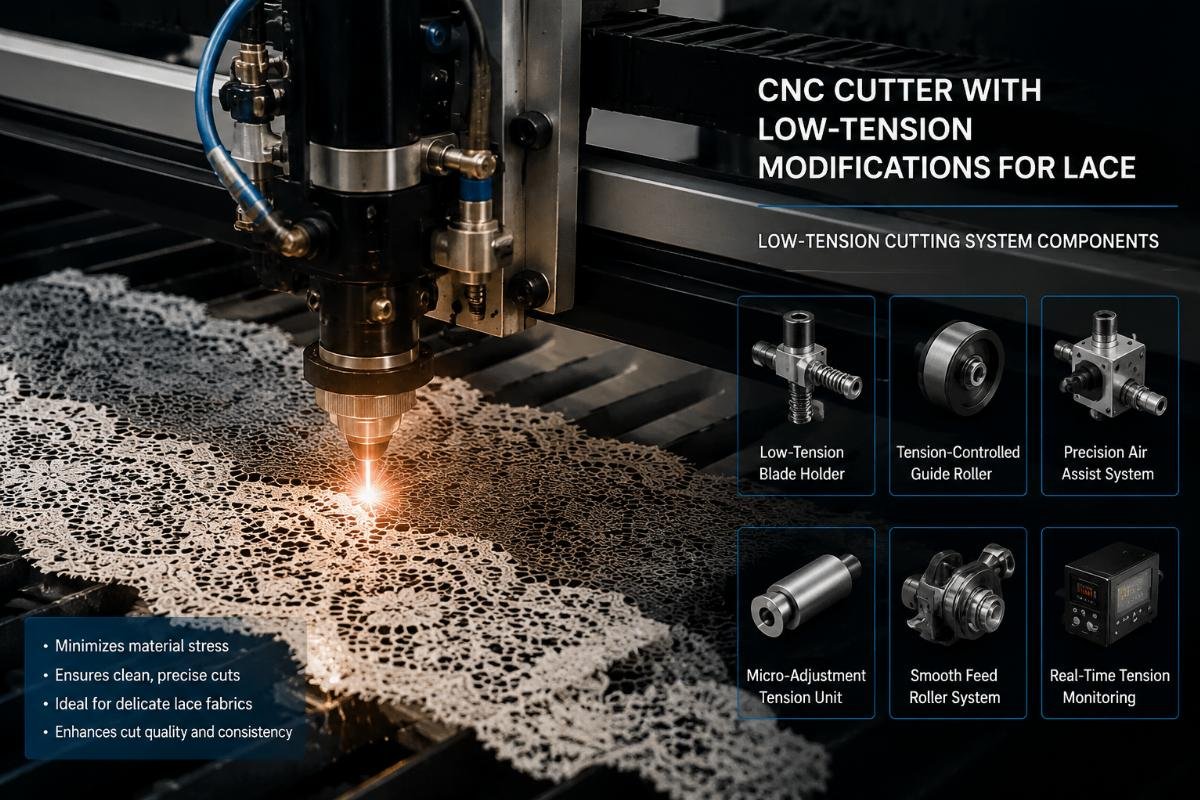
Low-tension customization modifies how the cutting system contacts and moves the lace, not just how fast it cuts. Parameter-level changes reduce brush bar pressure, slow feed rates, and adjust vacuum suction zones based on lace composition. Hardware-level changes replace rigid hold-down systems with compliant materials, redesign roller surfaces for elastic fabrics, and install zone-controlled vacuum tables that don't pull the entire piece taut.
How Do I Know If My Lace Needs Parameter Tuning or Hardware Upgrade?
This is the decision point where most manufacturers get stuck. They see defects, they know standard settings don't work, but they don't know if their existing equipment can be fixed or if they need different machines. I use a three-sample test to make this determination: rigid lace with minimal elasticity, semi-elastic lace with partial spandex content, and high-stretch lace with significant elastic recovery.
Test 1: Rigid lace (like nylon Chantilly)
If your machine can cut rigid lace without edge waviness after you reduce brush bar pressure by 30-40%, the equipment is capable of low-tension operation. The deformation you saw with standard settings was parameter-based, not a hardware limitation. This is the best-case scenario because you can solve it with control adjustments.
Test 2: Semi-elastic lace (cotton-spandex blends)
If reducing brush bar pressure eliminates pattern collapse but creates fabric lifting during cutting, you're at the edge of your equipment's capability. The machine can't operate in the narrow tension range this material needs. You'll either accept some lifting and deal with occasional miscuts, or you need hardware modifications like a lighter-touch hold-down system.
Test 3: High-stretch lace (elastane bridal lace)
If the fabric deforms even with minimal brush bar contact and reduced vacuum, your equipment wasn't designed for this material class. The standard rigid contact system can't handle elastic recovery. This is when I tell customers they need machines designed for compliant materials from the start—not retrofitted standard cutters.
I once worked with a garment manufacturer who was cutting elastic lace for lingerie. They had already reduced every parameter they could adjust: slowest feed rate, minimum brush bar pressure, lowest vacuum setting. The edges were still wavy. When I ran their lace samples on our test machine, I realized the issue wasn't the pressure level—it was that their equipment applied pressure as a point contact (rigid brush bars), while elastic lace needs distributed contact (soft roller or compliant pad). No parameter adjustment would fix that. They needed different hardware.
The distinction between parameter-level and hardware-level solutions is not about quality—it's about whether your material falls within the tension range your current equipment can produce. Standard CNC cutters can go "low tension" for rigid materials, but they hit a floor where they can't reduce tension further without losing basic functions like holding the fabric flat. Materials that need tension below that floor require redesigned contact systems, not just gentler settings.
When we customize low-tension systems at Realtop, the first step is always testing customer samples with incrementally reduced tension to find where their specific lace starts showing defects. If defects appear before we reach the equipment's lower tension limit, we know parameter tuning will work. If the material needs even less tension than the machine can provide while still functioning, we're in hardware customization territory.
Does Low-Tension Cutting Reduce Production Speed?
Every customer who asks about low-tension customization eventually asks this question: "How much slower will my production be?" They know they can't cut lace at the same speed as leather, but they need to understand the trade-off before they commit to equipment investment. The real answer is more complicated than a simple percentage reduction.
Low-tension cutting reduces throughput because slower feed rates and gentler material handling are the mechanisms that prevent deformation. The speed reduction isn't a side effect you can engineer away—it's the actual solution. The trade-off is not quality versus speed; it's controlled deformation at lower speed versus uncontrolled deformation that creates defects in entire batches at higher speed.
What Actually Slows Down in Low-Tension Operation?
When I configure a machine for low-tension lace cutting, three time factors change compared to standard operation. Understanding which factor dominates your production time helps you calculate realistic throughput expectations.
Material loading time increases: With standard tension, you can load fabric quickly because the vacuum and brush bar immediately lock it in place. With low-tension settings, you need more careful positioning because the reduced hold-down force means the fabric can shift if not aligned properly. For small batches of bridal lace, this adds 2-3 minutes per piece. For continuous rolls of elastic lace, it's negligible once the material is threaded.
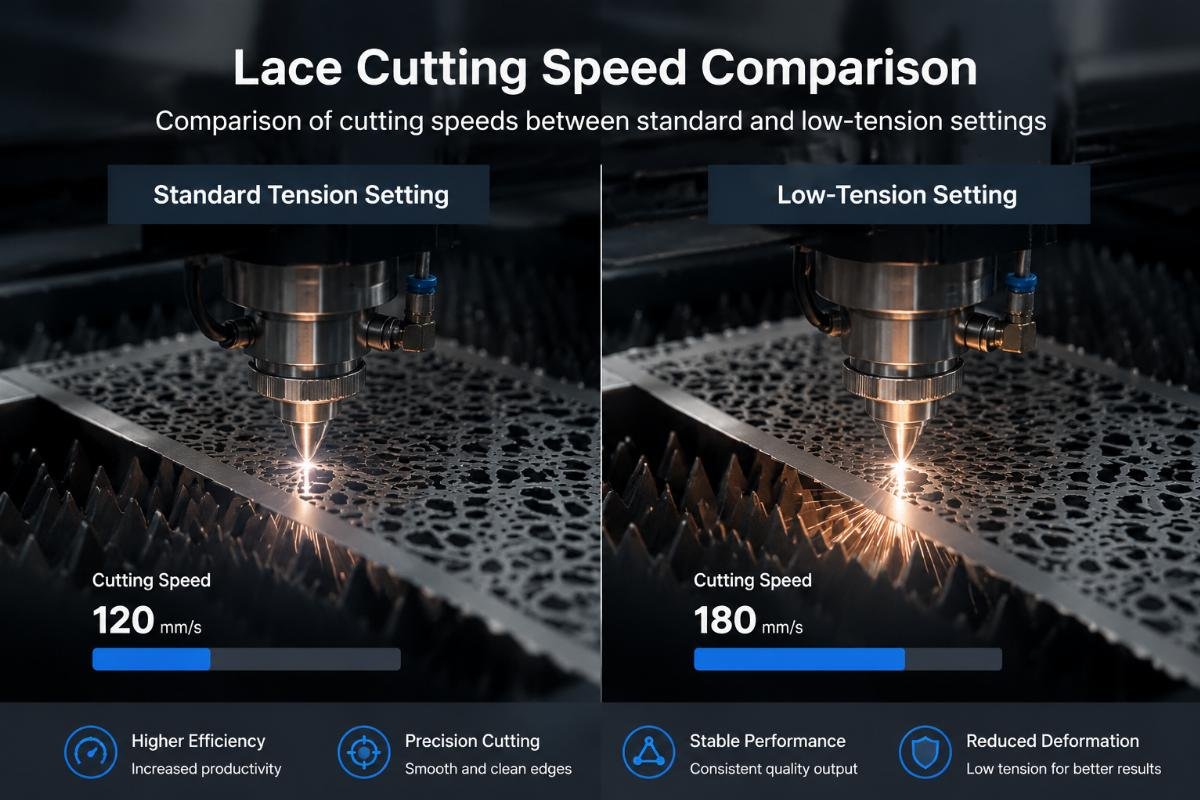
Cutting speed decreases: Standard CNC cutters run at feed rates optimized for stable materials—often 600-800 mm/second for straight cuts.6 Elastic lace often requires 200-400 mm/second to prevent fabric stretch during the cutting stroke.7 The speed reduction isn't about blade capability; it's about giving the elastic fibers time to respond to the cut without pulling away from the blade path. This directly cuts throughput by 40-60% compared to standard materials.
Quality check time decreases: This is the hidden productivity gain nobody counts until they actually run low-tension equipment. When you cut lace with standard tension, your reject rate might be 15-25% for complex patterns.8 Every rejected piece requires operator inspection, disposal decision, and sometimes customer communication about delayed orders. When low-tension customization reduces your reject rate to 3-5%, you spend less time managing defects even though each piece cuts slower.
I worked with a bridal atelier that was cutting French lace appliqués on a standard machine. They were running at 600 mm/second and rejecting 18% of pieces due to collapsed eyelets. When we switched them to a low-tension configuration at 300 mm/second, their reject rate dropped to 4%. Their throughput per hour decreased by 35%, but their usable output per hour actually increased by 12% because they weren't throwing away nearly as many pieces. The slowdown was real, but the productivity loss wasn't as bad as the numbers suggested.
The core trade-off is this: you cannot cut delicate lace at standard speed without accepting significant defect risk. Low-tension customization is choosing to control where the time goes—into slower, careful cutting rather than into scrapping failed pieces and explaining delays to customers. Some manufacturers see this as a speed penalty. I see it as choosing which problem you want to manage: slower production with predictable output, or faster cutting with unpredictable waste.
How Do I Determine If My Lace Type Needs Low-Tension Equipment?
This is the question manufacturers should ask before they buy cutting equipment, but most ask it after they've already damaged inventory on a standard machine. The decision isn't about whether low-tension is "better"—it's about whether your specific lace composition and pattern complexity will survive standard CNC tension without defects. I use a material assessment process based on three factors I can evaluate from a physical sample.
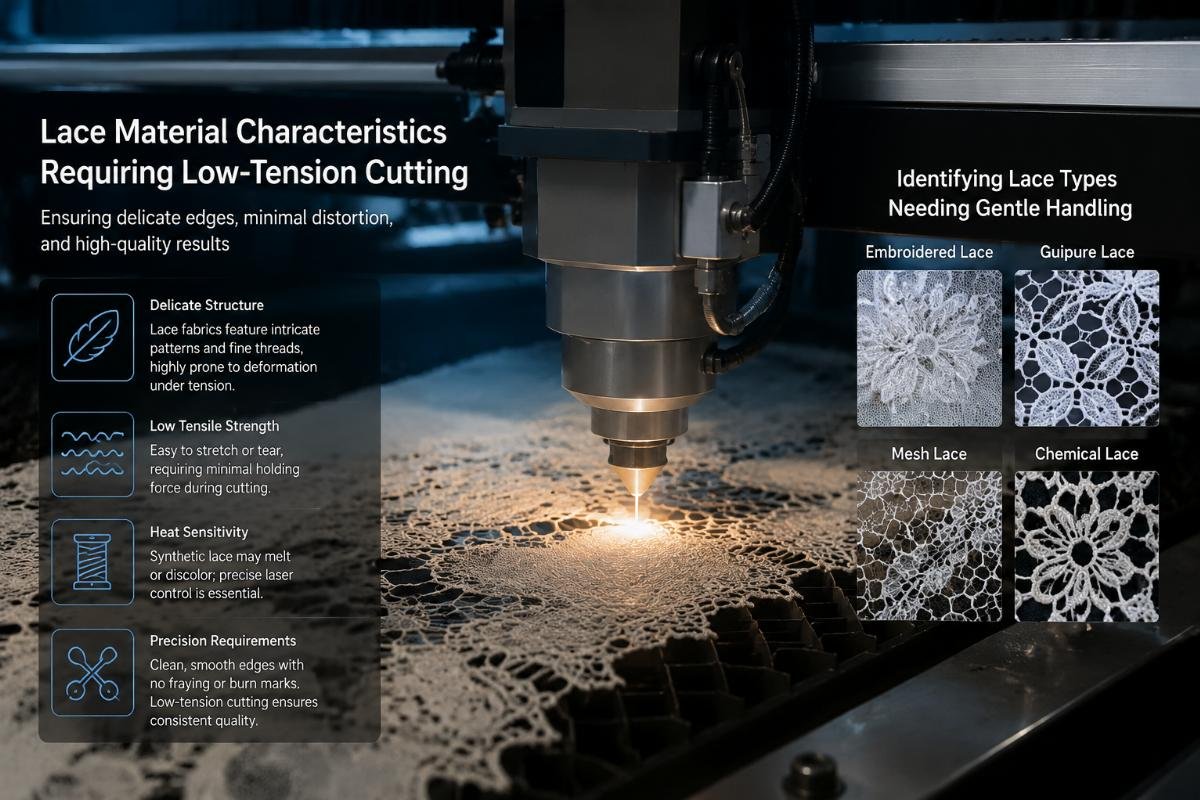
Your lace needs low-tension equipment if it has any of these characteristics: elastic fiber content that creates visible stretch when you pull gently, hollow patterns with open areas larger than 10mm where pressure can't distribute9, or lightweight construction where the fabric lifts easily under normal airflow. If your lace has two or more of these characteristics, standard CNC tension will likely cause defects.
What Can I Test With a Physical Sample Before Equipment Purchase?
When customers send me lace samples for equipment evaluation, I don't need lab testing or specification sheets. I need enough fabric to run three physical tests that predict how it will behave under CNC cutting tension. These tests take 10 minutes and tell me more than any technical data sheet.
Test 1: Manual stretch recovery
Hold the lace sample at two points 10cm apart and stretch it gently—don't pull hard, just apply light tension like the machine's feed system would. Release and watch how the fabric recovers. If it snaps back to original dimensions within 2 seconds, you have significant elastic fiber content10 and standard feed tension will elongate it during cutting. If it stays stretched or recovers slowly, the material is more rigid and might tolerate standard tension.
Test 2: Hollow pattern collapse
Place the lace flat and press your finger gently into the largest hollow area. If the pattern collapses inward or the edges of the hollow bend, that's what will happen under a standard brush bar. The more the pattern deforms under finger pressure, the more likely standard hold-down systems will crush it. Rigid lace with reinforced pattern edges resists this deformation; delicate lace with thin connecting threads collapses easily.
Test 3: Fabric lifting behavior
Hold the lace sample 5cm above a table and drop it. Watch how it falls and settles. Lightweight lace that floats down slowly or curls as it falls will lift easily under blade air turbulence or vacuum airflow. Heavier lace that drops straight and lies flat has enough weight to resist lifting and might not need aggressive hold-down pressure.
I once evaluated samples for a garment manufacturer who was choosing between standard and low-tension equipment. They sent three lace types: nylon Chantilly (rigid, heavy pattern), cotton-elastane blend (semi-elastic, medium weight), and polyester elastic lace (high stretch, lightweight). The Chantilly passed all three tests with minimal deformation—standard equipment would work fine. The cotton-elastane blend showed moderate stretch recovery and some pattern collapse—borderline case that might work with parameter adjustment. The elastic lace failed all three tests—stretched significantly, patterns collapsed under finger pressure, fabric floated when dropped. That material needed low-tension equipment; there was no way to make standard tension work without constant defects.
The reason I focus on physical tests rather than material specifications is that two laces with identical fiber content (like "90% nylon, 10% spandex") can behave completely differently based on knit structure, pattern density, and finishing treatments. I've seen rigid nylon lace with no elastic content that still needs low-tension cutting because the pattern is so open and delicate.11 I've seen lace labeled "stretch" that cuts fine with standard tension because the elastic fibers are in the backing, not the surface pattern.
When you're evaluating whether you need low-tension equipment, the question isn't "what is my lace made of?"—it's "how does my lace respond to the specific forces a CNC cutter applies?" If you can't answer that from physical handling, you're guessing. And guessing before you buy a $20,000-50,000 cutting machine is expensive risk.12
Conclusion
Low-tension cutting customization isn't about buying slower machines or accepting lower quality—it's about matching equipment capability to lace behavior under the specific forces of CNC cutting. When your lace deforms before the blade arrives, the problem is tension, not cutting technique.
"[PDF] Design Principles for Machining System Configurations", https://ykoren.engin.umich.edu/wp-content/uploads/sites/122/2023/05/Design_principles_for_machining_system_configurations_2002.pdf. Industrial CNC cutting systems typically employ uniform material handling tension calibrated for stable substrates such as leather, cardboard, and textiles with minimal elastic recovery, as these materials maintain dimensional stability under mechanical pressure. Evidence role: mechanism; source type: education. Supports: Standard CNC cutting systems use uniform tension optimized for dimensionally stable materials. Scope note: Source describes general CNC design principles rather than specific tension values or lace-specific limitations ↩
"[PDF] Mechanical Behavior of Woven Fabrics - DSpace@MIT", https://dspace.mit.edu/bitstream/handle/1721.1/89902/53282217-MIT.pdf?sequence=2&isAllowed=y. Textile materials with open-work architectures demonstrate localized stress concentration at structural nodes when subjected to external pressure, as the discontinuous material distribution prevents uniform load transfer across the fabric plane. Evidence role: mechanism; source type: paper. Supports: Open-work textile structures exhibit non-uniform stress distribution under applied pressure. Scope note: Source addresses general textile mechanics rather than specific CNC cutting applications ↩
"Comparative Analysis of Clothing Pressure Distribution in Obese ...", https://pmc.ncbi.nlm.nih.gov/articles/PMC13072379/. When external pressure is applied to textiles with heterogeneous structural density, solid regions experience direct compression while adjacent void spaces undergo boundary deformation due to localized stress concentration at pattern edges. Evidence role: mechanism; source type: paper. Supports: Non-uniform pressure application on patterned textiles creates differential compression. Scope note: Source describes general pressure mechanics on patterned materials rather than specific brush bar systems ↩
"Spandex - Wikipedia", https://en.wikipedia.org/wiki/Spandex. Elastic fibers in textile composites respond to vacuum-generated tensile forces through molecular chain extension, resulting in dimensional changes that occur prior to mechanical cutting operations when vacuum hold-down systems are employed. Evidence role: mechanism; source type: paper. Supports: Vacuum-induced tension causes elastic fiber elongation in textile substrates. Scope note: Source addresses elastic fiber mechanics generally rather than specific CNC vacuum table applications ↩
"[PDF] Detecting Fabric Density and Weft Distortion in Woven Fabrics Using ...", https://par.nsf.gov/servlets/purl/10278191. In automated textile cutting processes, dimensional changes may occur during material positioning and fixation stages prior to blade contact, particularly when handling forces exceed the material's elastic limit or when non-uniform pressure distribution induces localized deformation. Evidence role: mechanism; source type: paper. Supports: Material deformation can occur during pre-cutting handling stages in automated cutting systems. Scope note: Source discusses general material handling deformation rather than specific lace cutting scenarios ↩
"Speeds and feeds - Wikipedia", https://en.wikipedia.org/wiki/Speeds_and_feeds. Industrial CNC cutting systems for stable substrates typically operate at feed rates ranging from 500-1000 mm/second for straight-line cuts, with specific values depending on material thickness, blade type, and required edge quality. Evidence role: statistic; source type: education. Supports: Standard CNC cutting systems operate within specific feed rate ranges for stable materials. Scope note: Source provides general industry ranges rather than the specific 600-800 mm/second values cited ↩
"[PDF] Innovative Automated Stretch Elastic Waistband Sewing Machine for ...", https://arxiv.org/pdf/2503.18373. Elastic textile materials generally require reduced feed rates during mechanical cutting operations to allow elastic recovery time and minimize tension-induced elongation, with optimal speeds varying based on elastic fiber content and fabric construction. Evidence role: general_support; source type: paper. Supports: Elastic textiles require reduced processing speeds to minimize deformation. Scope note: Source discusses general principles for elastic materials rather than the specific 200-400 mm/second range cited ↩
"[PDF] Examining Cut-and-Sew Textile Waste within the Apparel Supply ...", https://bren.ucsb.edu/sites/default/files/2024-04/Examining%20Cut-and-Sew%20Textile%20Waste%20within%20the%20Apparel%20Supply%20Chain%204.10.24.pdf. Industrial textile cutting operations for complex patterns and delicate materials report defect rates varying widely based on material properties and equipment configuration, with challenging materials showing elevated rejection rates compared to stable substrates. Evidence role: statistic; source type: research. Supports: Complex textile cutting operations can produce significant defect rates. Scope note: Source provides general quality trends rather than the specific 15-25% range for lace cutting ↩
"Effects of Void Characteristics on the Mechanical Properties ... - PMC", https://pmc.ncbi.nlm.nih.gov/articles/PMC12252172/. In textiles with discontinuous structures, the size of void regions relative to solid material dimensions influences stress transfer efficiency, with larger voids creating greater stress concentration at boundaries and reduced pressure distribution across the pattern. Evidence role: mechanism; source type: paper. Supports: Void dimensions in patterned textiles affect pressure distribution characteristics. Scope note: Source discusses general void size effects rather than the specific 10mm threshold cited ↩
"Impact of the Elastane Percentage on the Elastic Properties of ... - PMC", https://pmc.ncbi.nlm.nih.gov/articles/PMC9570736/. The rate of dimensional recovery following tensile deformation in textile materials correlates with elastic fiber content and type, with faster recovery times generally indicating higher proportions of elastomeric fibers such as spandex or elastane within the fabric structure. Evidence role: mechanism; source type: paper. Supports: Elastic recovery rate correlates with elastic fiber content in textile composites. Scope note: Source describes general recovery principles rather than the specific 2-second threshold cited ↩
"1910.262 - Textiles. | Occupational Safety and Health Administration", http://www.osha.gov/laws-regs/regulations/standardnumber/1910/1910.262. Textile materials with delicate structural geometries may require reduced mechanical handling forces regardless of fiber elastic properties, as pattern integrity depends on maintaining structural connections that can fail under standard processing pressures even in non-elastic substrates. Evidence role: mechanism; source type: paper. Supports: Pattern geometry influences required handling forces independent of elastic properties. Scope note: Source addresses general structural considerations rather than specific lace cutting applications ↩
"Industrial Automatic Digital Fabric Cutter Machine for Sale - stylecnc", https://www.stylecnc.com/cnc-knife-cutting-machine/digital-fabric-cutting-machine.html. Industrial-grade CNC cutting systems for textile and garment manufacturing typically represent substantial capital investments, with equipment costs varying based on cutting area, automation level, and specialized features for different material types. Evidence role: statistic; source type: other. Supports: Industrial CNC cutting equipment represents significant capital investment. Scope note: Source provides general investment context rather than the specific $20,000-50,000 range cited ↩