






-
 Courier delivery
-
 DHL Courier delivery
-
 Warranty 1 year
-
 Free 30-Day returns

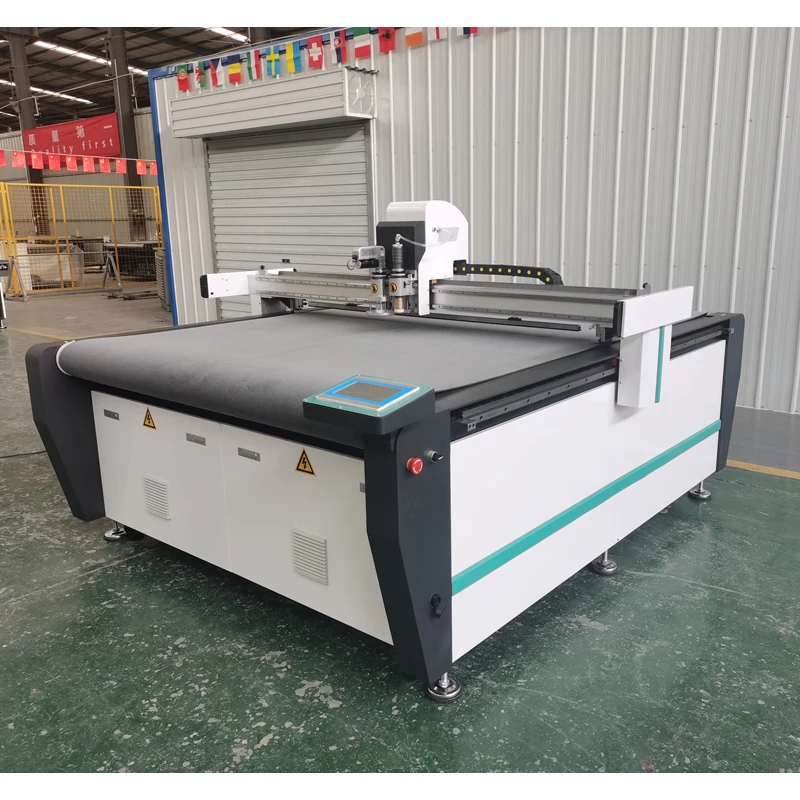
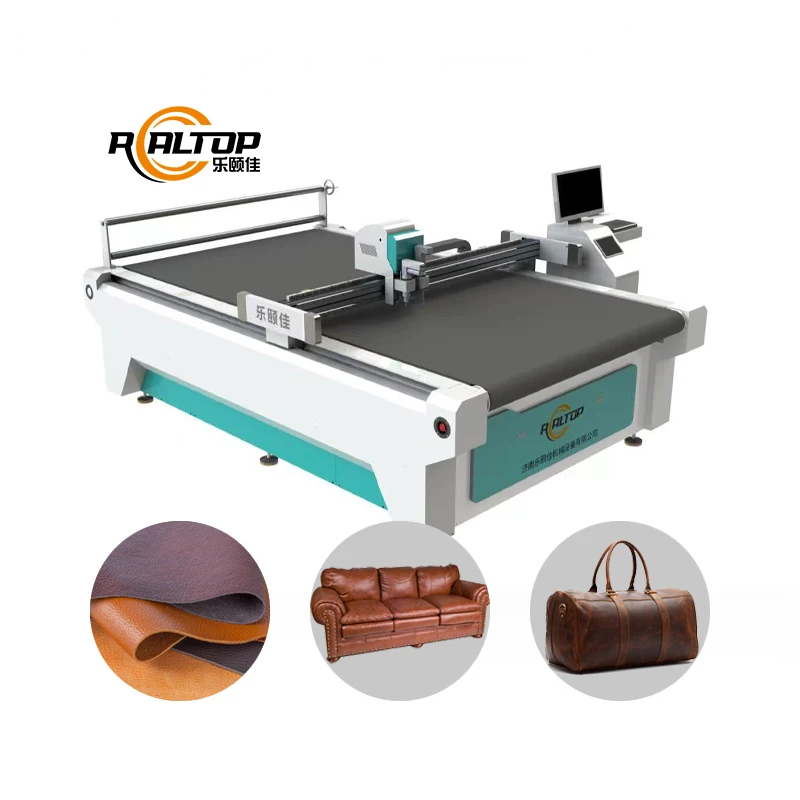
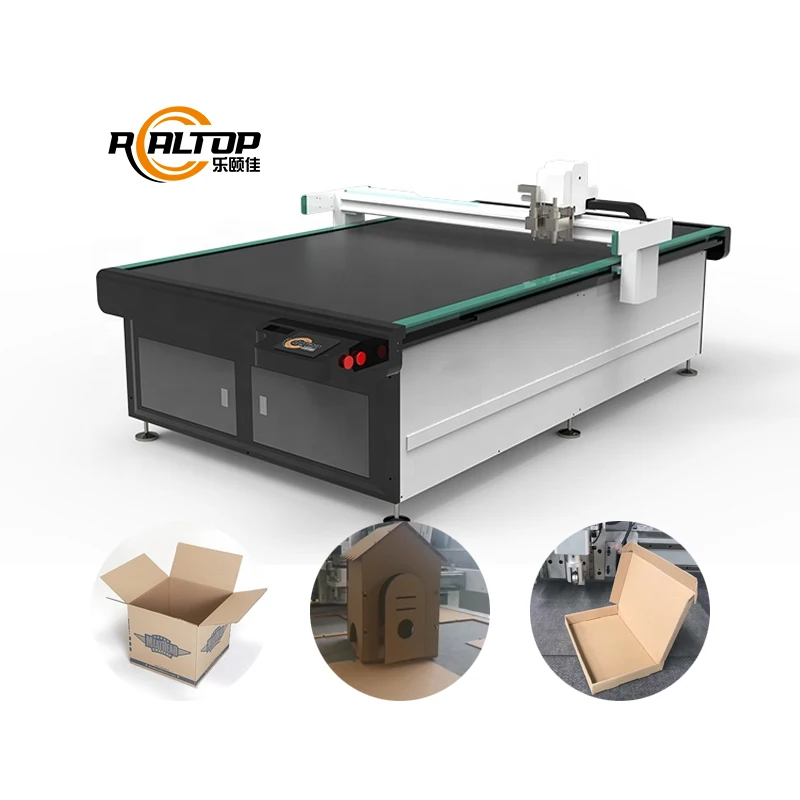
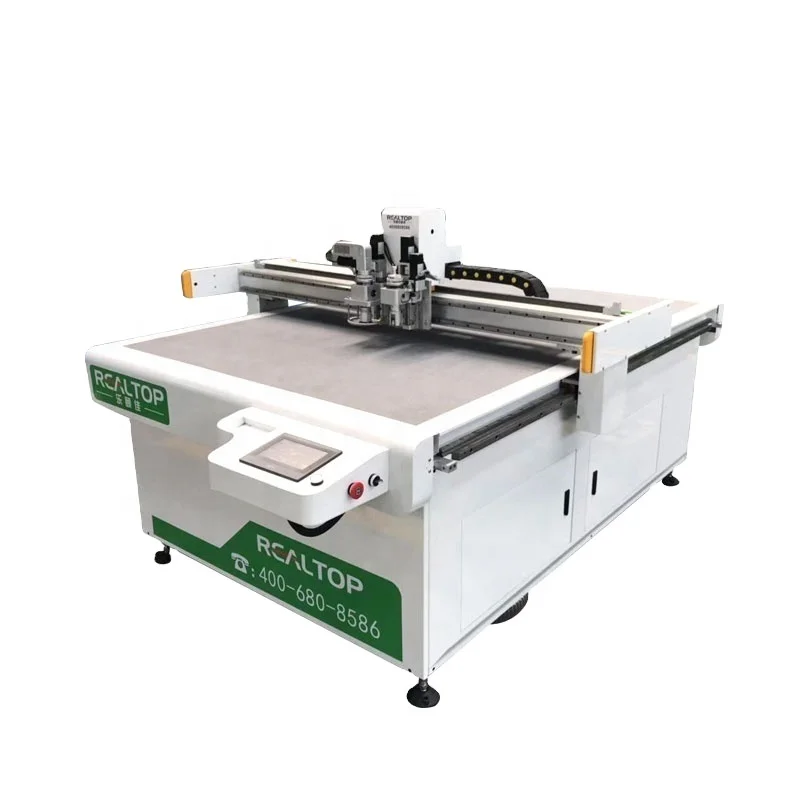
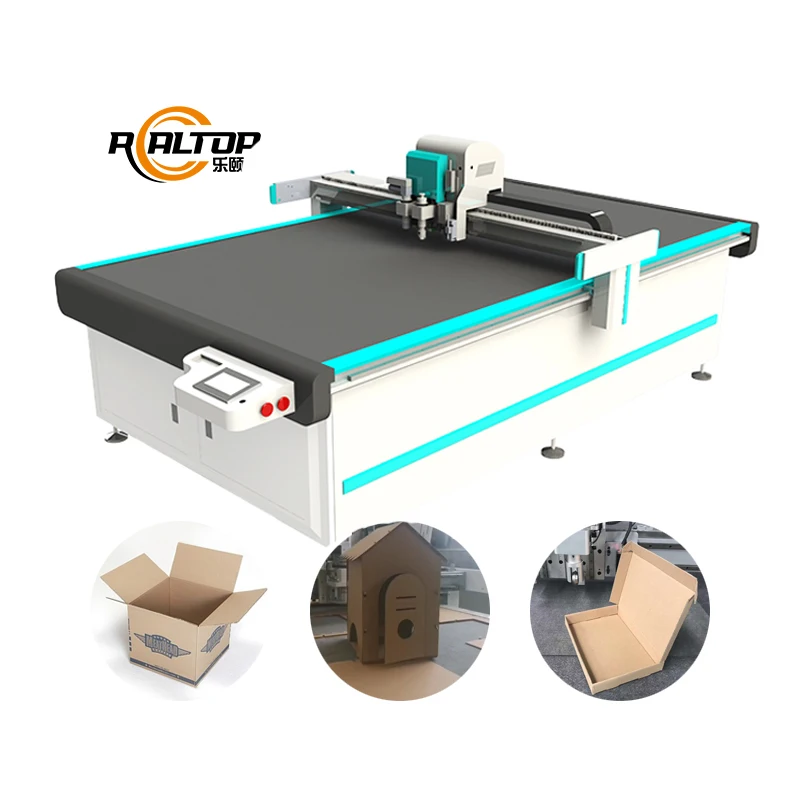
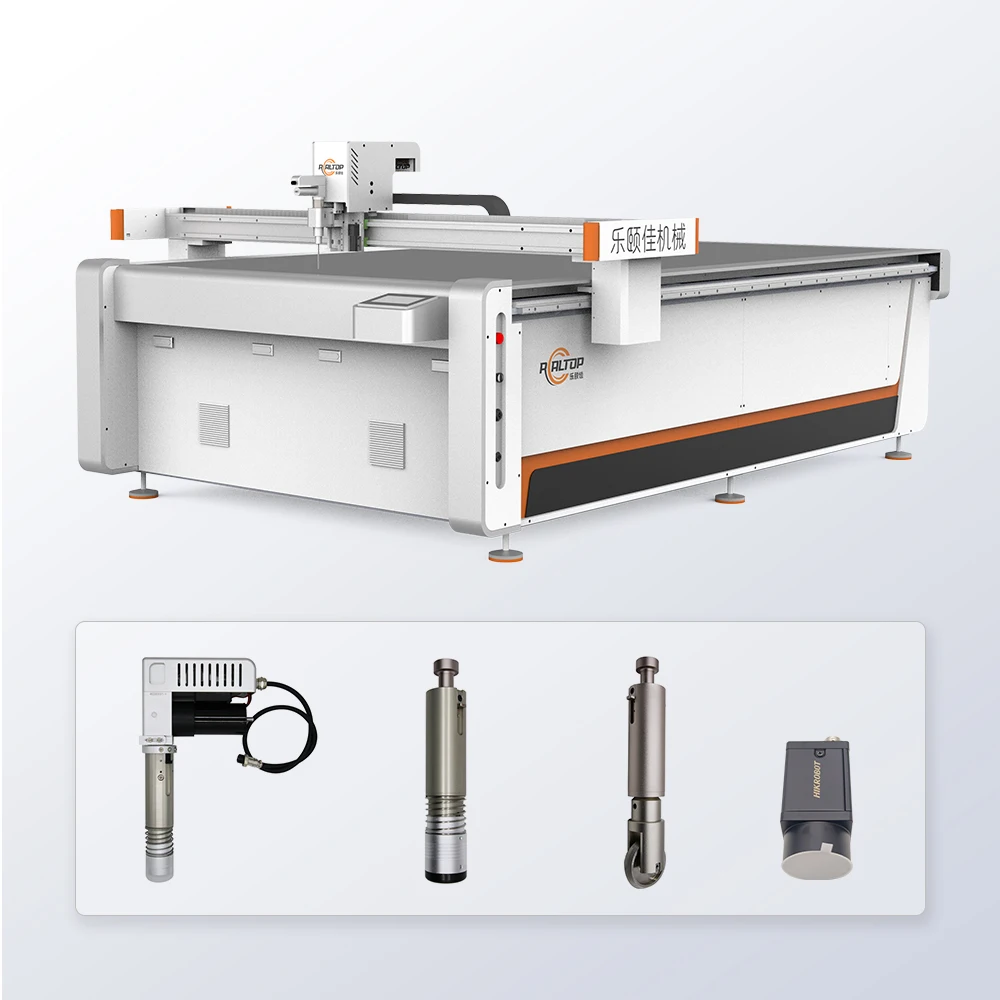
In-house tool head configuration — every oscillating knife, drag knife or creasing wheel is matched to your material sample before the RT-D2516/RT-S2516 leaves our Jinan factory.
Technical Specifications
| Parameter | Value |
|---|---|
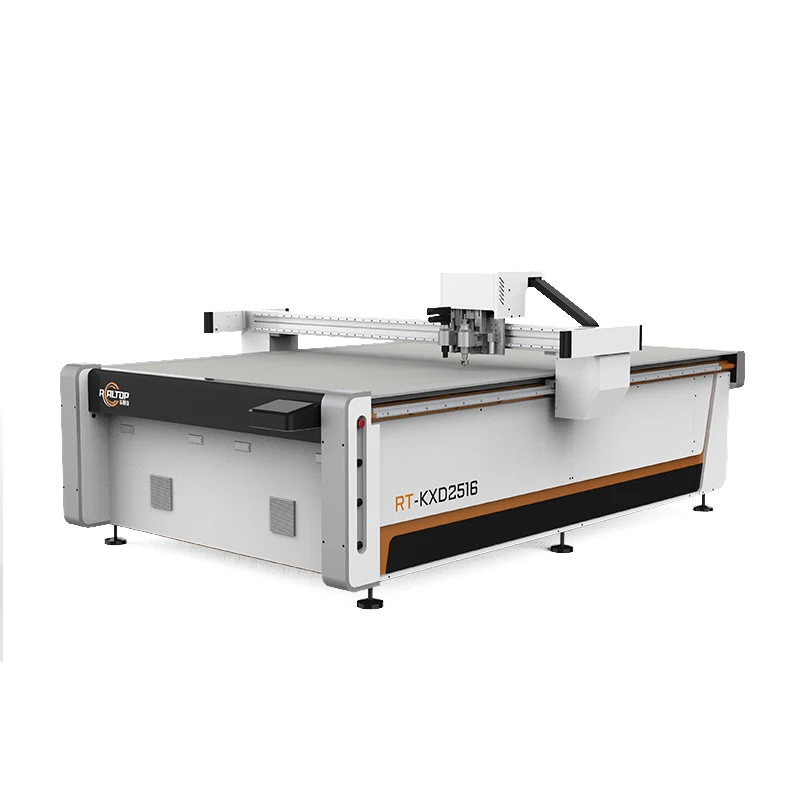
| Model | RT-D2516/RT-S2516 |
| Product Type | CNC Oscillating Knife Cutting Machine |
| Working Area | 1600×2500 mm |
| Machine Size (L×W×H) | 3450×2300×1250 mm |
| Rated Power | 9 kW |
| Voltage | 380V±10% |
| Vacuum Pump | 7.5 kW |
| Table Type | Flat working table with vacuum adsorption |
| Multifunctional Tool Head | Swiss imported knife with vibration full/half cutting and cursor location |
| Translational Velocity | 800–1200 mm/s |
| Cutting Thickness | 20–80 mm (varies by material and density; basis to be confirmed) |
| Repeated Accuracy | ≤0.1 mm |
| Transmission System | Digital servo motor, linear guide, synchronous belt, ball screw |
| Servo Motor | Delta (Taiwan) |
| Guide Rail | Taiwan Hiwin linear square rail |
| Safety Device | Infrared sensors |
| Auto Feeding | Yes (conveyor belt system) |
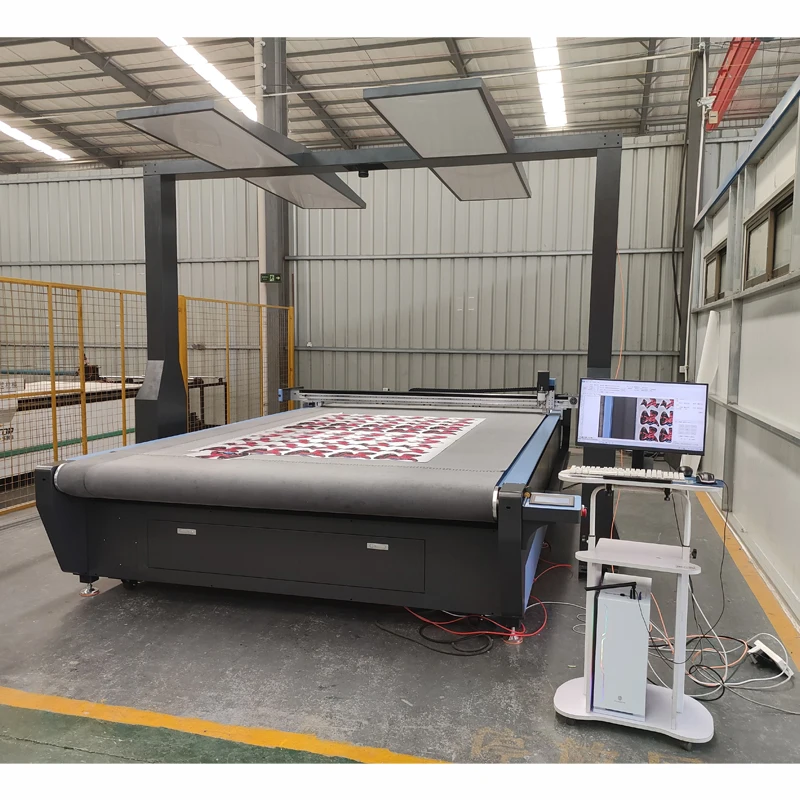
| Vision System | Independent R&D panoramic camera, small CCD mark point, projection positioning (optional) |
| Software | Realtop self-developed, one-click import, nesting design for carton, foot pad, seat sleeve, garment |
| Frame Structure | Hard steel frame with unique beam structure |
| Felt Belt | Wear-resistant anti-pull felt with composite fiber |
| Language Options | English, Russian, Italian, Chinese; special languages customizable |
Application Suitability
| Application | Material or Output |
|---|---|
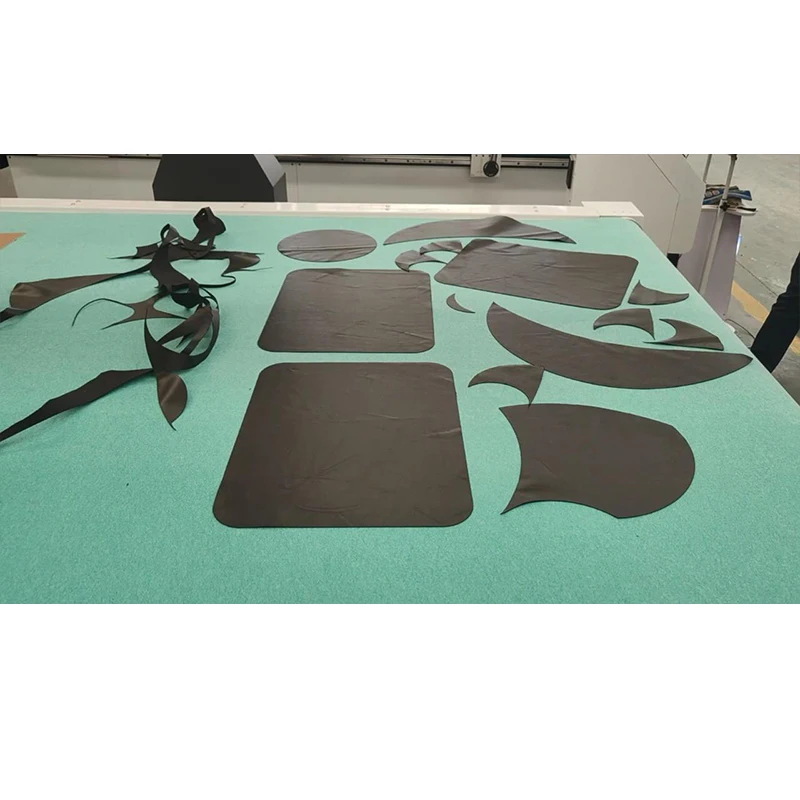
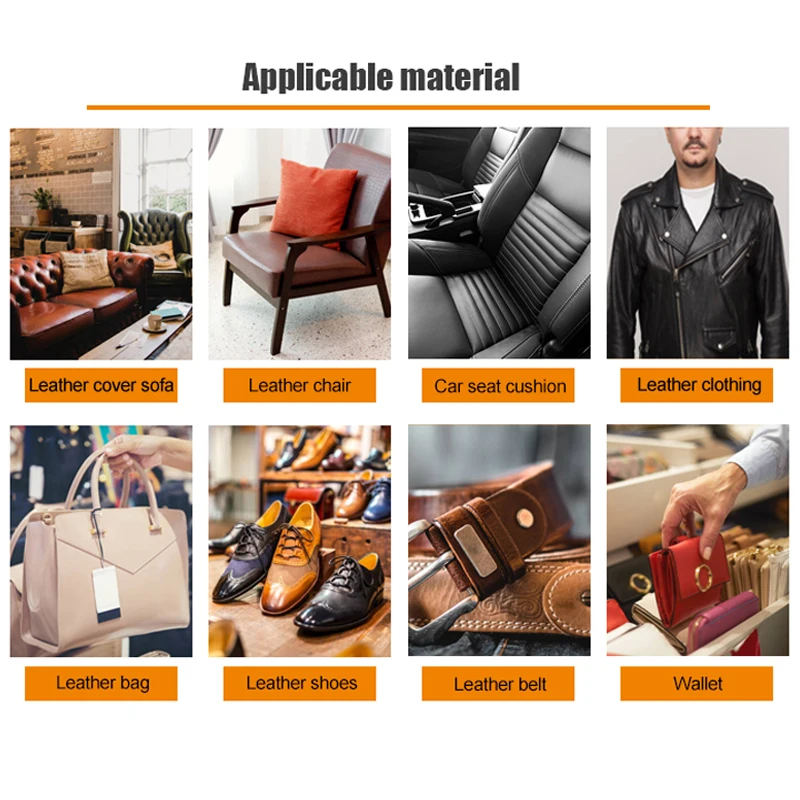
| Genuine Leather Nesting | Hides with flaw detection, irregular contour extraction, automatic nesting |
| Automotive Interior Trim | Fabric, PU, EVA, XPE, composites for seat covers, foot pads, headliners |
| Packaging Sample Making | Corrugated cardboard, plastic box, film, sticker, greyboard |
| Soft Furnishings & Apparel | Textile, non-woven fabric, carpet, clothing cloth, shoe material |
| Sealing & Gasket Production | Rubber, PTFE, ETFE, fiberglass, composite gasket materials |
| Advertising & Signage | PVC, foam board, PP, PE, sticker, vinyl |
Why "20–80 mm Cutting Thickness" Can Mislead Your CNC Oscillating Knife Cutting Machine Purchase
Real cutting depth depends on material density, not just the machine’s stroke.
When I configured a cutter for a leather workshop years ago, the spec sheet promised deep cutting. The problem wasn’t the knife stroke — it was the vacuum table. The hides were uneven, had rough edges, and the standard zoning couldn’t hold them flat. Pieces lifted mid-cut, ruining the batch. A CNC oscillating knife cutting machine manufacturer must verify hold-down force and tool pressure against your specific material density before quoting a cutting range. [NEED_CITE: vacuum adsorption force requirements for flexible and porous materials] Without a physical sample test, the 20–80 mm claim is just a mechanical limit, not a production guarantee.
Panoramic Vision and the Reality of Leather Utilization
Genuine leather is expensive and irregular. The independent R&D panoramic camera system scans the entire hide, identifies natural flaws like scars and brand marks, and allows the software to arrange patterns around them. This is where a CNC oscillating knife cutting machine manufacturer adds real value — not by selling a bigger table, but by integrating vision that maximizes yield from each hide. The small CCD camera handles precise mark point positioning for printed synthetic materials, while the panoramic unit tackles the organic shapes of natural leather.
Configurable Tooling for Multi-Material Shops
Many workshops don’t cut just one thing. The multifunctional tool head accepts Swiss imported knives for vibration full and half cutting, but the system also supports drag knives, creasing wheels, and punching tools. This means a packaging sample maker can score, crease, and cut corrugated board in a single setup without re-fixturing. The hard steel frame and unique beam structure keep the tool head stable at translational velocities up to 1200 mm/s, which matters when you’re running short, intricate cuts on gasket material where a wobbling head produces ragged edges. [NEED_CITE: effect of frame rigidity on edge quality in high-speed knife cutting]
Reading the Spec Sheet Like a Production Engineer
The Delta digital servo motors and Taiwan Hiwin linear square rails define the machine’s repeatability, rated at ≤0.1 mm. In practice, this means nesting patterns stay dimensionally accurate across a 1600×2500 mm sheet — critical for automotive seat covers where pieces must stitch together with tight tolerances. The 7.5 kW vacuum pump paired with the flat adsorption table is what actually holds porous materials like foam and non-woven fabric in place. If your material is small or oddly shaped, vacuum zoning configuration determines whether parts stay put or drift. The Germany-imported conveyor belt and auto-feeding system handle roll-fed textiles, reducing manual loading between sheets and keeping the production rhythm consistent.
The Hidden Cost of Skipping the Material Sample Test
I learned this the hard way. Specifying a machine on working area and claimed thickness alone led to a production line shutdown. The material — thick, hairy-edge leather — didn’t respond to the standard vacuum zoning or knife frequency. Every piece lifted, and the line jammed. When you skip the sample cutting report on your actual material, you’re gambling with tool head selection, knife oscillation frequency, and vacuum pressure. A wrong drag knife on foam crushes the edge instead of slicing it. An incorrect oscillation frequency on dense rubber leaves uncut fibers. [NEED_CITE: tool head selection criteria for composite and foam materials] These aren’t defects in the machine; they’re defects in the configuration.
Why Source This Equipment from the Factory Floor
Realtop builds both knife and laser platforms in-house, which means the recommendation starts with your material, not with clearing inventory. The tool head and table configuration is specified per your sample, not taken from a default package. The CCD camera and panoramic vision systems are developed internally, so software integration with your existing DXF, PLT, or AI files is confirmed before the order is finalized. Voltage, plug type, and control language are locked in during the specification phase, avoiding on-site surprises. The factory test record documents actual performance on your material before the crate is sealed.
Documentation & Verification
- Machine specification sheet detailing tool head options and vacuum table zoning layout
- Electrical schematic with confirmed voltage, frequency, and plug type for destination market
- Sample cutting report on buyer-supplied material showing edge quality and dimensional accuracy
- Factory test record documenting repeatability, vacuum hold-down, and CCD tracking at speed
- Software license with confirmed file format compatibility list for existing design workflows
- Spare parts list with part numbers for knives, belts, and vacuum seals
Installation, Commissioning & Support
- Floor space of at least 4000×3000 mm required to accommodate the 3450×2300 mm footprint and operator access
- Dedicated 380V±10% circuit with capacity for the 9 kW machine load plus the 7.5 kW vacuum pump
- Machine ships partially assembled; beam and gantry require on-site alignment and calibration
- First-run commissioning includes vacuum zoning adjustment and tool head pressure calibration for your material
- Operator training covers software nesting, vision system calibration, and tool change procedures
- Wear items include oscillating knives, felt belt sections, and vacuum seals with part-numbered spares list
What We Need to Configure Your Line
Send us a sample of your actual production material — the real hide thickness, the exact foam density, the printed fabric you run daily. Tell us your target daily volume and the sheet or roll dimensions you buy. Confirm your workshop’s voltage and frequency, and let us know the control language your operators need. With that, we run a sample cut, document the results, and build the configuration around what the material actually demands.
Frequently Asked Questions
Q: How is cutting thickness verified for my specific material and density?
A: We require a physical sample of your production material. The sample is run on the RT-D2516/RT-S2516 with the proposed tool head and vacuum configuration. The resulting sample cutting report documents achievable depth, edge quality, and hold-down performance. The 20–80 mm range is a mechanical limit; your material’s density and structure determine the practical cut depth we confirm before you commit.
Q: What voltage, plug type and control language are confirmed before shipment?
A: The standard configuration is 380V±10%, but this is confirmed against your facility’s actual supply during the specification phase. Plug type is matched to your country’s standard. Control language options include English, Russian, Italian, and Chinese, with special languages available on request. All three parameters are locked in the specification sheet before production begins.
Q: How does the vision system perform at production speed on printed marks?
A: The panoramic camera handles large, irregular patterns like genuine leather hides, while the small CCD camera tracks specific printed mark points on synthetic materials. Performance depends on print contrast, mark size, and camera calibration. The factory test record includes a CCD tracking accuracy check run at production translational velocity on your supplied printed material, not at a reduced demo speed.
Q: What custom configuration range does the factory support?
A: The tool head accepts multiple options — oscillating knife, drag knife, creasing wheel, punching, and marking tools — selected based on your material mix. Table zoning can be reconfigured for small parts. The software is customized for specific nesting workflows like carton, automotive foot pad, or garment patterns. Conveyor and auto-feeding systems are included for roll-fed operations. All configurations are validated with sample cutting before order confirmation.
Q: What does the factory test record include before the machine ships?
A: The record documents repeated accuracy across the full 1600×2500 mm working area, vacuum hold-down performance on your material sample, tool head cutting quality at specified translational velocity, and CCD or panoramic vision tracking accuracy. It includes photographs of cut edges and dimensional measurements of test pieces. This record is shared with you before the machine is packed for shipment.
You may also like

商品评价
Clear filtersThere are no reviews yet.