








-
 Courier delivery
-
 DHL Courier delivery
-
 Warranty 1 year
-
 Free 30-Day returns

In-House CNC Design — Realtop engineers oscillating knife tables from frame to software, specifying tool head and vacuum zoning against your actual board grade before any order is confirmed.
Technical Specifications
| Parameter | Value |
|---|---|
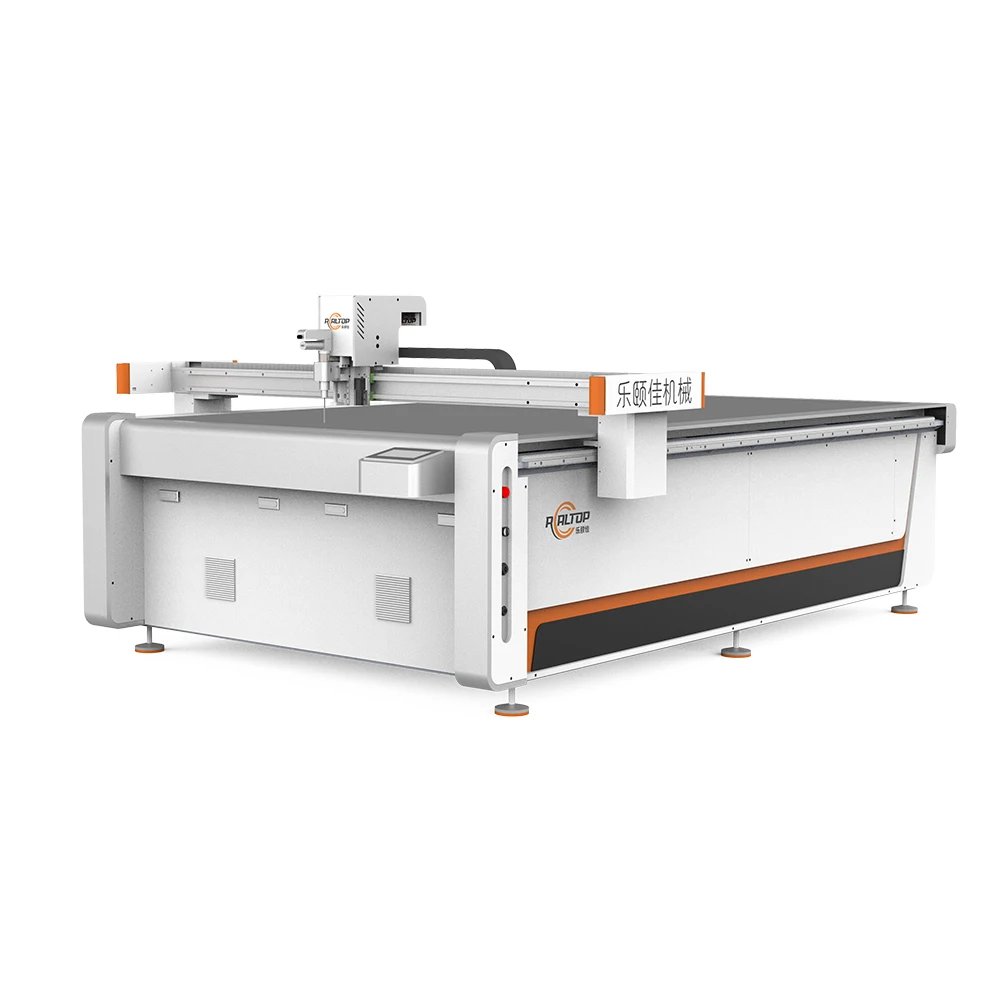
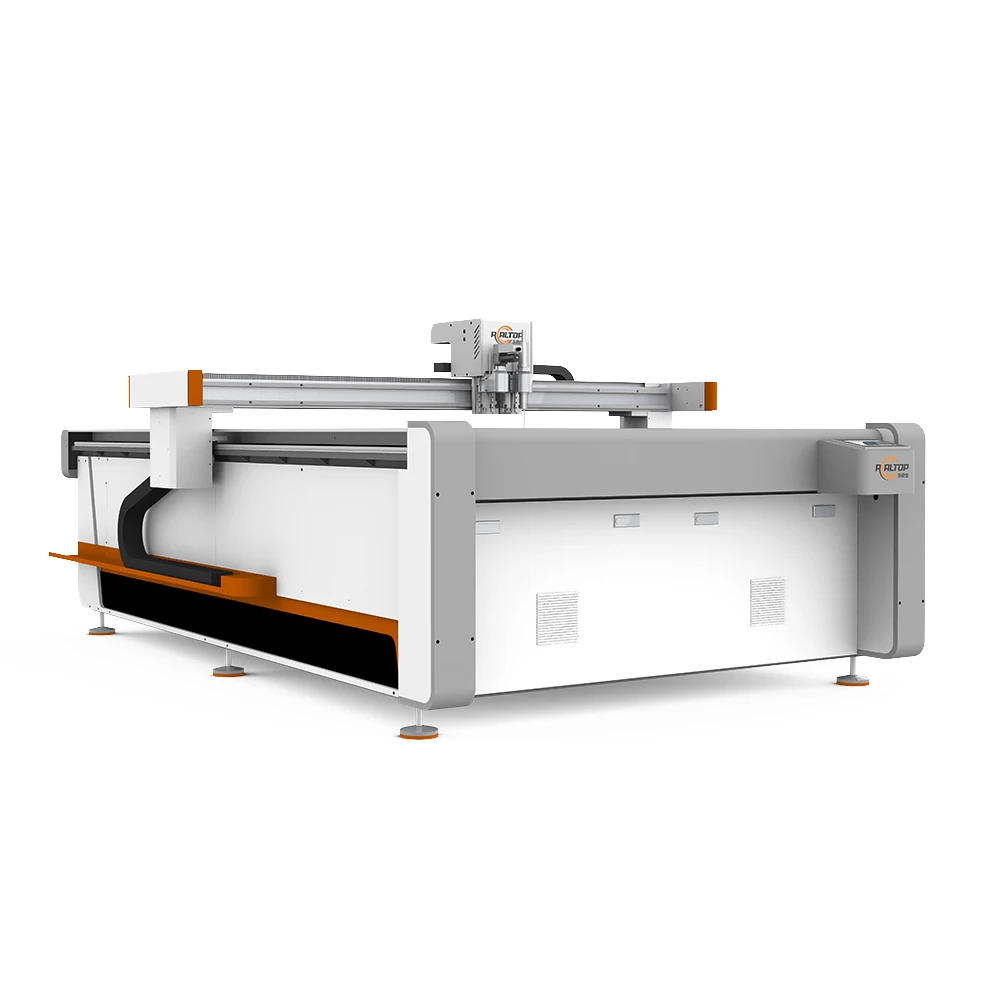
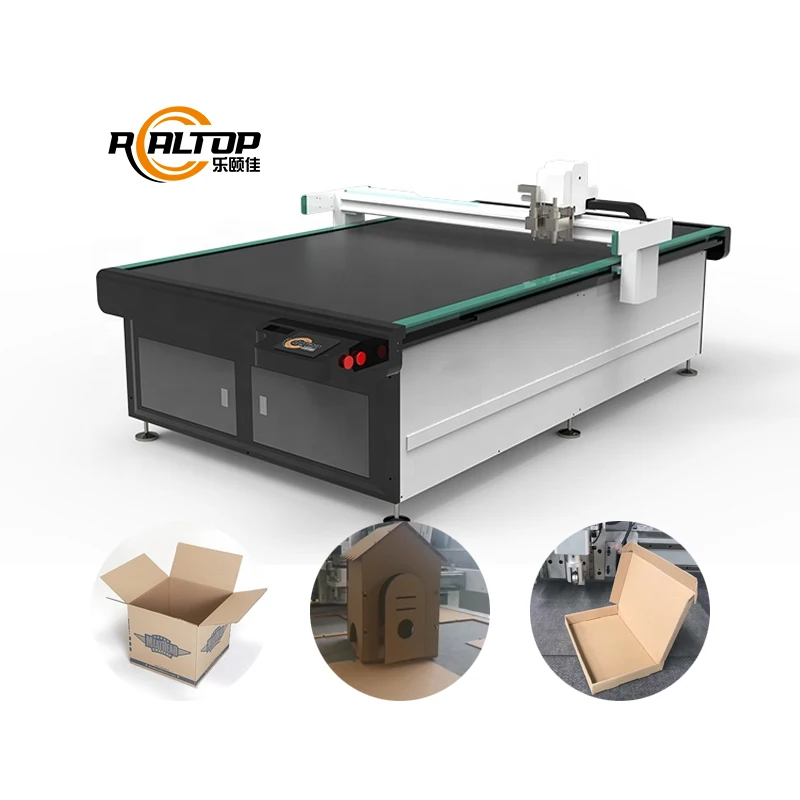
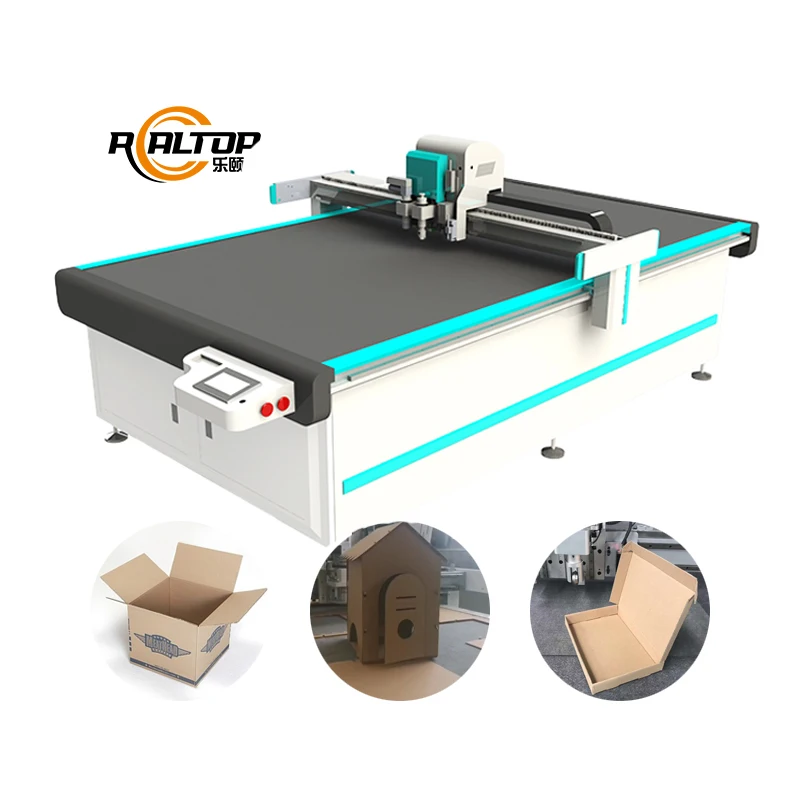
| Product Type | CNC Oscillating Knife Cutting Machine |
| Working Area | 1600 × 2500 mm |
| Machine Size | 3450 × 2300 × 1250 mm |
| Rated Power | 9 kW |
| Translational Velocity | 800–2000 mm/s |
| Cutting Thickness Range | ≤100 mm (varies with the material) |
| Repeated Accuracy | ≤0.1 mm |
| Transmission System | Digital servo motor, linear guide, synchronous belt, ball screw |
| Guide Rail | Taiwan Hiwin |
| Servo Motor | Taiwan Delta |
| Vacuum Pump | 7.5 kW |
| Working Table | Flatbed vacuum adsorption platform |
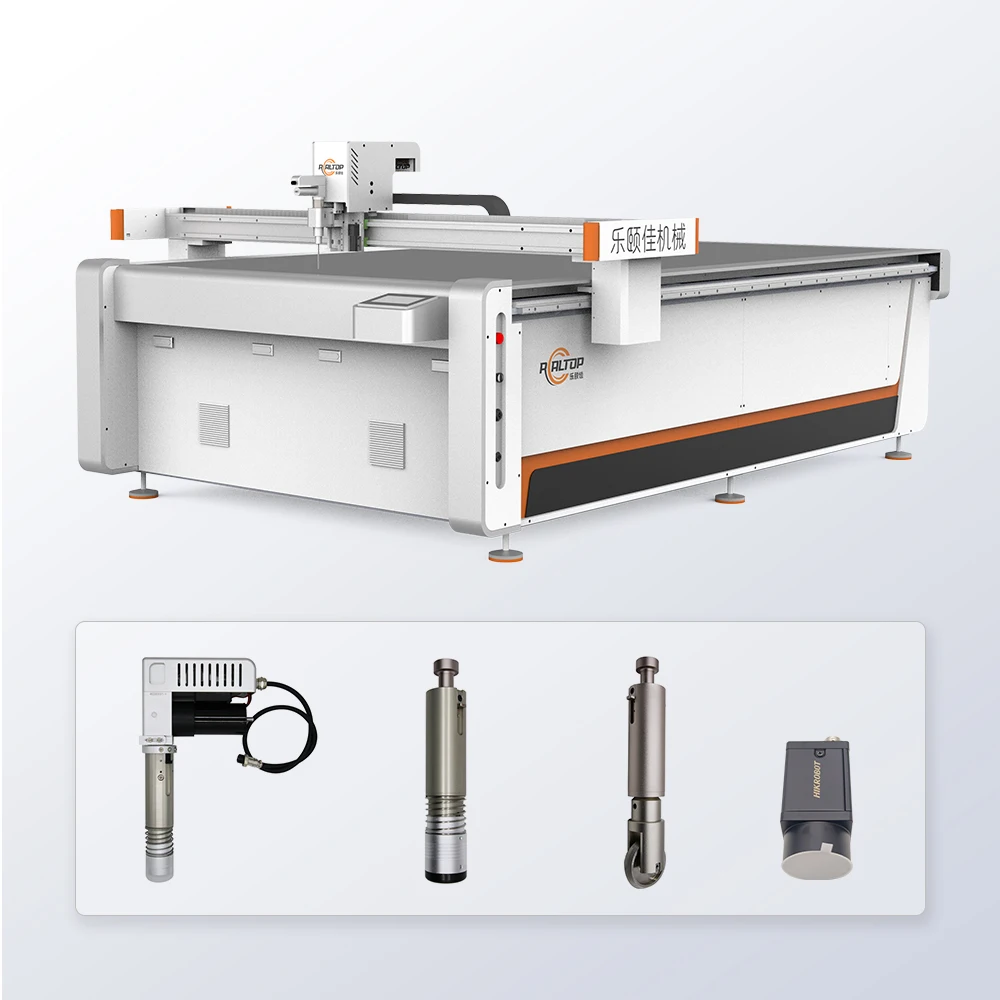
| Knife Head | Swiss imported oscillating knife with vibration full cutting, half cutting and cursor location |
| Safety Device | Infrared sensor array |
| Instruction System | HP-GL compatible format |
| Software | Professional carton nesting software (customized language, lifelong technical support) |
| Control System Language | English, Russian, Italian, Chinese (special languages available on request) |
| Voltage | 380V ± 10% |
Application Suitability
| Application | Material or Output |
|---|---|
| Packaging carton sample making | Corrugated board across flute grades, kraft liner, chipboard |
| Short-run corrugated box production | Single and double-wall corrugated for custom packaging runs |
| Cardboard display and signage cutting | Honeycomb board, foam board, composite panel for point-of-purchase |
| Pattern and sticker cutting | Adhesive vinyl, sticker stock, business cards, tags and labels |
| Folding carton prototyping | Boxboard and coated stock requiring precise crease and cut workflows |
Why Corrugated Flute Grade Matters More Than Working Area
A CNC Oscillating Knife Cutting Machine manufacturer that only asks about sheet size is missing the variable that determines whether your machine actually runs. The flute profile and grammage of your board stock dictate the knife frequency, blade depth and vacuum zoning — not the table dimensions.
I once saw a packaging line stall because the cutting table was specified for a B-flute prototype run, then the buyer switched to double-wall BC-flute for their production order. The oscillating knife could not penetrate the higher density material at the configured frequency, and the vacuum zones were too broad to hold the thicker sheet flat. Four days of on-site adjustment followed before the knife pressure and oscillation rate matched the actual board. That kind of delay is avoidable when material verification happens before the order [NEED_CITE: material-specific cutting parameter validation for corrugated board grades].
Build Philosophy Rooted in the Factory Floor
Every CNC oscillating knife cutting table that leaves our Jinan facility carries a cutting method and configuration matched to the buyer’s material profile. The design team specifies knife head type, oscillation frequency range and vacuum pump capacity based on the thickest and densest board grade the machine will encounter — not the thinnest. This approach stems from years of resolving field mismatches where a machine built for general-purpose cutting met a specialized corrugated grade and failed to deliver clean edges [NEED_CITE: oscillating knife frequency matching to material density].
The Taiwan Hiwin linear guide rails and Delta servo motors form the motion backbone, delivering repeatability within 0.1 mm across the full 1600 × 2500 mm working area. That precision matters when creasing lines must align to cutting paths within a fraction of a millimeter, especially on multi-panel carton layouts where cumulative drift would reject an entire sheet.
Vacuum Zoning and the Small-Part Problem
A 7.5 kW vacuum pump delivers strong hold-down for large corrugated sheets, but packaging sample making often involves small die-cut shapes that sit between broad vacuum zones. Without configurable zoning, small carton blanks lift during the final cut segments, producing ragged edges or shifting the workpiece enough to spoil registration. The vacuum table on this machine is sectioned so that operators can activate only the zones directly under the workpiece, concentrating suction where it matters.
This zoning approach is particularly important for nesting software output, where the professional carton nesting software arranges multiple small shapes across the sheet to maximize yield. Each shape may span a different zone boundary, and the operator needs to understand which zones to engage for a given layout [NEED_CITE: vacuum table zoning strategies for nested small-part cutting].
Reading the Specification Sheet Against Your Production Reality
The Swiss imported oscillating knife head performs full cutting, half cutting and cursor location in a single tool station. Full cutting penetrates through the board for complete shape release, while half cutting scores the crease lines without severing the liner — essential for folding carton work where the crease must fold cleanly without cracking the printed surface. The cursor location function registers against printed marks to align cutting paths with pre-printed graphics.
Translational velocity ranges from 800 to 2000 mm/s depending on material resistance and cutting complexity. A straight cut through single-wall corrugated runs faster than a tight-radius contour through double-wall stock, and the HP-GL compatible instruction system manages these speed transitions within a single program file. The professional carton nesting software imports DXF, AI and PLT formats directly, so your existing CAD workflow transfers without manual redraw.
Repeated accuracy of ≤0.1 mm means that when a crease line and a cut line meet at a corner, they intersect precisely — no overcut, no gap, no weakened fold that fails during automated box erection.
The Hidden Cost of Skipping Material Trials
When a buyer confirms an order based on working area and price alone, the first production run becomes the real test — and the factory floor is not the place to discover that the knife frequency does not match the board density. Ragged edges on corrugated mean rejected samples, re-cut sheets and wasted board stock. Worse, a vacuum table with insufficient zoning lets small pieces lift mid-cut, damaging the knife tip and requiring unplanned blade changes [NEED_CITE: cost implications of untested material-machine mismatch in packaging operations].
Software incompatibility surfaces late too. If the nesting program cannot import your existing file format, operators spend hours converting and manually checking dimensions — time that compounds across every new job.
Why Source This Machine From Realtop
The design and production of both knife and laser cutting systems under one roof means the cutting method is chosen based on material behavior, not factory limitation. If your board grade responds better to a different knife configuration, the engineering team adjusts before build.
Tool head and table configurations are specified per material and production volume, documented in the specification sheet before order confirmation. Sample cutting on your own board stock — your flute profile, your grammage — produces a cutting report that shows edge quality, crease integrity and cycle characteristics before you commit.
Voltage, control language and software file format compatibility are confirmed against your site requirements. The machine arrives with the plug, the panel language and the file import path already matched to your workshop.
Documentation & Verification
- Machine specification sheet listing tool head and vacuum table configuration matched to your board grade
- Sample cutting report produced on your corrugated stock showing edge and crease quality
- Electrical schematic with voltage and circuit confirmation for your facility power supply
- Software licence and file format compatibility note for your existing CAD workflow
- Operation and maintenance manual in your selected control language
- Factory test record documenting cutting performance across your specified flute grades
Installation, Commissioning & Support
- Level concrete floor required to support 3450 × 2300 × 1250 mm machine footprint and cutting vibration
- Dedicated 380V ± 10% circuit with rated capacity for the 9 kW system plus 7.5 kW vacuum pump
- Machine ships in transport-ready sections; assembly and alignment completed on your floor
- First-run parameter tuning for knife pressure, oscillation frequency and vacuum zoning against your board stock
- Operator training covers nesting software workflow, tool head changeover and HP-GL file import
- Spare parts list includes replacement knife blades, vacuum seals and drive belt for scheduled maintenance
What We Need to Specify Your Machine
Provide the flute profiles you run most often, the grammage range and the thickest board you plan to cut. Tell us your target daily sheet volume and the typical blank sizes so we can configure vacuum zoning and nesting parameters. Confirm your site voltage, frequency and preferred control language, and let us know which CAD software you currently use for carton design.
If you can send physical samples of your board stock, we will run cutting trials and return a report before the order is finalized.
Frequently Asked Questions
Q: How is cutting thickness verified against my specific board grade and flute profile?
A: We run sample cuts on your actual corrugated stock — the exact flute grade and grammage you produce. The resulting cutting report documents knife pressure, oscillation frequency and edge quality, so you see machine performance on your material before placing the order. This verification prevents the common mismatch where a machine specified on working area alone cannot handle production-density board.
Q: What voltage, plug and control language options are confirmed before shipment?
A: The standard configuration runs on 380V ± 10%, but we confirm your site voltage and frequency before production. Control system language options include English, Russian, Italian and Chinese, with special languages available on request. Plug type and electrical schematic are matched to your local standards and documented in the pre-shipment confirmation.
Q: Can the vacuum table zoning be configured for small carton samples without material lift?
A: The vacuum table is divided into independently controlled zones. Operators activate only the sections directly beneath the workpiece, concentrating the 7.5 kW pump suction on small blanks that would otherwise lift between broad zones. This zoning is critical when the nesting software arranges multiple small shapes across a single sheet layout.
Q: Does the software import my existing DXF, AI or PLT file format and nesting workflow?
A: The professional carton nesting software imports DXF, AI and PLT formats and is compatible with HP-GL instruction output. Before the order, we confirm file format compatibility with your existing CAD workflow and document the import path in the software licence note. The software language is customized to match your operator preference.
Q: What sample cutting and factory test documentation is provided before dispatch?
A: You receive a sample cutting report produced on your own board stock, a factory test record covering your specified flute grades, and a machine specification sheet listing the exact tool head and vacuum table configuration built into your unit. Electrical schematics and a spare parts list accompany the shipment documentation package.
You may also like

商品评价
Clear filtersThere are no reviews yet.