





-
 Courier delivery
-
 DHL Courier delivery
-
 Warranty 1 year
-
 Free 30-Day returns

In-house tool head configuration — We match oscillating knife type, vacuum zoning and cutting depth to your gasket material sample before the machine is built.
Technical Specifications
| Parameter | Value |
|---|---|
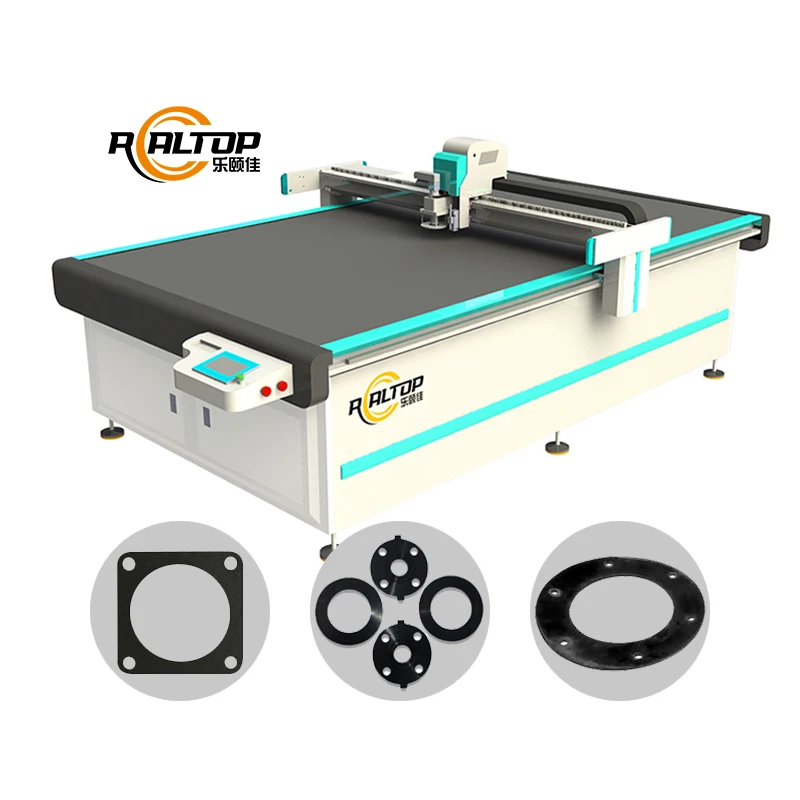
| Product Type | CNC Oscillating Knife Cutting Machine |
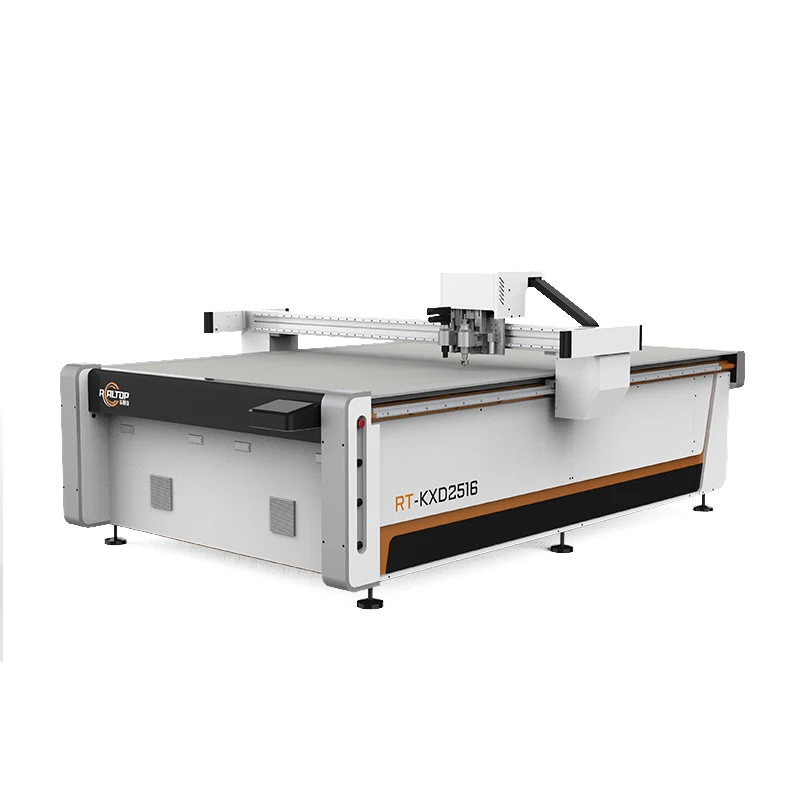
| Model | RT-D2516/RT-S2516 |
| Working Area | 1600 × 2500 mm |
| Machine Size | 3450 × 2300 × 1250 mm |
| Rated Power | 9 kW |
| Working Table | Flat vacuum adsorption table (magnesium-aluminum alloy) |
| Translational Velocity | 800–1200 mm/s |
| Max Cutting Thickness | ≤100 mm (varies with material density and tool head) |
| Repeated Accuracy | ≤0.1 mm |
| Transmission System | Digital servo motor, linear guide, synchronous belt, ball screw |
| Servo Motor Brand | Delta or Panasonic (optional) |
| Vacuum Pump | 7.5 kW |
| Multifunctional Head | Swiss imported knife: vibration full cutting, half cutting, cursor location |
| Tool Head Options | Oscillating knife, pneumatic knife, high-power vibrating knife, circular knife, V-cutting knife, drag knife, creasing wheel, dotted line knife, punching, brush |
| Positioning System | CCD camera mark point, panoramic camera recognition, or projection positioning (optional) |
| Safety Device | Infrared sensors, anti-collision beam, emergency stop |
| Voltage | 380V ± 10% |
| Instruction System | HP-GL compatible format |
| Software Language | English, Russian, Italian, Chinese, etc. (customizable) |
Application Suitability
| Application | Material or Output |
|---|---|
| Gasket and sealing pad production | Rubber, silicone, non-asbestos fiber sheet, composite cork |
| Automotive interior components | PU foam, sponge composite leather, EVA sound-dampening pads |
| Footwear and leather goods | Full-grain leather, synthetic upper material, insole board |
| Industrial insulation parts | Aramid fiber, ceramic fiber board, PTFE sheet |
| Packaging and carton sample making | Corrugated board, greyboard, honeycomb paper |
| Graphic advertising and printing | PVC foam board, vinyl, self-adhesive film |
Why Material Hardness Matters More Than Working Area
A cutting table rated only by bed size will fail on dense composite gasket stock.
When a buyer sources a CNC knife cutting machine manufacturer based solely on the 1600 × 2500 mm work envelope, the assumption is that any flat gasket material up to a certain thickness will cut cleanly. In practice, a 4 mm non-asbestos fiber sheet behaves entirely differently from a 15 mm closed-cell foam rubber pad. The oscillating frequency required, the blade geometry, and the vacuum hold-down pressure must all be matched to the specific shore hardness and compressibility of the stock. I have seen machines arrive at gasket factories with a standard oscillating head configured for soft foam, only to produce ragged, delaminated edges on dense rubber composite within the first production shift [NEED_CITE: cutting tool wear rates on varying gasket material densities]. The result is scrapped material, missed delivery windows, and a machine that sits idle while the correct tool head is sourced and shipped.
Specifying the Tool Head to the Stock You Actually Run
The RT-D2516/RT-S2516 platform is configurable with a range of tool heads, but selecting the right one requires knowing your material before the order is placed. The Swiss imported multifunctional head handles vibration full cutting and half cutting, which suits layered composite gasket materials where a kiss-cut on the backing liner is required. For dense rubber or thick non-asbestos sheet, a high-power vibrating knife or pneumatic knife delivers the downward force needed to penetrate without blade deflection. A CNC knife cutting machine manufacturer that configures the head per your sample material prevents the edge-quality failures that appear only after sustained production runs.
Vacuum Zoning and Small Gasket Hold-Down
The magnesium-aluminum alloy vacuum table on this system is paired with a 7.5 kW vacuum pump, but suction alone does not guarantee flat cutting on small gasket profiles. When the cutting path releases a small O-ring or flange gasket from the surrounding skeleton, the remaining vacuum zone must be sufficient to prevent the part from lifting under the blade. Without proper zoning or a porous belt surface matched to the gasket footprint, small parts drift during the final cuts, producing out-of-tolerance profiles and forcing manual sorting. The table configuration must be reviewed against your typical gasket nesting layout and minimum part size [NEED_CITE: vacuum adsorption requirements for small-part CNC digital cutting].
Reading the Specifications Against Your Production Reality
The 9 kW rated power covers the servo drives, vacuum pump and oscillating head motor simultaneously, which is adequate for continuous cutting of gasket stock up to the rated thickness range. The Delta or Panasonic servo motor options determine the acceleration profile — a Panasonic servo typically offers tighter following error on complex gasket contours with multiple small radii, while Delta provides cost-effective performance on larger, simpler flange profiles. The ≤0.1 mm repeated accuracy figure is measured under controlled conditions; actual cutting tolerance on compressible foam rubber depends on how well the vacuum table holds the material flat and whether the blade compensation in software accounts for material spring-back after the cut. The HP-GL compatible instruction system accepts standard DXF and PLT files from most gasket CAD nesting software, but file format compatibility must be confirmed against your existing workflow before the machine ships.
The Cost of Shipping the Wrong Configuration
Specifying a machine by work area and assuming the rest will sort itself out creates downstream costs that are difficult to recover. A vacuum table without adequate zoning for your smallest gasket profile causes part lift and scrap during production [NEED_CITE: material lift defects in CNC oscillating knife cutting]. A tool head chosen for general-purpose flexible material cutting produces crushed foam edges or incomplete penetration on dense rubber composite. Voltage and plug configuration not confirmed against your factory supply means the machine cannot be commissioned on arrival, delaying production while transformers or rewiring are arranged. Software that cannot import your existing nesting files forces operators to redraw gasket profiles manually, introducing dimensional errors and consuming engineering hours that should go to production planning.
What Building In-House Means for Your Configuration
The design team at the Jinan facility engineers both the knife cutting and laser cutting platforms, so the RT-D2516/RT-S2516 is not a resold frame fitted with third-party components. The thick-walled seamless steel frame undergoes high-temperature tempering and CNC machining center finishing, which maintains geometric accuracy over years of oscillating knife vibration that would loosen a lighter frame. The magnesium-aluminum vacuum table with fluorocarbon PVDF coating resists chemical exposure from rubber and silicone cutting residues. Sample cutting on your actual gasket material is completed before the order is confirmed, producing a cutting report that documents edge quality, achievable thickness and recommended tool head. Electrical schematics and voltage specifications are matched to your market standard before production begins, and the factory test record documents the as-built configuration against the agreed specification sheet.
Documentation & Verification
- Factory test record on your specific gasket material thickness and type before dispatch
- Electrical schematic confirming voltage, phase and plug type for your destination market
- Tool head and vacuum table configuration list matched to your material sample
- Sample cutting report documenting edge quality and cutting depth on your stock
- Machine specification sheet recording as-built parameters and servo motor brand
- Operation and maintenance manual with software licence and file format notes
Installation, Commissioning & Support
- Machine footprint of 3450 × 2300 mm requires level concrete floor with clearance for material loading on at least two sides
- 380V ± 10% three-phase supply with dedicated circuit breaker rated for the 9 kW total load plus vacuum pump start-up surge
- Vacuum table and frame arrive assembled; conveyor belt and auto-feeding system require on-site alignment and tensioning
- First commissioning includes vacuum zoning test on your smallest gasket profile and oscillating knife depth calibration
- Operator training covers HP-GL file import, nesting software setup and tool head changeover for different material types
- Spare parts list includes oscillating knife blades, vacuum belt sections and sensor replacements for planned maintenance intervals
Preparing Your Inquiry with the Right Detail
To get a configuration that matches your gasket production rather than a generic flatbed quote, send the material type, typical thickness range and shore hardness of the stock you run most frequently. Include a sample nesting layout showing your smallest gasket profile so that vacuum zoning can be evaluated against your actual part sizes. Confirm your factory supply voltage and frequency, the control language your operators require, and whether you need sample cutting on your own material before committing to the order.
Frequently Asked Questions
Q: How is cutting thickness confirmed for my specific gasket or composite material?
A: We cut samples on your actual stock before the order is placed. The cutting report documents the tool head used, blade type, achievable thickness and edge quality on your specific material. This eliminates the gap between a general thickness rating and what the machine can actually produce on dense rubber or layered composite in sustained runs.
Q: What tool head options are available and how do I choose the right one?
A: The platform supports oscillating, pneumatic, high-power vibrating, circular, V-cutting, drag and creasing knife heads among others. Selection depends on your material hardness, whether you need full-cut or kiss-cut, and the edge finish your gasket specification requires. We recommend the head based on your sample cutting results, not a generic chart.
Q: Can the machine be customized for my factory voltage, plug type and control language?
A: Voltage is configurable across standard industrial ranges, and the plug type is matched to your destination market before shipment. The control interface language is set to your operator requirement — English, Russian, Italian or other languages can be loaded. Electrical schematics are provided confirming the as-built configuration.
Q: What documentation ships with the machine?
A: You receive a machine specification sheet, electrical schematic, factory test record, sample cutting report on your material, operation and maintenance manual, software licence note, spare parts list and packing photographs. CE declaration documentation is provided where applicable to your market import requirements.
Q: How does your factory verify configuration before production begins?
A: After the sample cutting stage confirms tool head and table configuration, the specification sheet and voltage confirmation are signed off before production starts. The factory test record is completed on the finished machine, documenting servo motor brand, vacuum pump performance and cutting accuracy against the agreed parameters prior to packing.
You may also like

商品评价
Clear filtersThere are no reviews yet.