





-
 Courier delivery
-
 DHL Courier delivery
-
 Warranty 1 year
-
 Free 30-Day returns

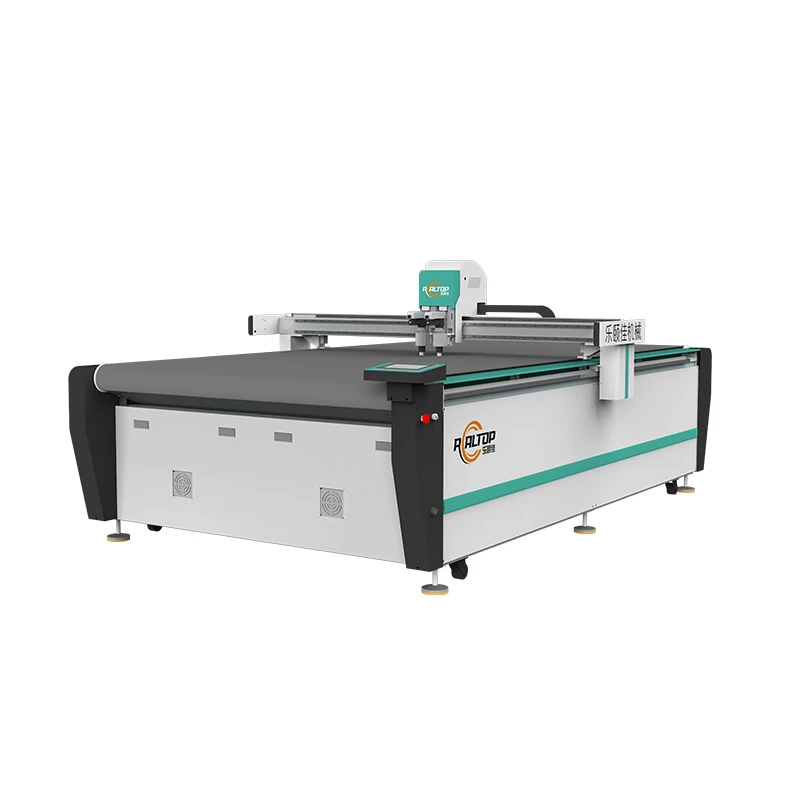
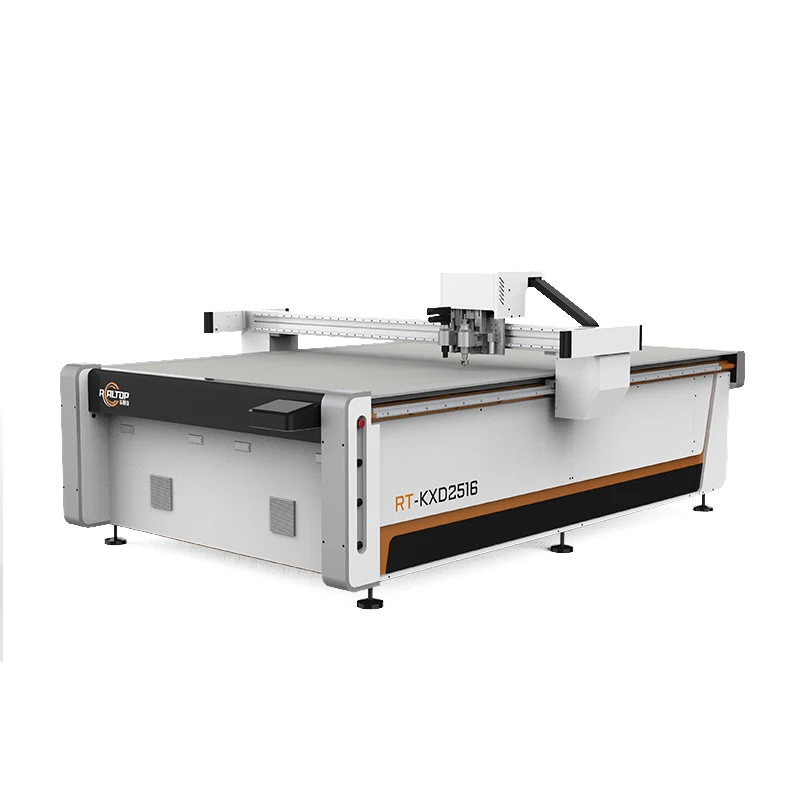
Integrated Knife and Laser Engineering — Realtop Machinery (Jinan) Co., Ltd designs and builds oscillating knife and laser cutting systems under one roof, allowing the RT-D2516/RT-S2516 platform to be configured from frame welding through final factory testing for leather-specific production demands.
Technical Specifications
| Parameter | Value |
|---|---|
| Model | RT-D2516/RT-S2516 |
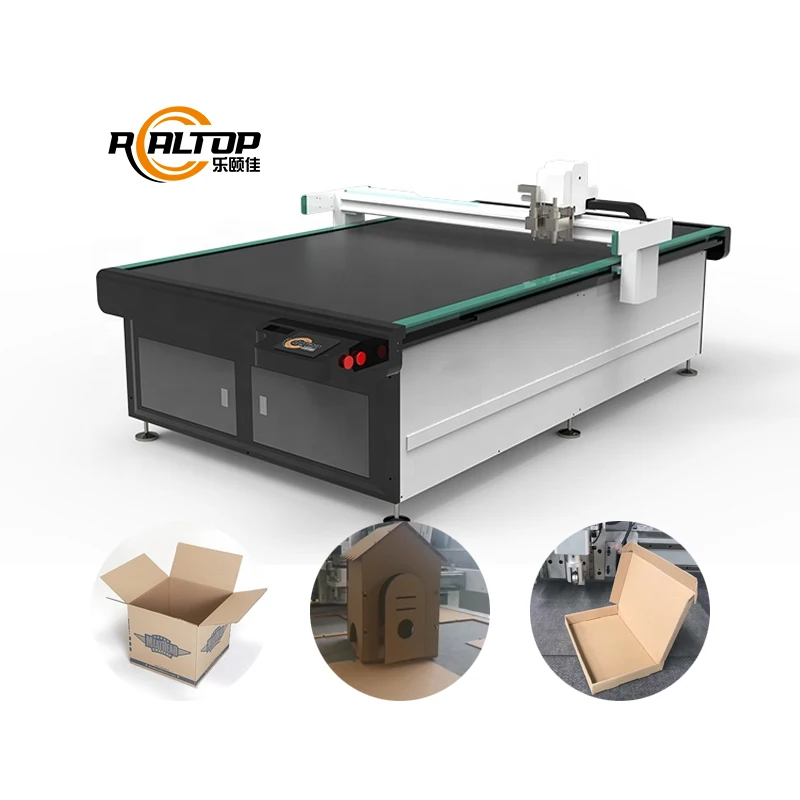
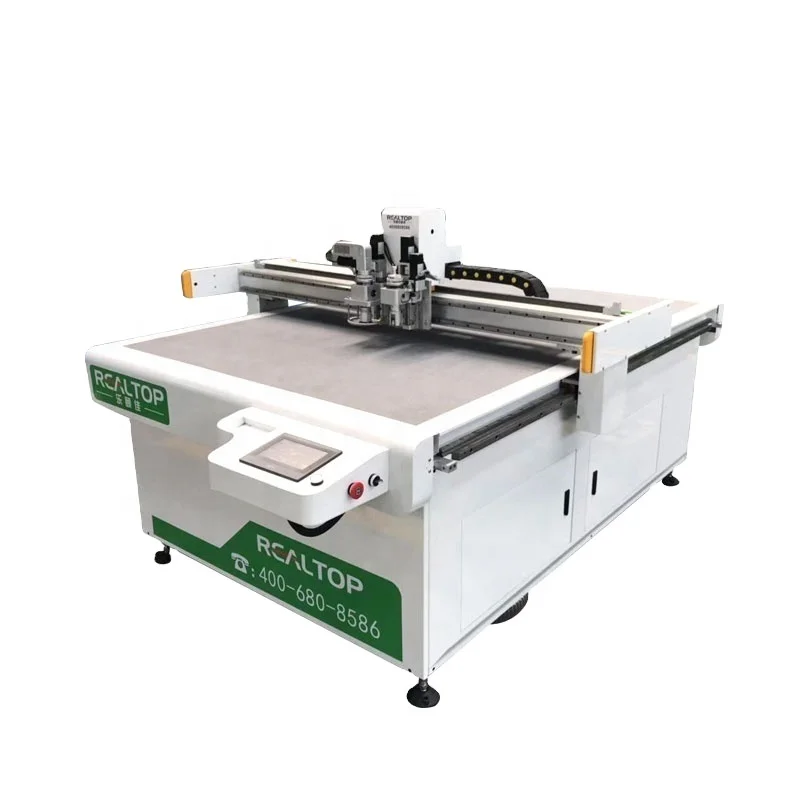
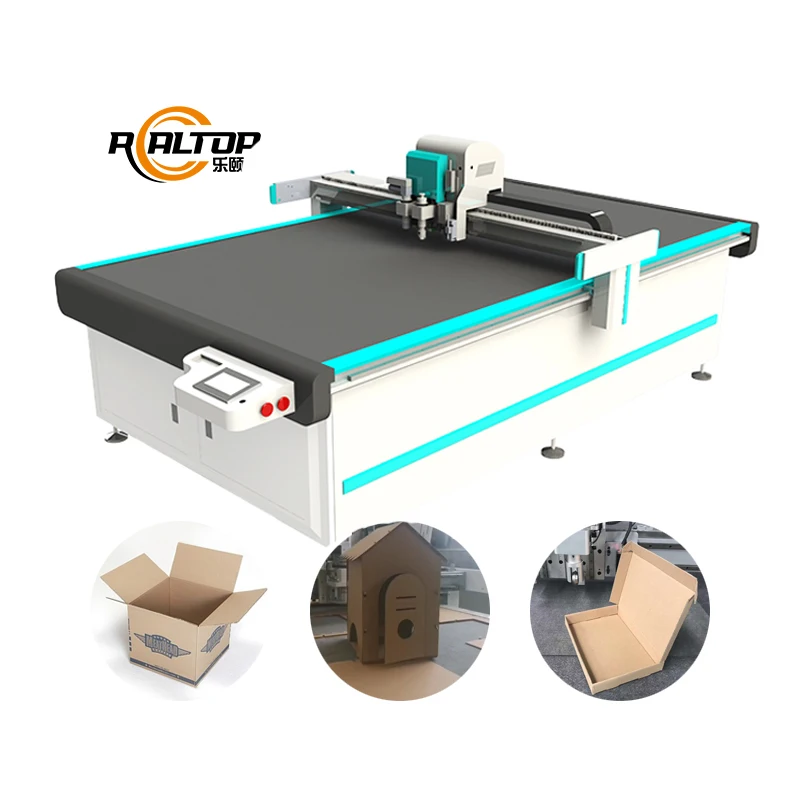
| Product Type | CNC Oscillating Knife Leather Cutting Machine |
| Working Area | 1600×2500mm |
| Machine Size | 3450×2300×1250mm |
| Rated Power | 9kW |
| Voltage | 380V±10% |
| Working Table | Magnesium-aluminum alloy vacuum adsorption table with fluorocarbon PVDF powder spraying, anodic and hard oxidation |
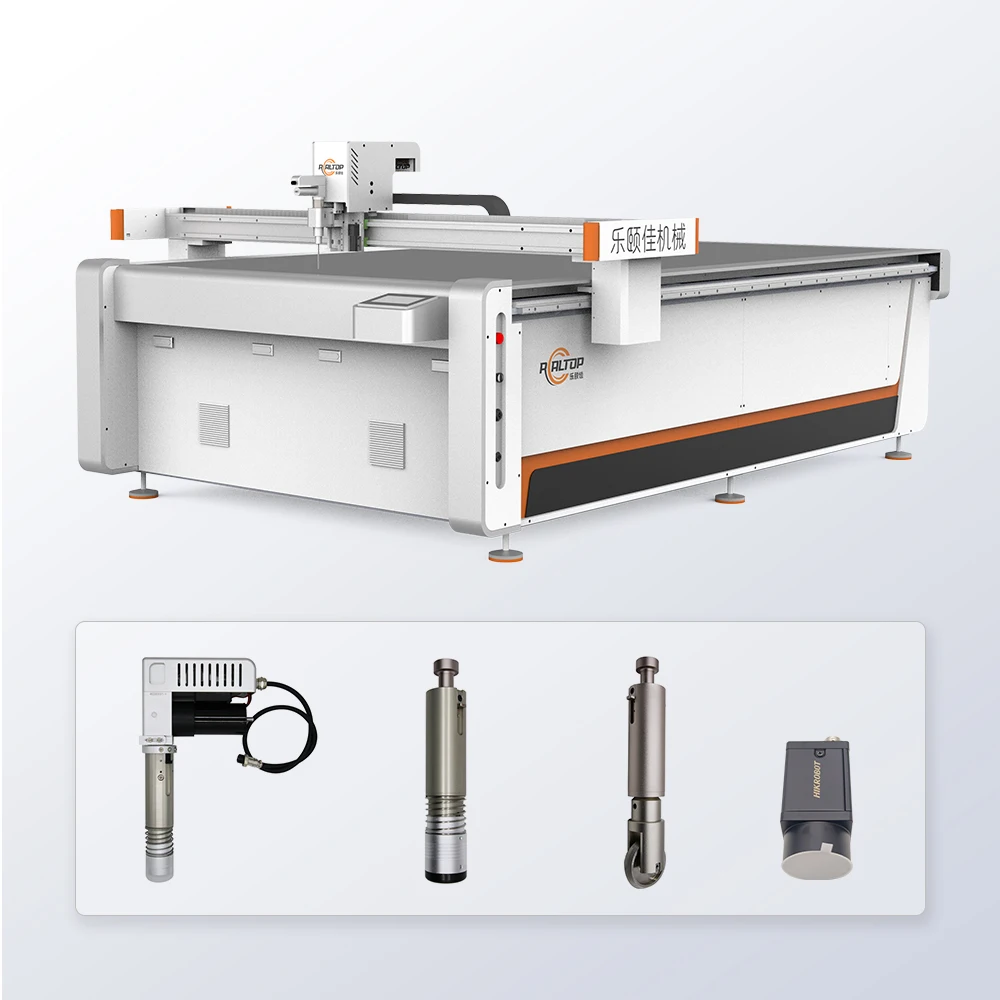
| Multifunctional Tool Head | Swiss imported knife (vibration full cutting, vibration half cutting, cursor location); optional pneumatic knife, high-power vibrating knife, circular knife, V cutting knife, drag knife, creasing wheel, dotted line knife, punching, brush |
| Visual Positioning | Small CCD camera mark point positioning, panoramic camera recognition positioning, projection positioning |
| Cutting Thickness | 20mm–80mm (basis not stated in source — confirm material type and density) |
| Translational Velocity | 800–1200mm/s |
| Repeated Accuracy | ≤0.1mm |
| Transmission System | Digital servo motor (Delta or Panasonic, IP67), linear guide, synchronous belt, ball screw; Taiwan Hiwin rail |
| Instruction System | HP-GL compatible format |
| Safety Device | Infrared induction blocking, anti-collision, emergency stop |
| Vacuum Pump | 7.5kW, integrated aviation aluminum shell with built-in silencer sponge |
| Feeding System | Germany imported conveyor belt, auto feeding |
| Language Options | English, Russian, Italian, Chinese; special languages customizable |
| Assembly State | Fully assembled |
| Warranty | One year (domestic and international) |
Application Suitability
| Application | Material or Output |
|---|---|
| Footwear and leather goods production | Genuine leather, PU, PVC, synthetic leather with clean blade-cut edges |
| Garment flexible material cutting | Multi-layer composite leather, fabric-laminated hides |
| Automotive interior and upholstery | Sponge composite leather, laminated foam-backed materials |
| Home furnishing and soft goods | Thick hide panels, padded leather sheets for furniture |
| Gasket and industrial soft material | Rubber, silicon, PVC, soft glass sheets |
| Packaging sample making | Carton, corrugated board, composite materials |
Why Specifying Working Area Alone Fails on Leather Lines
Cutting depth must be validated on your exact leather stock before any commitment is made. A 1600×2500mm working area looks sufficient on paper, but leather is rarely uniform. Thickness varies across the hide, composite constructions add sponge or fabric backing, and density shifts between full-grain, corrected-grain, and bonded material. A CNC leather cutting machine manufacturer that quotes only bed size without confirming tool head selection and cutting depth against your actual material is leaving your first two weeks of production to chance [NEED_CITE: CNC knife cutting depth validation on composite leather materials]. I have seen oscillating knife machines arrive at a workshop and stall immediately because the quoted depth was tested on standard PU while the buyer runs multi-layer composite genuine leather with foam lining — the blade pressure and feed tension were entirely wrong for the job.
Frame Construction and Dimensional Stability
The machine frame is welded from thick-walled seamless steel, then high-temperature tempered and finished on a CNC machining center. This process sequence matters because welding introduces internal stress that, if not relieved through tempering, can cause the frame to distort over months of continuous vibration from the oscillating knife head. CNC finishing after tempering ensures that the linear guide mounting surfaces and the vacuum table base remain within tolerance. For a CNC leather cutting machine manufacturer, controlling frame geometry is the foundation of every downstream accuracy claim — a warped frame turns a ≤0.1mm repeated accuracy specification into a theoretical number rather than a daily reality.
Vacuum Table Engineering for Leather Holding
The magnesium-aluminum alloy vacuum table on this platform uses fluorocarbon PVDF powder spraying combined with anodic and hard oxidation. Leather hides are irregular in shape and tend to lift at the edges during high-speed knife travel. The PVDF coating provides a flat, chemically resistant surface that maintains suction seal across the hide, while the anodic oxidation layer resists scratching from repeated material loading. The 7.5kW vacuum pump is housed in an aviation aluminum shell with integrated silencer sponge, keeping workshop noise manageable during continuous operation [NEED_CITE: vacuum adsorption performance on irregularly shaped leather hides during high-speed cutting].
Spec Interpretation: What the Numbers Mean on the Shop Floor
The translational velocity range of 800–1200mm/s interacts directly with cutting quality on leather. At the upper end, straight cuts across thin PU proceed cleanly; at the lower end, tight contours on thick composite leather benefit from reduced speed to prevent blade deflection. The Taiwan Hiwin linear guides paired with IP67-rated Delta or Panasonic servo motors maintain positional accuracy even when leather dust and adhesive residue accumulate on the rails — the IP67 sealing is not a brochure item but a practical necessity in leather workshops where airborne particles are constant. The Swiss imported knife head delivers oscillating full-cut and half-cut modes, allowing a single machine to score crease lines for bag panels and then cut through the full material thickness for shoe uppers without a tool change. CCD camera mark point positioning and panoramic camera recognition handle printed contour work where registration marks on pre-printed leather must be tracked at production speed.
The Cost of Mismatched Tool Heads and Table Zoning
Choosing the wrong knife for your leather type produces ragged edges on genuine hides or crushes foam backing on composite materials. A standard oscillating knife may handle single-layer PU but fail on sponge-laminated leather where the foam compresses ahead of the blade. Similarly, vacuum table zoning that cannot isolate small sections means tiny pattern pieces — shoe eyelets, strap ends, buckle tabs — lift off the table mid-cut, producing scrap instead of finished parts [NEED_CITE: vacuum zoning requirements for small leather pattern pieces during oscillating knife cutting]. These failures do not appear in a factory test on standard material; they emerge only once your specific leather construction is under the knife.
Why Procurement Through the Factory Matters
Realtop Machinery builds both knife and laser cutting platforms in-house, so the RT-D2516/RT-S2516 is not assembled from third-party modules but designed and welded from the frame up. Tool head selection, vacuum table specification, and vision system configuration are determined per material rather than offered as a generic package. Voltage and control language are confirmed against your local grid and operator requirements before production begins — a 380V±10% machine shipping to a region with unstable supply needs advance discussion, not post-delivery troubleshooting. Sample cutting on your own leather stock generates a parameter report that travels with the machine. OEM and ODM configurations are available for distributors who need custom working areas, branding, or region-specific electrical standards [NEED_CITE: OEM customization scope for CNC leather cutting equipment].
Documentation & Verification
- Machine specification sheet listing confirmed tool head and table configuration per your leather type
- Electrical schematic with voltage and frequency validated against your site supply before dispatch
- Sample cutting report produced on your own leather material with recorded parameters
- Factory test record with packing photographs documenting machine condition at shipment
- Software licence documentation with file format compatibility confirmed for your nesting workflow
- CE declaration documentation where applicable to your import market
Installation, Commissioning & Support
- Machine arrives fully assembled at 3450×2300×1250mm; confirm workshop door clearance and floor load capacity
- Dedicated 380V±10% circuit required for the 9kW rated power plus 7.5kW vacuum pump draw
- First-run commissioning includes vacuum zone calibration and servo motor tuning for your material feed rate
- Operator training covers Swiss knife head changes, CCD camera calibration, and HP-GL file import
- Spare parts list with consumable blade and vacuum seal inventory provided at cost
- Annual maintenance schedule covering linear guide lubrication and belt tension verification
Preparing Your Material and Production Brief
To move from inquiry to a confirmed configuration, share your leather type, whether it is single-layer or composite with backing, typical hide dimensions, and the daily volume your line must sustain. Specify your local voltage and frequency, the control language your operators need, and whether your existing nesting software exports in HP-GL or another format. If your production includes printed contour work, confirm whether registration marks are standard or variable across runs.
Frequently Asked Questions
Q: Can the machine be customized for working area, voltage, and control language?
A: Yes. The RT-D2516/RT-S2516 platform supports OEM and ODM configurations. Working area, tool head selection, voltage rating, and control interface language are all confirmed during the specification phase before production begins. Special languages beyond English, Russian, Italian, and Chinese can be arranged for your operator team.
Q: What does the factory quality control process cover from welding to final test?
A: The frame is welded from thick-walled seamless steel, high-temperature tempered to relieve stress, then finished on a CNC machining center for dimensional accuracy. Every unit undergoes a factory test that includes vacuum table flatness verification, servo motor calibration, and a cutting run on your specified material before packing.
Q: How is cutting thickness confirmed for my specific leather before I commit?
A: Before any order is finalized, your leather material — whether single-layer genuine hide, sponge composite, or multi-layer construction — is test-cut at the factory. The resulting sample cutting report documents blade type, oscillation settings, feed rate, and edge quality, and this report ships with the machine.
Q: What spare parts are stocked and how are replacements supplied?
A: Consumable items including Swiss knife blades, vacuum table seals, and conveyor belt sections are listed in the spare parts document provided with the machine. Replacements are supplied at cost through the after-sales channel, with the one-year warranty covering component defects for both domestic and international installations.
Q: Can I visit the factory to test the machine and inspect build quality?
A: Factory visits are arranged for machine testing and build inspection. You can observe frame construction, review the CNC machining process, and run your leather material through the RT-D2516/RT-S2516 to verify cutting performance and edge quality before shipment.
You may also like

商品评价
Clear filtersThere are no reviews yet.