









-
 Courier delivery
-
 DHL Courier delivery
-
 Warranty 1 year
-
 Free 30-Day returns

In-house design and manufacturing — Every cutting system is developed on our own production floor, allowing frame rigidity, servo tuning, and tool head integration to be matched to the buyer’s material before the machine leaves Jinan.
Technical Specifications
| Parameter | Value |
|---|---|
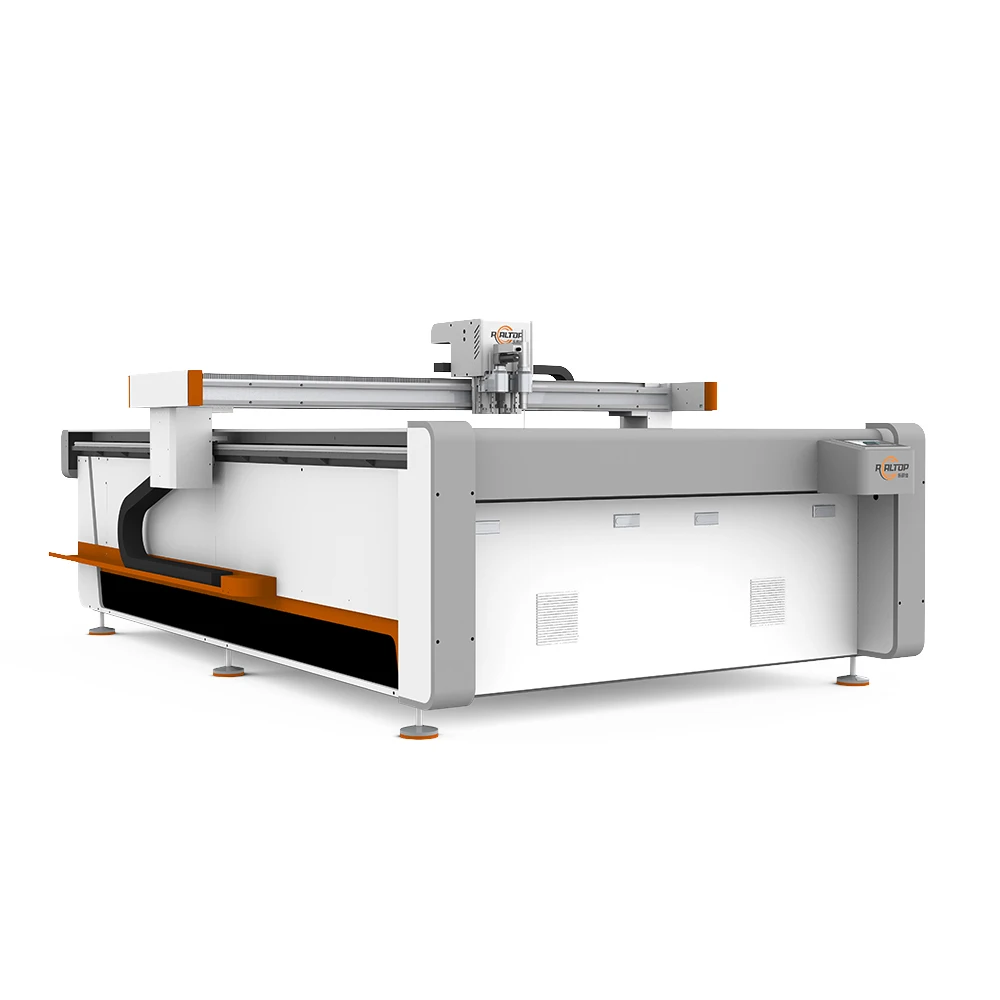
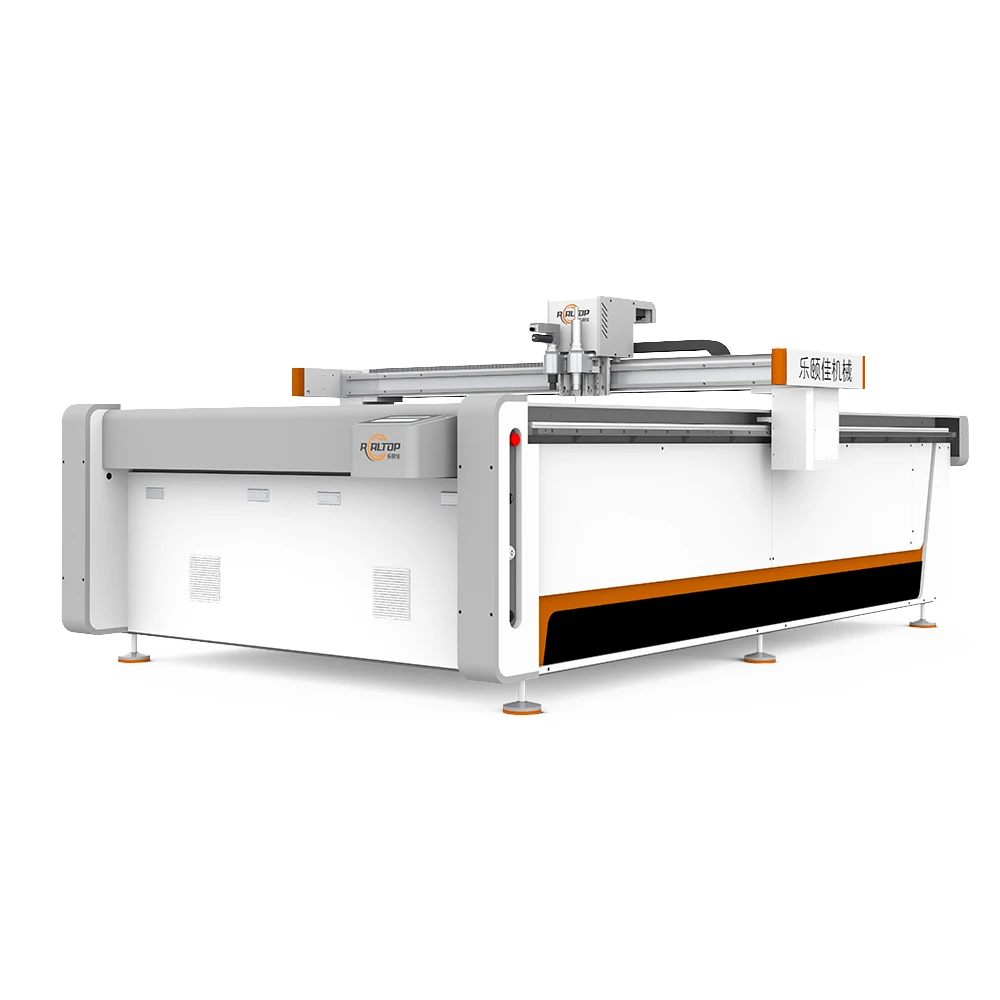
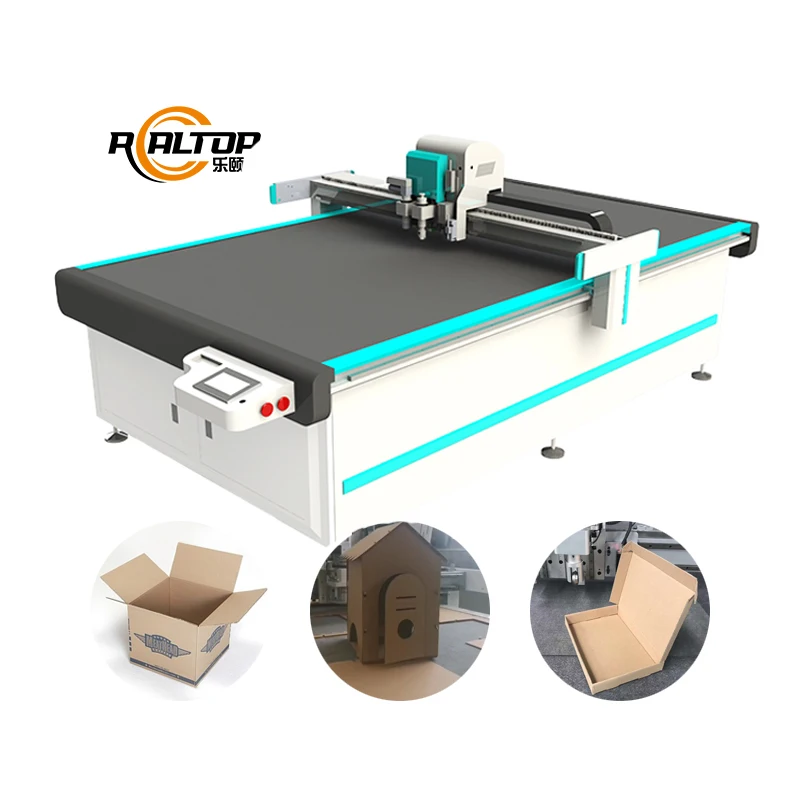
| Product Type | CNC Oscillating Knife Cutting Machine |
| Working Area | 1600 × 2500 mm |
| Machine Dimensions | 3450 × 2300 × 1250 mm |
| Rated Power | 9 kW |
| Voltage | 380 V ±10% |
| Table Configuration | Flatbed or auto-feeding available |
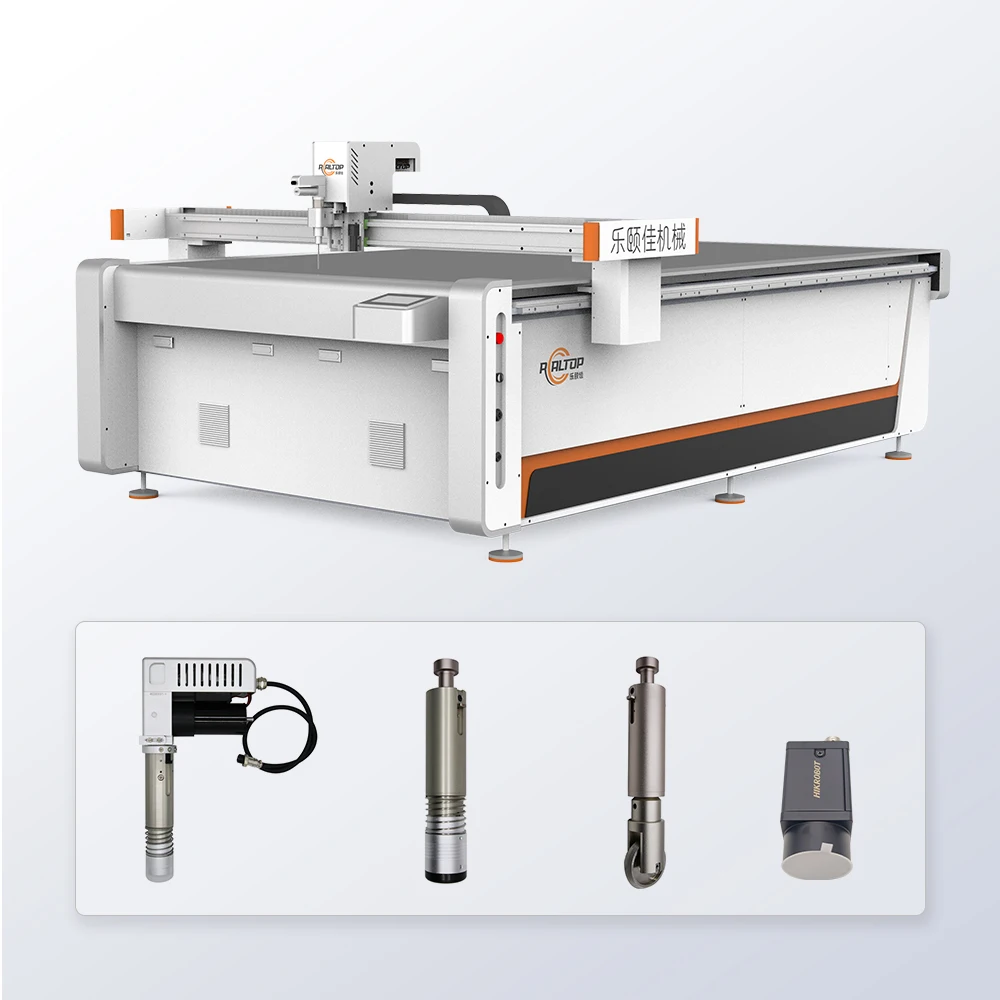
| Tool Head | Swiss imported oscillating knife; full-cut, half-cut, cursor location |
| Translational Speed | 800 – 2000 mm/s |
| Cutting Thickness Range | 200 – 800 mm/s (basis to be confirmed by material type) |
| Compatible Materials | Leather, flexible textiles, sponge composite, PVC sheet, soft glass, silicone, rubber, carbon fiber |
| Repeatability | ≤ 0.1 mm |
| Drive Train | Digital servo motor, imported linear guide, synchronous belt, ball screw |
| Servo Motor Option | Delta (China) or Panasonic (Japan) |
| File Format Support | PLT, DXF, AI; HP-GL compatible instruction set |
| Vacuum Pump | 7.5 kW |
| Vacuum Table | Aluminum air-box platform, integrated adsorption, split-zone optional |
| Safety System | Infrared perimeter sensors |
| Control Interface | Touch screen, multi-language |
Application Suitability
| Application | Material or Output |
|---|---|
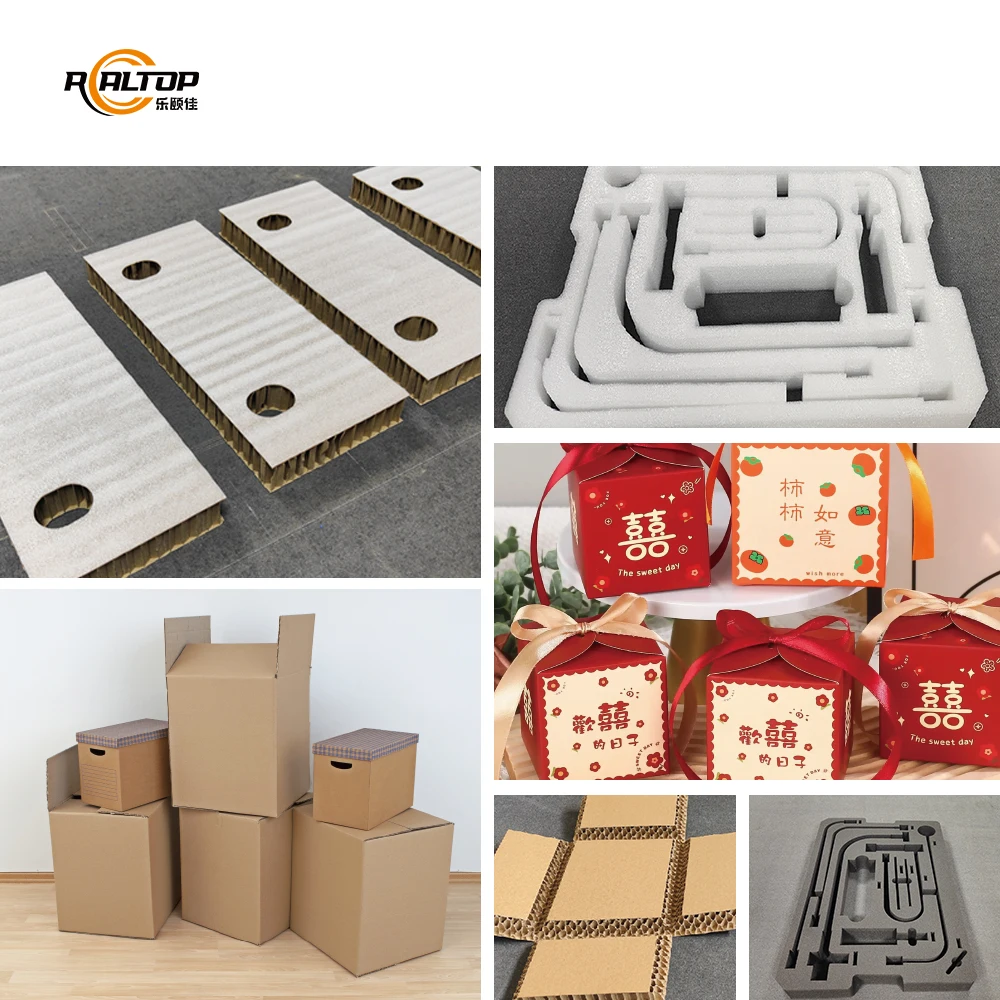
| Carton & packaging sample making | Corrugated board, grey board, folding carton stock, honeycomb paper |
| Leather goods & footwear | Full-grain, split, PU and synthetic leather hides |
| Automotive interior trimming | Instrument panel foam, door panel fabric, headliner composite |
| Signage & advertising | Self-adhesive vinyl, reflective film, foam board, magnetic sheet |
| Gasket & seal fabrication | Non-asbestos fiber, PTFE sheet, cork composite |
| Technical textile cutting | Aramid, carbon fiber prepreg, industrial filter cloth |
Why Spec’ing the Knife Before the Material Destroys Margins
The cutting tool must follow the stock, never the other way around.
A buyer in Southeast Asia ordered an oscillating knife table to cut five-layer corrugated board but selected the entry-level knife holder rated for single-ply carton. The holder burned through its bearings in weeks, leaving ragged crease lines that failed the client’s drop-test protocol. [NEED_CITE: ISO 1101 geometric tolerance requirements for die-cut packaging blanks] When we swap the specification to match the actual substrate density, the same CNC oscillating knife cutting machine manufacturer can deliver clean creases and full-through cuts without unplanned downtime.
Frame and Motion Architecture
The gantry rides on a thick-walled seamless steel frame that undergoes high-temperature tempering before final CNC machining center finishing. This sequence relieves welding stress so the linear guides stay parallel across the 2500 mm stroke. A rigid base is what lets the servo system hold ≤ 0.1 mm repeatability when the oscillating knife cycles thousands of times per minute.
Vacuum Adsorption and Small-Part Stability
An aluminum air-box platform with fluorocarbon PVDF coating keeps the surface flat despite temperature swings in the shop. Split-zone suction is available so operators can open only the valves under a small gasket or label, preventing edge lift that would otherwise drag the knife off path. This level of zoning matters when the part footprint is a fraction of the 1600 × 2500 mm bed. [NEED_CITE: vacuum hold-down best practices for flexible sheet cutting]
Servo, Drive, and Software Compatibility
Buyers choose between Delta or Panasonic digital servos; both carry IP67 protection to survive coolant mist in textile plants. The control accepts PLT, DXF and AI files, so a packaging studio can send an ArtiosCAD export straight to the table without re-drawing crease lines. HP-GL compatibility further opens legacy plotter files common in signage shops.
Cutting Thickness and Speed — Reading the Numbers Honestly
The listed 200 – 800 mm/s figure describes translational speed range, not a universal cutting depth. Real thickness capability depends on material density, tool profile and oscillation frequency. A soft 3 mm foam will cut at the top of the speed band; a 6 mm PVC sheet demands slower passes and a drag-knife insert. Confirming the substrate up front prevents quoting a configuration that cannot finish the job.
The Cost of Skipping a Material Test
Ragged edges on a leather hide mean the entire panel is scrapped; a crushed foam insert voids the automotive OEM’s cushioning spec. Both failures trace back to a tool head that was never matched to the substrate. [NEED_CITE: automotive interior material testing standards for cut-edge integrity] Running a sample coupon on the buyer’s own roll stock is the only way to lock in knife frequency, downward pressure and feed rate before the machine enters production.
Why Source From Our Jinan Production Facility
Our design team engineers the knife and laser ranges under one roof, so a buyer switching from foam to acrylic can move between technologies without changing vendors. The core factory handles frame welding, tempering and final assembly, giving us direct control over every tolerance stack-up. We confirm voltage, plug type and HMI language before the purchase order, eliminating the surprise of a 50 Hz panel landing in a 60 Hz market. A documented sample cutting report accompanies each order, proving performance on the exact material the buyer ships to us. Distributors receive OEM labeling and private documentation on request.
Documentation & Verification
- Machine specification sheet listing selected tool heads and table zones
- Electrical schematic with voltage and frequency confirmed for destination market
- Sample cutting report on buyer-supplied material prior to dispatch
- Factory test record showing repeatability measurement on the 2500 mm stroke
- Operation and maintenance manual translated to buyer’s language
- Spare parts list with consumable knife blades and belt part numbers
Installation, Commissioning & Support
- Flatbed version ships partially assembled; auto-feed model requires conveyor docking on site
- Dedicated 380 V three-phase circuit with 9 kW capacity plus 7.5 kW vacuum pump breaker
- First-run calibration of servo zero points across the full 1600 × 2500 mm travel
- Touch-screen HMI set to operator’s language during remote or on-site training
- Recommended blade replacement interval logged in the maintenance manual
- Vacuum pump filter inspection scheduled every 500 running hours
What to Include With Your Inquiry
Share the material type, maximum sheet thickness and the daily volume you expect to cut. Specify your local voltage and frequency, plus the CAD file formats already in use. If the stock arrives in rolls, tell us the roll diameter so we can size the auto-feeding cradle.
Frequently Asked Questions
Q: How do we verify frame quality before shipment?
A: We provide a factory test record that documents repeatability measurements taken across the full working envelope. Buyers may also arrange third-party inspection while the machine is still on our assembly floor, allowing visual checks of weld seams, linear guide alignment and cable routing before crating.
Q: Can voltage and plug configuration be customized?
A: Yes. The electrical schematic is finalized after we confirm your site voltage, frequency and plug standard. Control transformers and breakers are sized accordingly, and the touch-screen HMI is flashed with the target language before the panel is closed.
Q: What does OEM labeling involve for distributors?
A: Distributors supply their logo files and preferred documentation templates. We apply decals to the gantry, print manuals with the distributor’s branding, and reference only the distributor’s model code on the CE declaration and packing list.
Q: Is a material sample test really necessary?
A: Running your actual stock on our machine confirms knife type, oscillation frequency and vacuum zoning before the purchase order is signed. The resulting sample cutting report becomes part of the shipment documentation, giving both parties a benchmark for acceptance.
Q: How is quality controlled during production?
A: Each sub-assembly passes through tempering, CNC machining center finishing and metrology checkpoints. Final acceptance tests cover motion repeatability, vacuum pressure distribution and safety sensor response, with results logged in the factory test record provided to the buyer.
You may also like

商品评价
Clear filtersThere are no reviews yet.