



-
 Courier delivery
-
 DHL Courier delivery
-
 Warranty 1 year
-
 Free 30-Day returns

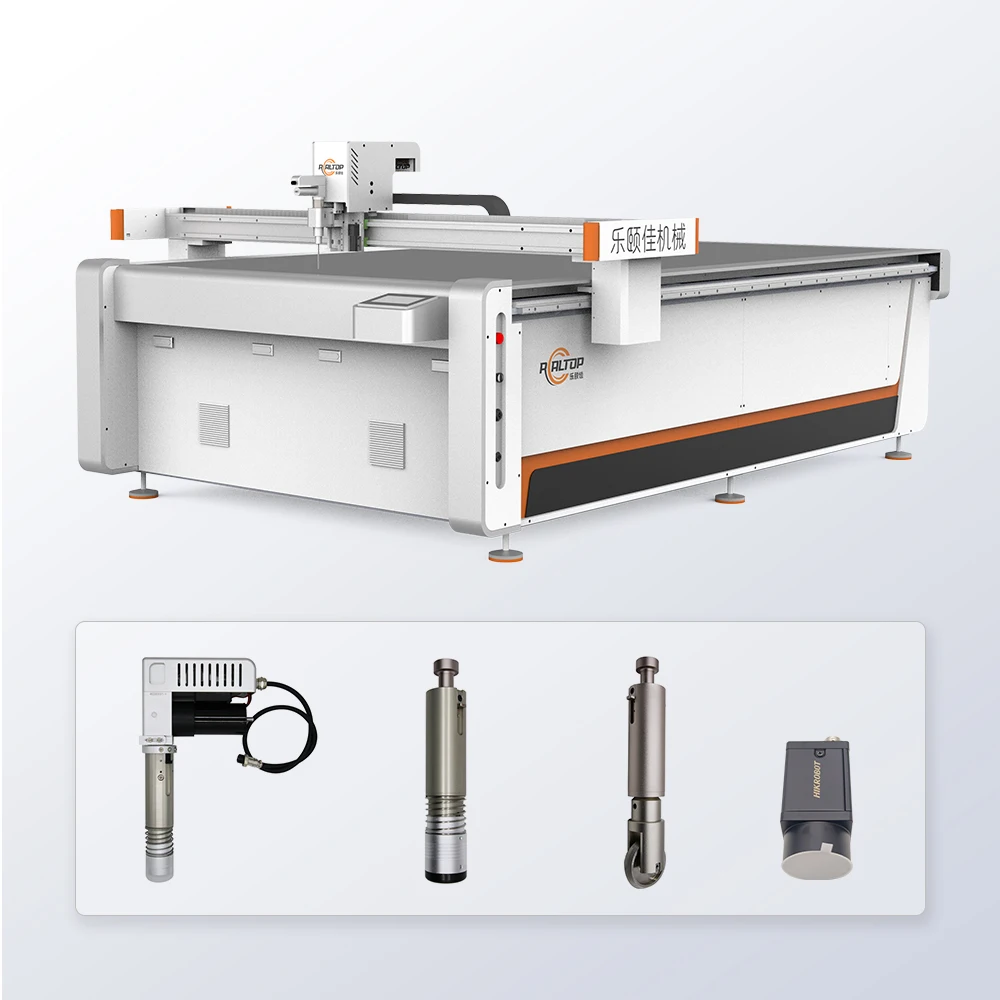
Bed Stability Engineering — REALTOP quenches every CNC oscillating knife cutting machine frame to eliminate internal stress before assembly, ensuring long-term dimensional accuracy under continuous production loads.
Technical Specifications
| Parameter | Value |
|---|---|
| Product Type | CNC Oscillating Knife Cutting Machine |
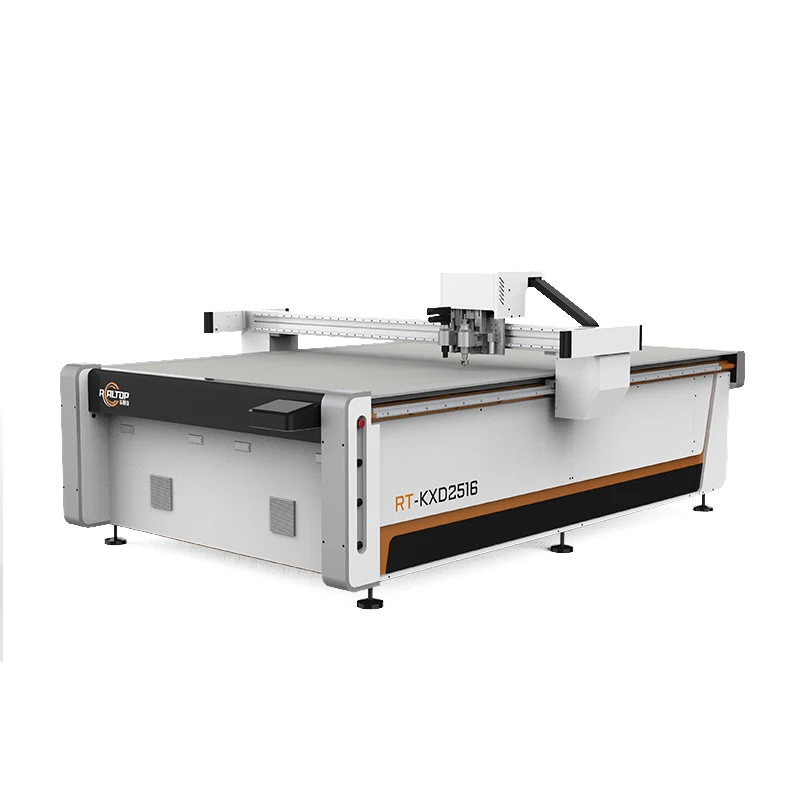
| Effective Cutting Area | 2500×1600mm / 2500×2200mm / 3000×2200mm |
| Maximum Speed | 2000mm/s (basis not stated in source — confirm material / thickness) |
| Reset Accuracy | ±0.1mm |
| Cutting Thickness | ≤40mm (basis not stated in source — confirm material type / density) |
| Table Type | Automatic feeding conveyor |
| Tool Head Options | Round knife, oscillating knife, marking pen |
| Data Format | dxf, plt, ai, pdf |
| Visual Positioning | Panoramic visual positioning (edge and template cutting) |
| Control System | REALTOP customized high-speed control system |
| Voltage | 380V / 220V |
| Safety Device | Infrared blocking stop, anti-collision protection |
| Belt Construction | Industrial belt, glass fiber tension cord, high temperature and corrosion resistant |
| Wiring | Oxygen-free copper shielded wire |
| Noise Design | Exclusive silent drive design |
Application Suitability
| Application | Material or Output |
|---|---|
| Gasket and seal production | Rubber, cork, PTFE, non-asbestos fiber, composite gasket sheet |
| Automotive interior trimming | Sound-deadening foam, headliner fabric, carpet, door panel composite |
| Industrial signage and graphics | Vinyl, adhesive film, corrugated board, foam board |
| Packaging sample making | Cardboard, corrugated flute, folding carton stock |
| Composite and foam fabrication | Closed-cell foam, EVA, sponge, multi-layer laminates |
Why the Cutting Method Must Be Decided Before the Machine Is Built
Match the process to the material, not the other way around.
When a buyer specifies a gasket cutting line based on working area alone, the conversation often skips past material density, edge-sealing requirements and actual sheet thickness. I have seen orders where a non-metal CO2 laser was quoted for asbestos-free fiber gasket at what turned out to be peak power rather than continuous rating, and the machine could not penetrate 3mm board on arrival. The entire batch had to be reworked off-site [NEED_CITE: continuous versus peak laser power rating definitions]. That failure is avoidable if the cutting method — oscillating knife, drag knife or laser — is locked in after a sample cut on the buyer’s own material, not after the purchase order is signed. A CNC oscillating knife cutting machine factory that builds both knife and laser platforms in-house can recommend the correct process without pushing one technology onto every application.
How the Frame and Motion System Are Specified at the Factory
Every frame on this line goes through a quenching cycle to relieve internal welding stress before the motion rails are mounted. That step matters because gasket materials like compressed non-asbestos fiber and PTFE demand tight held tolerances across the full bed, and a frame that still carries residual stress will drift over months of production. The belt drive uses a glass fiber tension cord inside an industrial-grade belt rated for high temperature and corrosion resistance, which suits workshops where cutting fluids or gasket dust accumulate.
Control System and Drive Architecture
The REALTOP customized high-speed control system is developed in-house rather than sourced from a third-party motion vendor, which means the firmware can be adjusted for specific material behaviors — for example, slowing the oscillating stroke frequency when cutting dense cork-rubber laminates while keeping traverse speed high on open areas. The silent drive design reduces acoustic load in enclosed workshops, an issue that becomes relevant when multiple cutting cells run side by side. Language and interface customization are confirmed during the specification stage so operators in different markets can work in their own language from day one [NEED_CITE: industrial control panel language requirements by export region].
Reading the Spec Sheet Against Actual Gasket Production
The oscillating knife head is the default choice for dense gasket materials because the vertical stroke slices through fiber-reinforced sheets without crushing the edge, which preserves seal face integrity. Cutting thickness is listed at up to 40mm, but that figure depends entirely on material density and must be confirmed with a sample cut on the buyer’s actual stock. Maximum speed is rated at 2000mm/s, though real traversing speed will vary with contour complexity and the number of tool changes in a nesting layout. Reset accuracy of ±0.1mm ensures that gasket bolt-hole patterns stay within tolerance for flange assembly downstream. The panoramic visual positioning system handles both edge-following on pre-printed gasket sheets and template-matching for contour work, which matters when cutting from printed marking rather than raw file coordinates.
What a Misconfigured Vacuum Zone Costs in Gasket Work
If the vacuum table zoning is not matched to the smallest gasket in the nesting layout, lightweight cut parts can lift during the final pass and produce a ragged edge or an out-of-tolerance bolt hole. I have walked into production floors where operators were taping down small flange gaskets by hand because the vacuum pull-through was designed around the original sheet size, not the finished part geometry. That kind of workaround slows throughput and introduces edge damage that only shows up at the customer’s assembly line [NEED_CITE: vacuum table zoning best practices for nested small-part cutting]. The cost is never visible on the quotation — it surfaces weeks later in scrap rate and rework hours.
Why Procurement Teams Source This Line from REALTOP
The design team covers both knife and laser cutting technology, so a buyer comparing methods for gasket, foam or textile work gets a recommendation based on the material rather than on which machine happens to be in stock. The core factory handles frame fabrication, motion assembly and control system integration under one roof, which keeps OEM branding and specification changes inside a single production chain. Every machine is tested on the buyer’s own material before dispatch, with a sample cutting report documenting edge quality and achieved depth. Voltage, plug type and control language are confirmed in writing before production starts, eliminating the shipment-surprise problem that plagues cross-border equipment orders. Documentation covers electrical schematics, tool head configuration lists and software compatibility notes so the buyer’s maintenance team can support the machine locally.
Documentation & Verification
- Machine specification sheet listing confirmed tool head, bed size and voltage for your order
- Electrical schematic with voltage and frequency matched to your facility supply
- Factory test record on your gasket material with measured cutting depth and edge quality
- Tool head and vacuum table configuration list per your nesting layout
- Software licence and file format compatibility note for dxf, plt, ai and pdf workflows
- Spare parts list identifying wear items and recommended reorder intervals
Installation, Commissioning & Support
- Foundation must be level and load-rated for the chosen bed size and conveyor feed system
- Dedicated 380V or 220V circuit with breaker sized to the confirmed motor and vacuum pump draw
- Machine ships in modular sections for container loading and on-site reassembly
- First-run calibration covers knife stroke frequency, vacuum zoning and visual positioning alignment
- Operator training includes nesting software workflow and tool head changeover procedures
- Wear parts kit includes oscillating knife blades, belt segments and vacuum seals for initial operation
What to Include in Your First Inquiry
To size the correct CNC oscillating knife cutting machine for your line, share the gasket material type, maximum sheet thickness and daily cutting volume you plan to run. Confirm your facility voltage and frequency, the control language your operators need, and whether your existing nesting software exports in dxf, plt, ai or pdf. If you want a sample cut on your own material before commitment, send a representative sheet and your standard nesting file so we can document edge quality and cutting speed in a test report.
Frequently Asked Questions
Q: How does REALTOP support OEM branding and custom specifications for distributors?
A: The in-house design team handles frame, motion and control system development at the core factory, so branding, color, software splash screen and documentation can be customized per distributor. Specification changes — including bed size, tool head range and voltage — are engineered and documented before production rather than retrofitted after assembly.
Q: What factory quality control steps are applied before a machine ships?
A: Each frame is quenched to relieve welding stress before rail mounting. Motion systems are aligned and measured on the bed, then the assembled machine runs a factory test on the buyer’s material. A test record documenting edge quality, cutting depth and positioning accuracy accompanies the shipment.
Q: How is the cutting method selected between knife and laser for my material?
A: The selection depends on material composition, thickness and edge requirement. Oscillating knife suits dense gasket and fiber materials where edge crushing must be avoided. Laser is evaluated for applications needing sealed edges on synthetics. A sample cut on your actual material confirms the correct method before the order is placed.
Q: What documentation arrives with the machine?
A: Shipment includes a machine specification sheet, electrical schematic with confirmed voltage, tool head and table configuration list, sample cutting report, operation manual, software licence with file format compatibility note and a spare parts list. CE declaration is provided where applicable to the destination market.
Q: How are voltage and language requirements confirmed before production?
A: Voltage, plug type and frequency are specified during the inquiry stage and written into the technical agreement. Control panel language is selected from available options and confirmed before the control system is loaded. Any regional compliance requirement is reviewed with the buyer before the machine enters production.
You may also like

商品评价
Clear filtersThere are no reviews yet.